
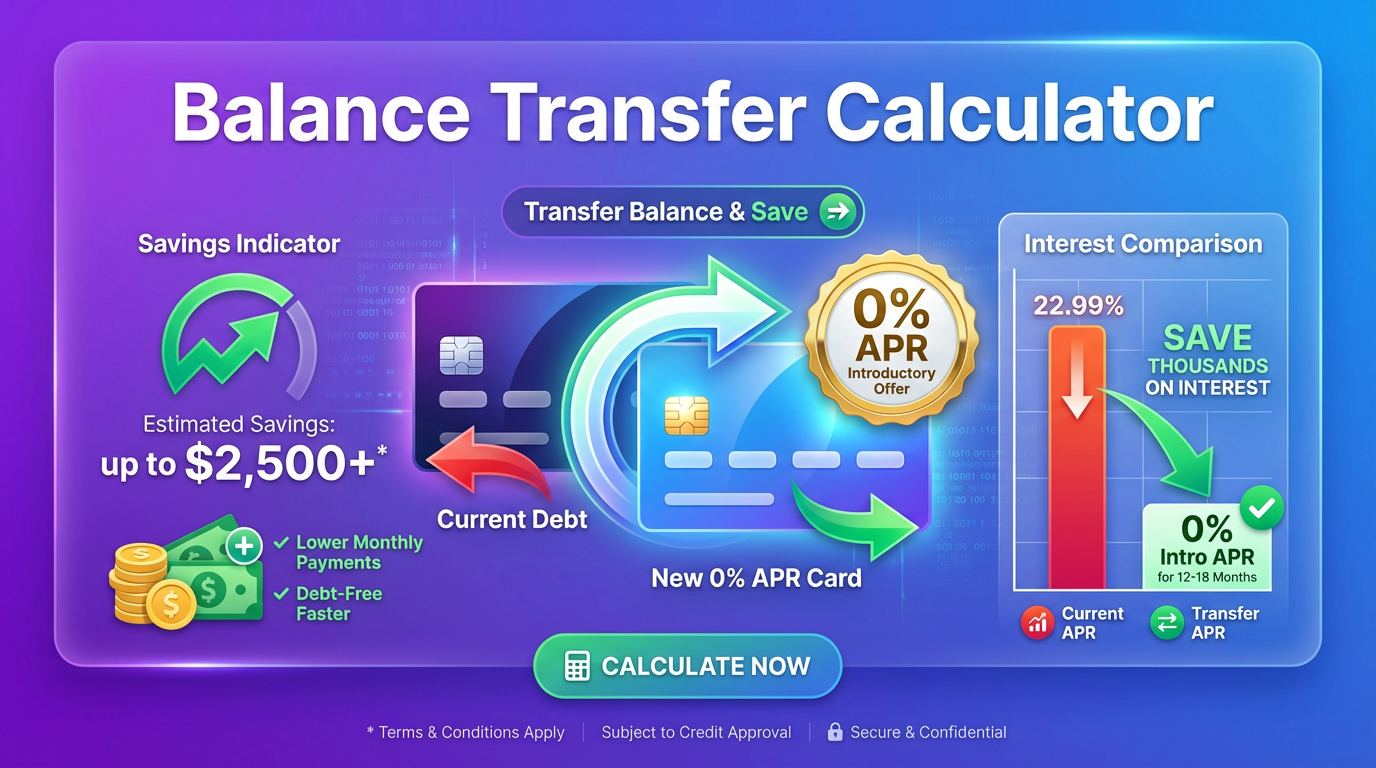
Balance Transfer Calculator: Maximize Your 0% APR Opportunity
Calculate how much you could save with a 0% APR balance transfer card.
How This Balance Transfer Calculator Works
Our balance transfer calculator helps you determine whether moving credit card debt to a 0% APR promotional offer will save you money. Enter your current balance, interest rate, and payment amount, then input the balance transfer card details to see:
- Total interest saved during the promotional period
- Balance transfer fee cost and whether it’s worth paying
- Monthly payment needed to pay off before the promo ends
- Remaining balance if you don’t pay off during the promo
- Net savings after accounting for transfer fees
The calculator shows you exactly when a balance transfer makes sense—and when it doesn’t.
Understanding Balance Transfers
A balance transfer moves existing credit card debt to a new card offering a 0% APR promotional period, typically lasting 12-21 months. During this time, 100% of your payment goes toward principal instead of interest.
How Balance Transfers Work
- Apply for a balance transfer card – You’ll need good to excellent credit (typically 670+)
- Request the transfer – Provide your old card’s account number and transfer amount
- Pay the transfer fee – Usually 3-5% of the transferred amount
- Make payments during promo period – All payments reduce principal
- Pay off before promo ends – Or face the regular APR (often 18-29%)
Current Balance Transfer Offers (2024)
| Card Type | Promo APR | Promo Length | Transfer Fee | Regular APR |
|---|---|---|---|---|
| Best Available | 0% | 21 months | 3% | 18.74-29.74% |
| Very Good | 0% | 18 months | 3% | 19.24-29.99% |
| Good | 0% | 15 months | 3-5% | 20.49-29.99% |
| Average | 0% | 12 months | 5% | 22.99-29.99% |
The Balance Transfer Math
Without Balance Transfer: $10,000 at 22% APR, $300/month payment – Time to payoff: 44 months – Total interest: $3,056 – Total paid: $13,056
With Balance Transfer (18 months at 0%, 3% fee): – Transfer fee: $300 – Monthly payment needed to payoff in 18 months: $556 – Total interest: $0 – Total paid: $10,300 – Savings: $2,756
Balance Transfer Calculator Examples: Real Numbers
Example 1: Ideal Scenario – High Balance, Can Pay Off ($12,000)
Scenario: Sarah has $12,000 in credit card debt at 24.99% APR and can afford $700/month.
Current Situation: – Balance: $12,000 – Current APR: 24.99% – Monthly Payment: $700 – Time to Payoff: 20 months – Total Interest: $2,847
Balance Transfer Option: – New Card: 0% APR for 18 months – Transfer Fee: 3% ($360) – Payment to Payoff in 18 Months: $667/month
Results: | Factor | Without Transfer | With Transfer | |——–|——————|—————| | Monthly Payment | $700 | $667 | | Months to Payoff | 20 | 18 | | Total Interest | $2,847 | $0 | | Transfer Fee | $0 | $360 | | Total Cost | $14,847 | $12,360 |
- Net Savings: $2,487
- Monthly Payment Drops: $33/month
- Payoff 2 Months Faster
✓ Verdict: Excellent candidate for balance transfer
Example 2: Tight Timeline – Must Be Strategic ($8,000)
Scenario: Marcus has $8,000 at 21.99% APR but can only afford $400/month.
Current Situation: – Balance: $8,000 – Current APR: 21.99% – Monthly Payment: $400 – Time to Payoff: 24 months – Total Interest: $1,523
Balance Transfer Option: – New Card: 0% APR for 15 months – Transfer Fee: 3% ($240) – Payment to Payoff in 15 Months: $534/month (more than Marcus can afford)
If Marcus Pays $400/Month During Promo: – Paid during 15-month promo: $6,000 – Remaining balance: $2,000 – Regular APR kicks in: 22.99% – Additional months to payoff: 6 months – Interest on remaining balance: $198
Results: | Factor | Without Transfer | With Transfer | |——–|——————|—————| | Total Months | 24 | 21 | | Total Interest | $1,523 | $198 | | Transfer Fee | $0 | $240 | | Total Cost | $9,523 | $8,438 |
- Net Savings: $1,085
- 3 Months Faster
✓ Verdict: Still worth it, even without full payoff during promo
Example 3: Small Balance – Transfer Fee Eats Savings ($3,000)
Scenario: Amanda has $3,000 at 19.99% APR and pays $150/month.
Current Situation: – Balance: $3,000 – Current APR: 19.99% – Monthly Payment: $150 – Time to Payoff: 24 months – Total Interest: $548
Balance Transfer Option: – New Card: 0% APR for 15 months – Transfer Fee: 3% ($90) – Payment to Payoff in 15 Months: $200/month
If Amanda Pays $150/Month: – Paid during promo: $2,250 – Remaining balance: $750 – Interest on remaining (6 months at 22%): $67
Results: | Factor | Without Transfer | With Transfer | |——–|——————|—————| | Total Interest | $548 | $67 | | Transfer Fee | $0 | $90 | | Total Cost | $3,548 | $3,157 |
- Net Savings: $391
⚠ Verdict: Marginal benefit—only worth it if you’re disciplined
Example 4: Large Balance – Extended Promo Needed ($20,000)
Scenario: Jennifer has $20,000 at 23.49% APR and can pay $600/month.
Current Situation: – Balance: $20,000 – Current APR: 23.49% – Monthly Payment: $600 – Time to Payoff: 47 months – Total Interest: $8,147
Balance Transfer Option: – New Card: 0% APR for 21 months (longest available) – Transfer Fee: 3% ($600) – Payment to Payoff in 21 Months: $953/month (more than Jennifer can afford)
If Jennifer Pays $600/Month: – Paid during 21-month promo: $12,600 – Remaining balance: $7,400 – Additional time at regular APR (24.99%): 14 months – Interest on remaining balance: $1,156
Results: | Factor | Without Transfer | With Transfer | |——–|——————|—————| | Total Months | 47 | 35 | | Total Interest | $8,147 | $1,156 | | Transfer Fee | $0 | $600 | | Total Cost | $28,147 | $21,756 |
- Net Savings: $6,391
- 12 Months Faster
✓ Verdict: Significant savings even without full promo payoff
Example 5: Multiple Cards – Strategic Consolidation ($15,000)
Scenario: David has three cards totaling $15,000 and qualifies for a $12,000 credit limit on a new 0% card.
| Card | Balance | APR | Min Payment |
|---|---|---|---|
| Chase | $6,500 | 24.99% | $195 |
| Citi | $5,000 | 22.49% | $150 |
| Discover | $3,500 | 19.99% | $105 |
| Total | $15,000 | 22.87% avg | $450 |
Strategy: Transfer the two highest-APR cards (Chase + Citi = $11,500) to the new 0% card. Keep Discover separate.
Balance Transfer Details: – Amount Transferred: $11,500 – Transfer Fee (3%): $345 – Promo Period: 18 months at 0% – Payment on Transfer Card: $639/month (to payoff in 18 months) – Continue $105/month on Discover
Results: – Discover paid off: Month 42 → Month 39 (faster due to focus) – Transfer card paid off: Month 18 – Total interest saved: $3,892 – Transfer fee paid: $345 – Net Savings: $3,547
✓ Verdict: Partial transfers can still yield significant savings
When Balance Transfers Make Sense
✓ Ideal Candidates for Balance Transfer
You’re a good candidate if:
- Your current APR is 18%+ and you have good credit
(670+)
- The higher your current rate, the more you save
- Good credit is required for the best 0% offers
- You can pay off (or nearly pay off) during the promo
period
- Divide your balance by promo months to find required payment
- $10,000 ÷ 18 months = $556/month needed
- The transfer fee is less than interest you’d pay
- Quick math: 3% fee = 3 months of interest at ~12% APR
- If your rate is 20%+, you break even in ~2 months
- You won’t add new debt to old cards
- Paid-off cards with available credit are tempting
- Success requires spending discipline
- You understand the post-promo rate
- Rates jump to 18-29% after the promo
- Have a plan for any remaining balance
✗ When to Skip Balance Transfers
Balance transfers may not help if:
- Your credit score is below 670
- You likely won’t qualify for 0% offers
- Available cards may have high fees or short promos
- Your balance is small (under $2,000)
- Transfer fees eat into limited savings
- Focus on aggressive payoff instead
- You can’t resist using paid-off cards
- Many people transfer debt, then rack up new charges
- This doubles your debt instead of eliminating it
- The promo period is too short
- 12-month promos require higher monthly payments
- If you can’t pay off in time, savings diminish
- You’ve done multiple transfers already
- “Transfer churning” can hurt your credit
- Eventually you won’t qualify for new offers
Balance Transfer Fees: Are They Worth It✓
Understanding the 3-5% Fee
Most balance transfer cards charge 3-5% of the transferred amount as a one-time fee:
| Balance | 3% Fee | 4% Fee | 5% Fee |
|---|---|---|---|
| $5,000 | $150 | $200 | $250 |
| $10,000 | $300 | $400 | $500 |
| $15,000 | $450 | $600 | $750 |
| $20,000 | $600 | $800 | $1,000 |
Break-Even Analysis
How long until the fee pays for itself✓
At 22% APR, your monthly interest on $10,000 is approximately $183. A 3% transfer fee ($300) equals 1.6 months of interest. After that, every month at 0% is pure savings.
| Current APR | Monthly Interest ($10K) | 3% Fee Break-Even |
|---|---|---|
| 15% | $125 | 2.4 months |
| 18% | $150 | 2.0 months |
| 22% | $183 | 1.6 months |
| 25% | $208 | 1.4 months |
| 29% | $242 | 1.2 months |
Rule of Thumb: If your promo period is at least 3x longer than your break-even point, the transfer is likely worth it.
No-Fee Balance Transfer Cards
Some cards offer no transfer fee for a limited time (often 60 days from account opening). These are rare but valuable:
- Pros: No upfront cost, all savings are pure
- Cons: Shorter promo periods (often 12-15 months), harder to qualify
If you find a no-fee offer and qualify, it’s almost always worth taking.
Common Balance Transfer Mistakes
Mistake #1: Not Having a Payoff Plan
The Problem: Transferring debt without calculating if you can pay it off during the promo period.
Example: Moving $15,000 to an 18-month 0% card without realizing you need to pay $834/month to clear it in time.
The Fix: Use our calculator to determine the exact monthly payment needed. If it’s not affordable, either transfer a smaller amount or accept you’ll pay some interest after the promo.
Mistake #2: Using Old Cards Again
The Problem: After transferring $10,000 to a new card, you now have $10,000 in available credit on the old card—and you use it.
Example: Six months later, you have $8,000 on the 0% card AND $5,000 in new charges on the old card at 24% APR.
The Fix: Cut up old cards, freeze them in ice, or call to reduce credit limits. Remove the temptation entirely.
Mistake #3: Missing a Payment
The Problem: Many 0% offers have a clause that one late payment cancels the promotional rate.
Example: You miss one payment by 3 days. Your 0% rate immediately jumps to 29.99% penalty APR on the entire balance.
The Fix: Set up autopay for at least the minimum payment. Then manually pay extra each month.
Mistake #4: Ignoring the Post-Promo Rate
The Problem: Assuming you’ll figure it out later when the promo ends.
Example: Your 21-month promo ends with $4,000 remaining. The rate jumps to 24.99%, and that $4,000 now costs you $83/month in interest alone.
The Fix: Calculate your remaining balance at promo end. Plan for another transfer, aggressive payoff, or consolidation loan before the rate increase hits.
Mistake #5: Transferring More Than You Can Handle
The Problem: Maxing out a new card’s credit limit with transferred debt.
Example: You get approved for a $12,000 limit and transfer exactly $12,000. Your credit utilization on that card is 100%, hurting your credit score.
The Fix: Keep utilization below 30% if possible, or at least below 50%. Transfer less, or request a credit limit increase after approval (before transferring).
How to Execute a Successful Balance Transfer
Step 1: Check Your Credit Score
You’ll need 670+ for the best offers. Check free at Credit Karma, Credit Sesame, or your bank’s app.
- 750+: Qualify for longest promos (18-21 months), lowest fees
- 700-749: Good offers available (15-18 months)
- 670-699: Limited offers (12-15 months), possibly higher fees
- Below 670: May not qualify; consider other options
Step 2: Calculate Your Required Payment
Formula: Balance ÷ Promo Months = Monthly Payment Needed
| Balance | 12 Months | 15 Months | 18 Months | 21 Months |
|---|---|---|---|---|
| $5,000 | $417 | $334 | $278 | $239 |
| $7,500 | $625 | $500 | $417 | $358 |
| $10,000 | $834 | $667 | $556 | $477 |
| $15,000 | $1,250 | $1,000 | $834 | $715 |
| $20,000 | $1,667 | $1,334 | $1,112 | $953 |
Can you afford this payment✓ If not, calculate how much you CAN transfer and pay off in time.
Step 3: Compare Balance Transfer Offers
Look for: – Longest 0% period you can qualify for – Lowest transfer fee (3% is standard, some offer less) – No annual fee (most good offers have none) – Reasonable post-promo APR (in case you have a remaining balance)
Step 4: Apply and Transfer
- Apply for the new card
- Once approved, request the balance transfer (online or by phone)
- Continue paying the old card until the transfer completes (7-14 days)
- Verify the transfer posted correctly
- Set up autopay on the new card
Step 5: Execute Your Payoff Plan
- Pay the calculated amount every month
- Track your progress monthly
- If you get a windfall (tax refund, bonus), apply it to the balance
- Set a calendar reminder 2 months before the promo ends
Step 6: Plan for Promo End
If you’ll have a remaining balance: – Apply for another balance transfer card (if credit allows) – Aggressively pay down in final months – Consider a debt consolidation loan – At minimum, know your new rate and payment
Frequently Asked Questions
What is a balance transfer✓
A balance transfer moves existing credit card debt from one card to another, typically to take advantage of a 0% APR promotional offer. You pay a one-time transfer fee (usually 3-5% of the amount transferred), then make payments during the promotional period with no interest charges. The goal is to pay off the balance before the promotional rate expires and a higher regular APR applies.
How much can I save with a balance transfer✓
Savings depend on your current APR, balance, and ability to pay off during the promo period. Typical savings:
| Balance | Current APR | Promo Length | Transfer Fee | Approx. Savings |
|---|---|---|---|---|
| $5,000 | 22% | 18 months | 3% ($150) | $1,200-1,500 |
| $10,000 | 22% | 18 months | 3% ($300) | $2,500-3,000 |
| $15,000 | 22% | 18 months | 3% ($450) | $3,800-4,500 |
| $20,000 | 22% | 21 months | 3% ($600) | $5,500-7,000 |
Use our calculator above with your specific numbers for an exact estimate.
What credit score do I need for a balance transfer card✓
Most 0% APR balance transfer cards require good to excellent credit:
- 750+: Best offers (21-month promos, 3% fees)
- 700-749: Very good offers (15-18 month promos)
- 670-699: Good offers (12-15 month promos)
- 640-669: Limited options, higher fees possible
- Below 640: Unlikely to qualify for 0% offers
If your score is below 670, consider a debt consolidation loan or focus on paying down balances to improve your score first.
Is the balance transfer fee worth it✓
Usually yes, if your current APR is above 15% and the promo period is 12+ months.
Quick calculation: A 3% fee equals about 1.5-2 months of interest at typical credit card rates. If your promo period is 15-21 months, you’ll save 13-19 months of interest payments minus the fee.
When it’s NOT worth it: – Balance under $2,000 (savings too small) – Promo period under 12 months – You won’t pay off before promo ends AND post-promo rate is very high
Can I transfer a balance to a card I already have✓
Usually no. Most issuers don’t allow balance transfers between their own cards. For example, you can’t transfer a Chase balance to another Chase card.
You can transfer between different issuers: – Chase → Citi ✓ – Citi → Discover ✓ – Bank of America → Capital One ✓ – Chase → Chase ✗
How long does a balance transfer take✓
Expect 7-14 business days for the transfer to complete:
- Day 1: Apply for new card
- Days 3-7: Card approval and delivery
- Days 7-14: Transfer request processing
- Days 14-21: Transfer completes, shows on both accounts
Important: Continue making payments on your old card until the transfer is confirmed. Late payments during the transfer process still hurt your credit.
What happens when the 0% period ends✓
When the promotional period expires, the card’s regular APR applies to any remaining balance—typically 18-29% depending on your creditworthiness.
Example: You have $3,000 remaining when your 18-month promo ends. The rate jumps to 24.99%. Your minimum payment might now be $90, with $62 going to interest and only $28 to principal.
Options before promo ends: 1. Pay off the remaining balance aggressively 2. Apply for another 0% balance transfer card 3. Take out a debt consolidation loan 4. Prepare to pay the higher rate temporarily
Can I do multiple balance transfers✓
Yes, but with considerations:
Pros: – Chain together promos for extended 0% periods – Keep avoiding interest indefinitely (in theory)
Cons: – Each application creates a hard credit inquiry – Multiple new accounts lower your average account age – Eventually you may not qualify for new offers – Transfer fees add up (3% each time)
Best practice: Limit to 2-3 transfers maximum. Use the 0% periods to aggressively pay down debt, not just postpone it.
Will a balance transfer hurt my credit score✓
Short-term: Possibly a small dip (5-15 points) due to: – Hard inquiry from the application – New account lowering average age – Potential high utilization on new card
Long-term: Usually helps your score because: – Lower overall utilization (new available credit) – Consistent on-time payments – Faster debt payoff means lower balances
Tip: Don’t close old cards after transferring—keep them open with zero balance to maintain available credit and account age.
What if I can’t pay off before the promo ends✓
You have several options:
- Transfer again: Apply for another 0% card before your current promo ends
- Pay aggressively in final months: Throw every extra dollar at the balance
- Consolidation loan: Lock in a fixed rate lower than the post-promo APR
- Accept the higher rate temporarily: Make a plan to pay off ASAP
Worst option: Ignore it. The rate increase will cost you significantly if you continue making minimum payments.
Should I close my old card after the balance transfer✓
Generally, no. Closing cards: – Reduces your total available credit (hurts utilization ratio) – Shortens your credit history if it’s an older account – Provides no benefit since there’s no balance
Better approach: – Keep the card open with a zero balance – Remove it from your wallet to avoid temptation – Use it once every 6 months to prevent automatic closure – Set up a small recurring charge (Netflix) on autopay
Exception: Close if the card has an annual fee you don’t want to pay.
Can I use the new card for purchases during the promo✓
Technically yes, but it’s usually a bad idea.
Most cards apply payments to the lowest-APR balance first. If you have: – $8,000 balance transfer at 0% – $500 new purchase at 22%
Your payments go toward the 0% balance first, while the $500 accrues interest. You can’t pay off the purchase until the transfer is paid.
Some cards offer 0% on purchases too—if yours does, it’s safer but still risky for spending discipline.
Best practice: Don’t use the balance transfer card for anything except paying off the transferred debt.
Related Calculators
Explore more debt payoff strategies:
- Debt Consolidation Calculator – Compare consolidation loans vs balance transfers
- Credit Card Payoff Calculator – See how extra payments accelerate payoff
- 0% APR Payoff Calculator – Plan your promo period payoff strategy
- APR Comparison Calculator – Compare multiple card offers
This calculator provides estimates for educational purposes only. Actual savings depend on the specific balance transfer offer, your payment consistency, and avoiding new debt. Always read the terms and conditions of any balance transfer offer before applying.