
Multiple Debt Optimizer: Your Personalized Payoff Plan
Find the mathematically optimal way to pay off all your debts faster.
How This Multiple Debt Optimizer Works
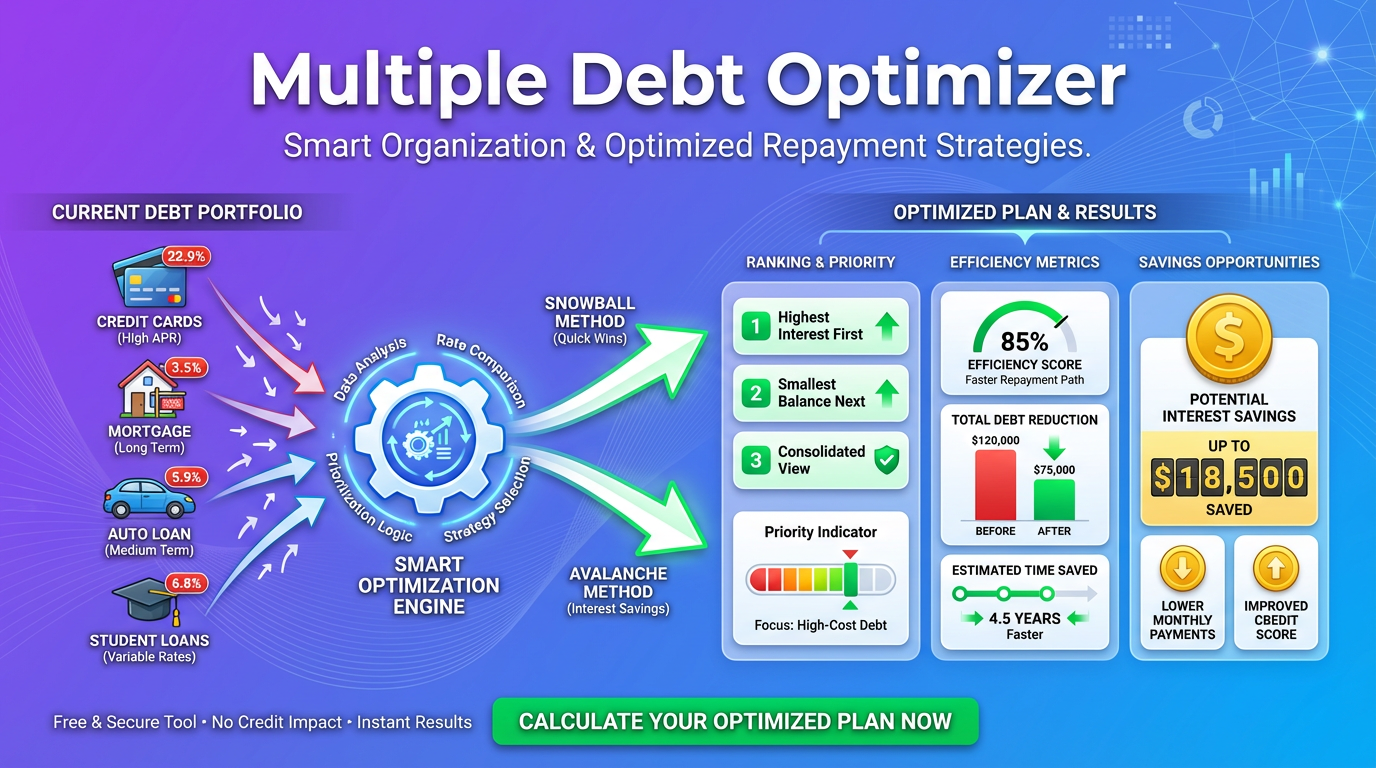
Our debt optimizer calculator uses an advanced algorithm to create your personalized payoff strategy. Unlike simple snowball (smallest balance) or avalanche (highest interest) methods, our optimizer considers multiple factors:
- Interest rates – Minimize total interest paid
- Balance sizes – Factor in psychological quick wins
- Minimum payments – Account for cash flow requirements
- Your preferences – Weight math vs. motivation based on your goals
- Payoff momentum – Strategically sequence for sustained progress
Enter all your debts, your extra payment amount, and your priorities. The optimizer calculates the most efficient payoff order for your unique situation.
Why Debt Optimization Matters
The Problem with One-Size-Fits-All Strategies
Debt Avalanche (Highest Interest First): – ✓ Mathematically optimal—saves the most money – ✗ First payoff may take years—people quit before seeing progress
Debt Snowball (Smallest Balance First): – ✓ Quick wins build momentum – ✗ May cost hundreds or thousands more in interest
The Solution: Optimized Hybrid Strategy
Our optimizer finds the sweet spot between maximum savings and sustainable motivation. Sometimes paying off a small debt first (even at a lower rate) keeps you on track to save thousands later.
The Research Behind Optimization
Studies from Harvard Business Review and Northwestern University found:
- People with more accounts paid off are more likely to continue
- The feeling of progress matters as much as actual progress
- Purely mathematical approaches have higher dropout rates
- A small early win can increase overall debt payoff success by 15-20%
Our optimizer uses these behavioral insights combined with financial math to create a strategy you’ll actually stick with.
Debt Optimizer Examples: Real Numbers
Example 1: Classic 5-Debt Scenario ($32,000)
Scenario: Michael has 5 debts and $600/month extra to put toward payoff.
Current Debts:
| Debt | Balance | APR | Minimum |
|---|---|---|---|
| Store Card | $1,200 | 26.99% | $35 |
| Visa | $5,800 | 22.99% | $145 |
| Personal Loan | $8,500 | 14.99% | $195 |
| Car Loan | $12,000 | 6.99% | $285 |
| Mastercard | $4,500 | 19.99% | $112 |
| Total | $32,000 | — | $772 |
Extra Payment Available: $600/month
Three Strategy Comparison:
| Strategy | Total Interest | Time to Debt-Free | First Payoff |
|---|---|---|---|
| Avalanche (Store→Visa→MC→Personal→Car) | $4,847 | 28 months | 2 months |
| Snowball (Store→MC→Visa→Personal→Car) | $5,214 | 28 months | 2 months |
| Optimized Hybrid | $4,912 | 28 months | 2 months |
Optimized Payoff Order: 1. Store Card ($1,200) – Highest APR AND smallest balance (wins on both metrics) 2. Visa ($5,800) – Second highest APR 3. Mastercard ($4,500) – Third highest APR (avalanche continues) 4. Personal Loan ($8,500) – Medium APR, large balance 5. Car Loan ($12,000) – Lowest APR, largest balance
Analysis: In this case, avalanche and optimized are nearly identical because the highest-rate debt is also the smallest. The optimizer confirms avalanche is correct. Interest difference: Only $65 between strategies.
Example 2: When Optimization Beats Both Methods ($28,500)
Scenario: Sarah has 4 debts where snowball and avalanche give very different results.
Current Debts:
| Debt | Balance | APR | Minimum |
|---|---|---|---|
| Medical Bill | $2,800 | 0% | $100 |
| Credit Card A | $8,200 | 24.99% | $205 |
| Credit Card B | $6,500 | 21.99% | $162 |
| Personal Loan | $11,000 | 12.99% | $253 |
| Total | $28,500 | — | $720 |
Extra Payment Available: $400/month
Three Strategy Comparison:
| Strategy | Total Interest | Time | First Payoff | Notes |
|---|---|---|---|---|
| Avalanche (CC-A→CC-B→Loan→Medical) | $4,156 | 31 months | 9 months | Mathematically best |
| Snowball (Medical→CC-B→CC-A→Loan) | $4,892 | 31 months | 3 months | Early win |
| Optimized | $4,287 | 31 months | 3 months | Best of both |
Optimized Payoff Order: 1. Medical Bill ($2,800) – 0% APR BUT quick win in 3 months (psychology boost) 2. Credit Card A ($8,200) – Highest APR (now attack expensive debt) 3. Credit Card B ($6,500) – Second highest APR 4. Personal Loan ($11,000) – Lowest APR, largest balance
Why This Works: – Paying off medical first costs only $131 extra vs. pure avalanche – But you eliminate an account in 3 months vs. 9 months – That early win keeps you motivated for the 28-month journey ahead – Saves $605 compared to pure snowball
Example 3: High-Debt Optimization ($52,000)
Scenario: The Martinez family has significant debt across 6 accounts.
Current Debts:
| Debt | Balance | APR | Minimum |
|---|---|---|---|
| Store Card | $3,200 | 28.99% | $96 |
| Visa Platinum | $12,400 | 19.99% | $310 |
| Medical Collections | $4,800 | 0% | $150 |
| Auto Loan | $18,500 | 7.49% | $385 |
| Home Depot | $2,100 | 25.99% | $63 |
| Personal Loan | $11,000 | 15.99% | $275 |
| Total | $52,000 | — | $1,279 |
Extra Payment Available: $800/month
Three Strategy Comparison:
| Strategy | Total Interest | Time | First Payoff |
|---|---|---|---|
| Avalanche | $8,247 | 32 months | 2 months (Store) |
| Snowball | $9,834 | 33 months | 2 months (Home Depot) |
| Optimized | $8,412 | 32 months | 2 months |
Optimized Payoff Order: 1. Home Depot ($2,100) – Quick win at 25.99% (only slightly less than highest) 2. Store Card ($3,200) – Highest APR, second smallest 3. Medical Collections ($4,800) – 0% APR, eliminates account cheaply 4. Visa Platinum ($12,400) – High APR, tackle while momentum is strong 5. Personal Loan ($11,000) – Medium APR 6. Auto Loan ($18,500) – Lowest APR, finish strong
Why This Works: – Two accounts paid off in first 4 months = strong motivation – Only $165 more interest than pure avalanche – Saves $1,422 compared to snowball – Psychological benefit of eliminating accounts quickly
Example 4: Low Extra Payment Optimization ($19,500)
Scenario: Kevin can only put $150 extra toward debt each month.
Current Debts:
| Debt | Balance | APR | Minimum |
|---|---|---|---|
| Credit Card | $4,200 | 23.99% | $105 |
| Medical Debt | $1,800 | 0% | $75 |
| Student Loan | $8,500 | 6.8% | $95 |
| Personal Loan | $5,000 | 18.99% | $125 |
| Total | $19,500 | — | $400 |
Extra Payment Available: $150/month
Three Strategy Comparison:
| Strategy | Total Interest | Time | First Payoff |
|---|---|---|---|
| Avalanche (CC→Personal→Student→Medical) | $3,847 | 47 months | 12 months |
| Snowball (Medical→CC→Personal→Student) | $4,112 | 47 months | 5 months |
| Optimized | $3,923 | 47 months | 5 months |
Optimized Payoff Order: 1. Medical Debt ($1,800) – 0% APR, but paid off in 5 months for quick win 2. Credit Card ($4,200) – Highest APR, now full focus 3. Personal Loan ($5,000) – Second highest APR 4. Student Loan ($8,500) – Lowest APR, longest payoff
Why This Works: – With only $150 extra, the first payoff takes 12 months with avalanche – That’s a YEAR without visible progress—high dropout risk – Paying medical first costs only $76 more but gives a win in 5 months – Saves $189 vs. snowball while keeping motivation
Example 5: When Avalanche IS the Answer ($24,000)
Scenario: Diana’s situation where pure avalanche is truly optimal.
Current Debts:
| Debt | Balance | APR | Minimum |
|---|---|---|---|
| Store Card | $8,500 | 29.99% | $255 |
| Visa | $6,200 | 22.99% | $155 |
| Personal Loan | $5,800 | 14.99% | $145 |
| Car Loan | $3,500 | 4.99% | $125 |
| Total | $24,000 | — | $680 |
Extra Payment Available: $500/month
Three Strategy Comparison:
| Strategy | Total Interest | Time | First Payoff |
|---|---|---|---|
| Avalanche | $3,156 | 24 months | 8 months |
| Snowball | $4,423 | 25 months | 4 months |
| Optimized | $3,156 | 24 months | 8 months |
Optimized Payoff Order (Same as Avalanche): 1. Store Card ($8,500) – Highest APR by far 2. Visa ($6,200) – Second highest APR 3. Personal Loan ($5,800) – Third highest APR 4. Car Loan ($3,500) – Lowest APR
Why Optimizer Matches Avalanche: – The interest rate differences are HUGE (29.99% vs. 4.99%) – Snowball would cost $1,267 extra—too high for psychological benefit – First payoff in 8 months is reasonable – The optimizer confirms: stick with avalanche
How the Optimization Algorithm Works
The Scoring Formula
Our optimizer assigns a score to each debt based on weighted factors:
Score = (APR Weight × APR Score) + (Balance Weight × Balance Score) + (Progress Weight × Progress Score)APR Score: Higher rates get higher priority
Balance Score: Smaller balances get higher
priority
Progress Score: Debts closer to payoff get higher
priority
Weight Adjustment Based on Goals
| Your Priority | APR Weight | Balance Weight | Progress Weight |
|---|---|---|---|
| Save Most Money | 70% | 15% | 15% |
| Quick Wins | 30% | 50% | 20% |
| Balanced (Default) | 50% | 30% | 20% |
| Motivation Focus | 25% | 45% | 30% |
Dynamic Rebalancing
The optimizer recalculates after each debt is paid off because: – Remaining balances have changed – Time horizons have shifted – New “quick win” opportunities may emerge
This is something manual strategies can’t do effectively.
When to Use the Debt Optimizer
Best For:
✓ Multiple debts (4+) – More complexity = more
optimization value
✓ Mixed interest rates – Creates real trade-off
decisions
✓ Different balance sizes – Snowball/avalanche give
different results
✓ Moderate extra payment – $200-$1,000/month
range
✓ Uncertainty about strategy – Not sure which method
to choose
Less Valuable For:
✗ 2-3 debts only – Simple enough to compare
manually
✗ All similar APRs – Order doesn’t matter much
✗ All similar balances – Strategies produce same
results
✗ Very high extra payment – Everything paid off
quickly anyway
✗ Only one high-APR debt – Obvious where to focus
Optimization vs. Simple Strategies: When Each Wins
Avalanche Wins When:
- Largest balance has highest APR
- Interest rate differences are extreme (20%+ gap)
- First payoff timeline is acceptable (under 6 months)
- You’re highly motivated by saving money
Snowball Wins When:
- Interest rates are all similar (within 5%)
- You’ve failed at debt payoff before
- You need wins to stay motivated
- Smallest debts have decent APRs anyway
Optimization Wins When:
- Some low-APR debts have small balances
- Interest rate differences are moderate (5-15%)
- First avalanche payoff would take 9+ months
- You want data-driven decision making
- Complexity makes manual comparison hard
Creating Your Optimized Payoff Plan
Step 1: Gather Your Debt Details
For each debt, you need: – Current balance – Interest rate (APR) – Minimum payment – Account type (credit card, loan, etc.)
Step 2: Determine Your Extra Payment
Calculate how much extra you can pay above all minimums: – Total monthly income – Minus essential expenses – Minus total minimum payments – = Extra payment available
Step 3: Choose Your Priority
Select your optimization goal: – Save Most Money: Maximize interest savings – Quick Wins: Prioritize motivation and momentum – Balanced: Best of both worlds (recommended for most)
Step 4: Follow the Optimized Order
The calculator provides your payoff order. Stick to it: 1. Pay minimums on all debts 2. Put all extra money toward Debt #1 3. When Debt #1 is paid, roll payment to Debt #2 4. Repeat until debt-free
Step 5: Re-Optimize Quarterly
Life changes. Re-run the optimizer every 3 months to account for: – Balance changes – New debts added – Income changes – Interest rate changes
Psychological Factors in Debt Payoff
Why Psychology Matters
The math is easy. The behavior is hard.
Studies show: – 50%+ of people abandon debt payoff plans within 6 months – 70% of abandonments cite “lack of progress” as the reason – Seeing an account reach $0 creates dopamine response – Early wins increase likelihood of completion by 15-20%
The “Progress Principle”
Research by Harvard’s Teresa Amabile found that small wins are the single biggest motivator for sustained effort. In debt payoff:
- Eliminating an account = visible progress
- Reducing # of bills = psychological relief
- Checking off a debt = completion satisfaction
Optimization Psychology
Our optimizer factors in: – Time to First Win: Ensuring an early payoff – Win Distribution: Spacing wins throughout the journey – Momentum Building: Increasingly large payoffs over time – Finish Strong: Ending with a satisfying large payoff
Common Debt Optimizer Scenarios
Scenario A: One Tiny Debt at Low APR
Example: $500 medical bill at 0% among $20K in credit cards at 20%+
Optimizer Recommendation: Pay off the $500 first Cost: Maybe $20-30 in extra interest on credit cards Benefit: Account eliminated in month 1, motivation boosted
Scenario B: Large High-APR Debt
Example: $15,000 credit card at 26% among smaller debts at 15-18%
Optimizer Recommendation: Attack the $15K first (avalanche) Reason: Interest rate is too high to ignore—mathematical savings outweigh psychology
Scenario C: All Debts Similar Size and APR
Example: Four debts, all $4,000-$5,000 at 18-20% APR
Optimizer Recommendation: Slight preference for smaller/higher rate Reality: Order doesn’t matter much—pick one and start!
Scenario D: Low Extra Payment Available
Example: Only $100/month extra across 5 debts
Optimizer Recommendation: Strong weight toward smallest debt Reason: At $100 extra, first avalanche payoff could take 18+ months—too long for motivation
Frequently Asked Questions
What is debt optimization✓
Debt optimization is a strategic approach to paying off multiple debts that balances:
- Mathematical efficiency (paying less total interest)
- Psychological sustainability (maintaining motivation through quick wins)
- Cash flow management (working within your budget)
Unlike simple snowball (smallest first) or avalanche (highest interest first) methods, optimization uses a weighted algorithm to find the best payoff order for your specific situation.
How is this different from snowball or avalanche✓
| Method | Decision Rule | Focus |
|---|---|---|
| Snowball | Pay smallest balance first | Motivation/quick wins |
| Avalanche | Pay highest interest first | Saving money |
| Optimizer | Weighted analysis of both factors | Personalized balance |
The optimizer may recommend: – Snowball order (if APRs are similar) – Avalanche order (if rate differences are extreme) – Hybrid order (if a small low-APR debt provides valuable quick win)
Will the optimizer always give a different answer than snowball/avalanche✓
No. In many cases, the optimizer will confirm one of the simple strategies is best:
- If smallest debt = highest APR → All three methods match
- If APR differences are extreme → Optimizer recommends avalanche
- If APRs are nearly identical → Optimizer recommends snowball
The value is in confirming the right strategy and identifying cases where hybrid approaches work better.
How much extra should I pay toward debt✓
General guidelines:
| Monthly Income | Recommended Extra Payment |
|---|---|
| Under $3,000 | $100-200 if possible |
| $3,000-$5,000 | $200-400 |
| $5,000-$8,000 | $400-800 |
| Over $8,000 | $800-1,500+ |
Finding extra money: – Cut subscriptions: $50-150/month – Reduce dining out: $100-300/month – Side gig income: $200-500/month – Sell unused items: One-time boost
Every extra dollar reduces time and interest.
What if I can only afford minimum payments✓
If you can only afford minimums:
- Focus on increasing income – Side gigs, overtime, selling items
- Reduce expenses temporarily – Cut everything non-essential
- Consider balance transfer – Move high-APR debt to 0% promo
- Look into consolidation – May lower monthly payments
- Seek credit counseling – Nonprofit agencies offer free help
Optimization helps most when you have extra money to direct strategically.
Should I include my mortgage in debt optimization✓
Generally, no. Mortgage debt is different because:
- Interest rates are typically much lower (3-7%)
- Interest may be tax-deductible
- Timeline is 15-30 years by design
- Balance is typically very large
Focus optimization on: – Credit cards – Personal loans – Auto loans – Student loans – Medical debt
Pay mortgage separately according to your loan terms.
How often should I re-run the optimizer✓
Recommended schedule:
- After each debt payoff – Confirm next priority
- Quarterly (every 3 months) – Account for balance changes
- When circumstances change:
- Income increase/decrease
- New debt added
- Interest rate changes
- Windfall received
Re-optimizing ensures your strategy stays current.
What if I get a windfall (bonus, tax refund)✓
Options for windfalls:
- Apply to highest-priority debt – Continue optimization strategy
- Eliminate a small debt entirely – Psychological win
- Split the windfall – Some to debt, some to emergency fund
- Re-optimize with new data – See if order should change
Example: $2,000 tax refund – If smallest debt is $1,800: Pay it off, boost momentum – If all debts are large: Apply to highest-APR debt – If no emergency fund: Split 50/50
Does the optimizer account for different payment due dates✓
The basic optimizer focuses on total debt payoff, not cash flow timing. For payment timing:
Tips for managing due dates: – Request due date changes (most creditors allow this) – Align due dates with paydays – Use automatic payments for minimums – Make extra payments any time
What about debts with the same interest rate✓
If two debts have identical APRs, the optimizer considers:
- Balance size – Smaller balance = faster payoff
- Minimum payment – Higher minimum = more cash freed when paid
- Account type – Credit cards before loans (can reuse if emergency)
With same APR, smaller balance typically wins.
Can I customize the optimization weights✓
Yes! Our calculator lets you choose your priority:
- “Save Most Money” – Heavily weights APR (avalanche-leaning)
- “Quick Wins First” – Heavily weights balance (snowball-leaning)
- “Balanced” – Equal consideration (hybrid approach)
- “Motivation Focus” – Emphasizes psychological factors
Choose based on your personality: – Analytical/disciplined → Save Most Money – Previously failed at debt payoff → Quick Wins or Motivation – Unsure → Balanced (recommended default)
What if I have 0% promotional rate debt✓
0% APR debts require special consideration:
If promo period is long (12+ months): – May be worth paying other debts first – Interest savings on other debts are real
If promo period ends soon (under 6 months): – Pay off before rate jumps to 20%+ – Avoiding deferred interest is critical
If balance is small: – Quick win opportunity – Eliminate account while paying no interest
Our optimizer factors in promotional periods if you enter end dates.
How accurate is the optimization✓
The optimizer provides estimates based on: – Consistent extra payments – No new debt added – Interest rates remaining stable – Minimum payments as entered
Actual results may vary due to: – Variable interest rates – Minimum payment recalculations – Payment timing within billing cycles – Fees or charges added
Use results as a strategic guide, not a guarantee.
Related Calculators
Explore complementary debt tools:
- Debt Snowball vs Avalanche Calculator – Compare the two base strategies
- Credit Card Payoff Calculator – Focus on a single card payoff
- Financial Freedom Date Calculator – See your debt-free date
- Debt Consolidation Calculator – Consider combining debts into one loan
This calculator provides estimates for educational purposes. Actual results depend on consistent payments, stable interest rates, and no additional debt. Results are projections based on the information you provide.