
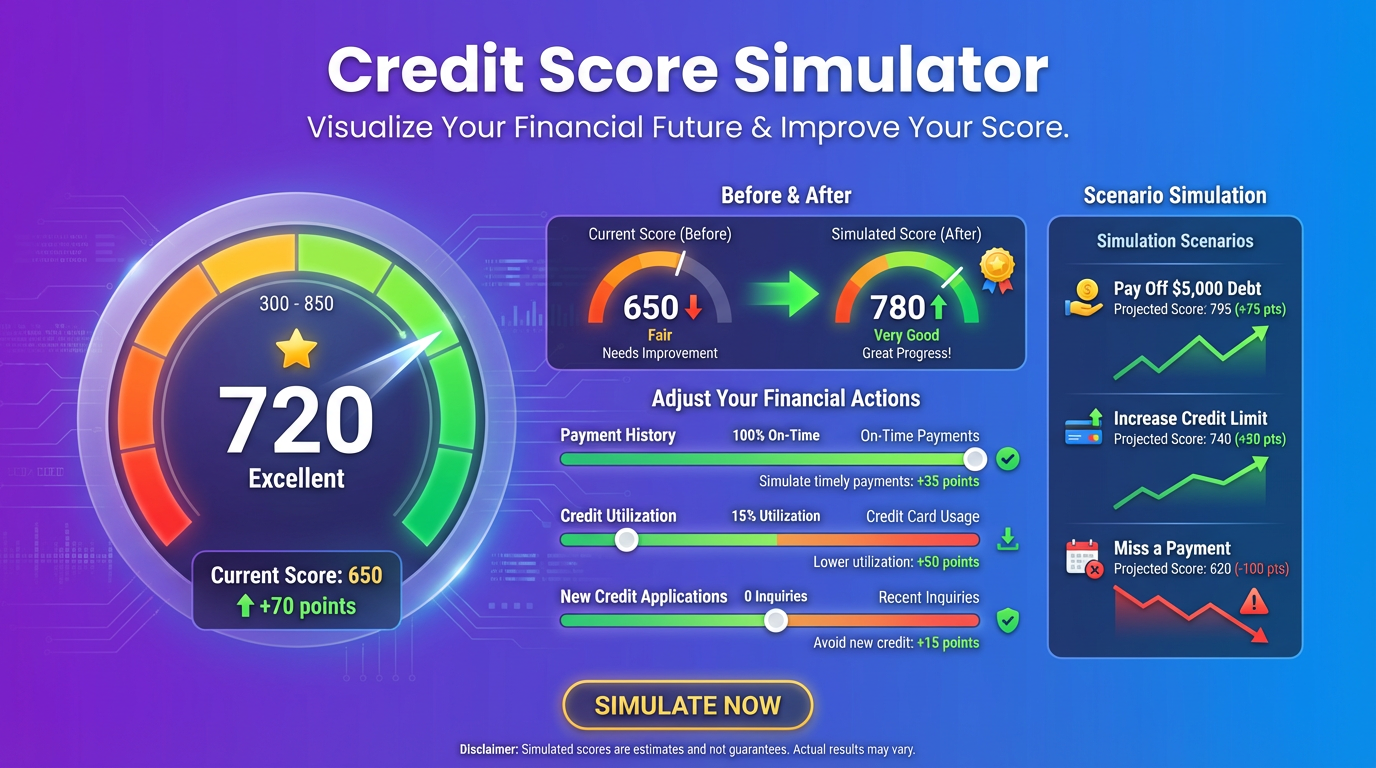
Credit Score Simulator: Preview Your Score Changes
See how different financial actions could affect your credit score.
How This Credit Score Simulator Works
Our credit score simulator helps you predict how specific actions will affect your credit score before you take them. Enter your current credit profile and simulate scenarios like:
- Paying down credit card balances – See score impact of reducing debt
- Opening new credit accounts – Understand hard inquiry effects
- Closing old accounts – Learn why this can hurt your score
- Missing a payment – See the damage of late payments
- Paying off collections – Understand the complex effects
Make smarter financial decisions by seeing the estimated impact first.
Understanding Credit Score Factors
The Five Factors That Determine Your Score
Credit scores (FICO and VantageScore) are calculated using five main factors:
| Factor | Weight | What It Measures |
|---|---|---|
| Payment History | 35% | On-time vs. late payments |
| Credit Utilization | 30% | Balances vs. credit limits |
| Length of Credit History | 15% | Age of accounts |
| Credit Mix | 10% | Types of credit (cards, loans, etc.) |
| New Credit | 10% | Recent applications and accounts |
How Each Factor Affects Your Score
Payment History (35%) – Single biggest factor – One 30-day late payment: -60 to -110 points – Late payments hurt more with higher scores – Negative marks stay 7 years (bankruptcy 10 years)
Credit Utilization (30%) – Percentage of available credit you’re using – Below 30% is good; below 10% is excellent – Calculated per-card AND overall – Updates monthly when issuers report
Length of Credit History (15%) – Average age of all accounts – Age of oldest account – Age of newest account – Longer history = better score
Credit Mix (10%) – Having different types of credit helps – Credit cards, auto loans, mortgage, student loans – Don’t open accounts just for mix
New Credit (10%) – Hard inquiries from applications – New accounts lower average age – Multiple applications in short time = higher risk signal
Credit Score Simulator Examples: Real Scenarios
Example 1: Paying Down Credit Card Debt
Scenario: Maria has high credit card balances and wants to see how paying them down affects her score.
Current Profile: – Credit Score: 645 – Total Credit Limit: $15,000 – Current Balances: $12,000 – Current Utilization: 80% – Payment History: Perfect (no late payments) – Average Account Age: 4 years
Simulation: Pay Down $6,000
| Metric | Before | After | Change |
|---|---|---|---|
| Balance | $12,000 | $6,000 | -$6,000 |
| Utilization | 80% | 40% | -40 points |
| Estimated Score | 645 | 695-715 | +50-70 points |
Why the Big Jump: – Utilization dropped from “poor” (80%) to “fair” (40%) – Utilization changes reflect immediately (next statement) – This single change addresses 30% of score calculation
Further Simulation: Pay Down to $1,500 (10% utilization)
| Metric | Before | After | Change |
|---|---|---|---|
| Balance | $12,000 | $1,500 | -$10,500 |
| Utilization | 80% | 10% | -70 points |
| Estimated Score | 645 | 720-745 | +75-100 points |
Example 2: Opening a New Credit Card
Scenario: James wants a new rewards card but worries about score impact.
Current Profile: – Credit Score: 735 – Total Credit Limit: $20,000 – Current Balances: $4,000 (20% utilization) – Number of Accounts: 4 – Average Account Age: 6 years – Last New Account: 2 years ago
Simulation: Open New Card with $8,000 Limit
Immediate Effects (0-30 days): | Factor | Impact | Points | |——–|——–|——–| | Hard inquiry | Negative | -5 to -10 | | New account (lowers avg age) | Negative | -5 to -10 | | Immediate Score Change | | -10 to -20 |
Short-Term Effects (1-3 months): | Factor | Impact | Points | |——–|——–|——–| | Hard inquiry fading | Neutral | 0 | | Increased total credit limit | Positive | +5 to +10 | | Lower utilization (20% → 14%) | Positive | +10 to +15 | | Net Score Change | | +5 to +15 |
Long-Term Effects (6-12 months): | Factor | Impact | Points | |——–|——–|——–| | Hard inquiry minimal | Neutral | 0 | | Account aging | Improving | +5 | | Better utilization | Positive | +10 to +15 | | Net Score Change | | +15 to +25 |
Summary: Short-term dip of 10-20 points, but long-term gain of 15-25 points if managed well.
Example 3: Closing an Old Credit Card
Scenario: Sarah wants to close a credit card she never uses. It’s her oldest account.
Current Profile: – Credit Score: 710 – Cards: 4 total – Oldest Card: 15 years (the one she wants to close) – Other Cards: 8, 5, and 2 years old – Average Account Age: 7.5 years – Total Credit Limit: $30,000 – Balances: $6,000 (20% utilization) – Limit on Card to Close: $10,000
Simulation: Close the 15-Year-Old Card
| Factor | Before | After | Impact |
|---|---|---|---|
| Average Account Age | 7.5 years | 5 years | -15 to -25 points |
| Total Credit Limit | $30,000 | $20,000 | — |
| Utilization | 20% | 30% | -10 to -20 points |
| Number of Accounts | 4 | 3 | -5 points |
| Estimated Score | 710 | 660-680 | -30 to -50 points |
Why This Hurts: – Loses oldest account (credit history shortened) – Loses $10,000 in available credit (utilization increases) – Reduces total number of accounts
Better Alternative: Keep the card open, use it once every 6 months for a small purchase, pay immediately. This maintains the account with no cost.
Example 4: Missing a Payment
Scenario: David is considering whether a late payment really matters.
Current Profile: – Credit Score: 780 (Excellent) – Payment History: Perfect (never late) – Account Age: 8 years average – Utilization: 15%
Simulation: One 30-Day Late Payment
| Factor | Before | After | Impact |
|---|---|---|---|
| Payment History | Perfect | 1 late | -60 to -110 points |
| Estimated Score | 780 | 670-720 | -60 to -110 points |
Why the Huge Drop: – Payment history is 35% of score – Higher scores have more to lose – One late payment can drop “excellent” to “fair” – Mark stays on report for 7 years
Score Recovery Timeline: | Time After Late Payment | Estimated Score | |————————-|—————–| | Immediately | 670-720 | | 6 months | 700-740 | | 1 year | 720-750 | | 2 years | 740-770 | | 7 years | Back to potential 780+ |
The Lesson: A single late payment can take years to fully recover from. Set up autopay for at least minimum payments.
Example 5: Paying Off a Collection Account
Scenario: Lisa has a $1,200 medical collection from 3 years ago. Should she pay it✓
Current Profile: – Credit Score: 620 – Collection Account: $1,200 (3 years old) – Other Negative Items: None – Utilization: 35% – Payment History: Perfect except collection
Simulation: Pay Off the Collection
With Older Scoring Models (FICO 8 and earlier): | Factor | Before | After | Impact | |——–|——–|——-|——–| | Collection Status | Unpaid | Paid | 0 to +10 points | | Estimated Score | 620 | 620-630 | Minimal change |
Why✓ Older FICO models count collections whether paid or unpaid. The damage is in having a collection at all.
With Newer Scoring Models (FICO 9, VantageScore 3.0+): | Factor | Before | After | Impact | |——–|——–|——-|——–| | Collection Status | Unpaid | Paid | +20 to +40 points | | Estimated Score | 620 | 640-660 | Moderate improvement |
Why✓ Newer models ignore paid collections or weight them less.
Best Strategy: “Pay for Delete” – Negotiate with collection agency to remove the item entirely when paid – If successful: +40 to +80 points (collection disappears) – Not all agencies agree, but worth asking
Time Factor: – Collection falls off after 7 years from original delinquency – At 3 years old, it has 4 years left – Paying may help with loan applications even if score doesn’t jump
Common Credit Score Scenarios
Quick Reference: Action Impact Estimates
| Action | Score Impact | Timeline |
|---|---|---|
| Pay card balance to 30% utilization | +20 to +50 | 1-2 months |
| Pay card balance to 10% utilization | +40 to +80 | 1-2 months |
| Open new credit card | -10 to -20 initially, +10 to +25 long-term | 3-12 months |
| Close old credit card | -20 to -50 | Immediate |
| One 30-day late payment | -60 to -110 | 7 years to fully recover |
| Pay off collection (older models) | 0 to +10 | Immediate |
| Pay off collection (newer models) | +20 to +40 | Immediate |
| “Pay for delete” collection | +40 to +80 | 1-2 months |
| Hard inquiry | -5 to -10 | 12 months to recover |
| Become authorized user (good account) | +10 to +30 | 1-3 months |
Utilization Impact Chart
| Utilization | Score Category | Typical Impact |
|---|---|---|
| 0% | Not ideal | May appear inactive |
| 1-9% | Excellent | Maximum positive impact |
| 10-29% | Good | Positive impact |
| 30-49% | Fair | Slight negative |
| 50-74% | Poor | Moderate negative |
| 75%+ | Very Poor | Significant negative |
Strategies to Improve Your Credit Score
Quick Wins (1-2 Months)
1. Pay Down Credit Card Balances – Biggest impact for most people – Get utilization below 30%, ideally below 10% – Pay before statement closes for fastest impact
2. Become an Authorized User – Ask family member with excellent credit to add you – Their account history appears on your report – Can add decades of positive history instantly
3. Request Credit Limit Increases – Lowers utilization without paying down debt – Some issuers do “soft pull” increases (no inquiry) – Ask every 6-12 months
4. Dispute Errors on Credit Report – Get free reports at AnnualCreditReport.com – Dispute inaccuracies with bureaus – Removing errors can boost score significantly
Medium-Term Strategies (3-12 Months)
5. Keep Old Accounts Open – Even if unused, they help average age – Use once every 6 months to keep active – Consider product changing instead of closing
6. Diversify Credit Mix – If you only have cards, a small personal loan can help – Don’t take on debt just for mix—only if needed anyway
7. Space Out Applications – Each hard inquiry costs 5-10 points – Multiple inquiries signal risk – Rate shopping for same loan type (mortgage, auto) within 14-45 days counts as one inquiry
Long-Term Habits (1+ Years)
8. Never Miss a Payment – Set up autopay for at least minimums – Payment history is 35% of score – One late payment can undo years of progress
9. Be Patient – Credit scores reward time – Average account age matters – Negative items fade after 7 years
Credit Score Myths Debunked
Myth 1: “Checking my own credit hurts my score”
Truth: Checking your own credit is a “soft inquiry” and has NO impact on your score. Check as often as you like.
Myth 2: “I need to carry a balance to build credit”
Truth: You do NOT need to carry a balance or pay interest. Use your card, pay in full each month—you still build credit.
Myth 3: “Closing cards improves my score”
Truth: Closing cards usually HURTS your score by increasing utilization and reducing average account age.
Myth 4: “All credit scores are the same”
Truth: You have many scores. FICO 8, FICO 9, VantageScore 3.0, and industry-specific scores can all differ by 20-50 points.
Myth 5: “Paying off a loan hurts your credit”
Truth: It can cause a small temporary dip (reducing credit mix), but the positive of having a paid loan outweighs this.
Myth 6: “Income affects my credit score”
Truth: Income is NOT a factor in credit scores. A minimum-wage worker can have an 800 score; a CEO can have a 500.
Frequently Asked Questions
How accurate is a credit score simulator✓
Credit score simulators provide estimates, not guarantees. Actual accuracy depends on:
- Good estimates (±10-20 points): Utilization changes, new account impacts
- Moderate estimates (±20-40 points): Hard inquiry effects, account closure
- Variable estimates (±30-50+ points): Late payment impacts, collection changes
Simulators can’t account for all factors in proprietary scoring algorithms. Use them for directional guidance, not exact predictions.
How quickly will my score change after paying down debt✓
Timeline: – Credit card balances: 1-2 billing cycles (30-60 days) – Issuers report to bureaus monthly, usually at statement close – To maximize speed, pay before statement closing date
Example: – Statement closes: 15th of month – Pay down balance by: 14th of month – New utilization reported: ~15th of month – Score updates: Within days of report
Will applying for a credit card hurt my score✓
Yes, temporarily: – Hard inquiry: -5 to -10 points – New account (lower average age): -5 to -10 points – Total immediate impact: -10 to -20 points
But long-term: – Higher credit limit = lower utilization – Additional positive payment history – Net effect after 6-12 months: Often positive
Don’t avoid credit applications out of fear—just be strategic.
How much will a late payment hurt my score✓
Significant damage:
| Starting Score | Drop from 30-Day Late |
|---|---|
| 780+ | -90 to -110 points |
| 720-779 | -70 to -90 points |
| 680-719 | -60 to -80 points |
| Below 680 | -40 to -60 points |
Higher scores have more to lose. The late payment stays on your report for 7 years, though impact diminishes over time.
Is 700 a good credit score✓
700 is “Good” but not “Excellent”:
| Score Range | Rating | What It Means |
|---|---|---|
| 800-850 | Exceptional | Best rates, easy approval |
| 740-799 | Very Good | Great rates, most approvals |
| 670-739 | Good | Decent rates, general approval |
| 580-669 | Fair | Higher rates, some denials |
| Below 580 | Poor | Difficult approval, high rates |
At 700, you’ll qualify for most products but may not get the absolute best rates. Aim for 740+ for optimal terms.
How long does negative information stay on my credit report✓
| Item | Time on Report |
|---|---|
| Late payments | 7 years |
| Collections | 7 years from original delinquency |
| Charge-offs | 7 years |
| Chapter 7 bankruptcy | 10 years |
| Chapter 13 bankruptcy | 7 years |
| Hard inquiries | 2 years (impact fades after 12 months) |
| Foreclosure | 7 years |
| Tax liens (unpaid) | Indefinitely (removed from reports as of 2018) |
Should I close credit cards I don’t use✓
Generally, no. Closing cards: – Reduces total credit limit (increases utilization) – Reduces average account age – Can drop your score 20-50 points
Better alternatives: – Keep card open, use once every 6 months – Ask to product change to no-annual-fee card – Set up small recurring charge with autopay
Exception: Close if annual fee isn’t worth it AND you can’t product change.
How do I get a free credit report✓
Official free sources: – AnnualCreditReport.com – Free weekly reports from all 3 bureaus – Credit Karma – Free VantageScore and TransUnion/Equifax reports – Credit Sesame – Free VantageScore and TransUnion report – Many credit cards – Free FICO score with your account
Avoid: Sites that require payment or credit card for “free” reports.
What’s the difference between FICO and VantageScore✓
| Aspect | FICO | VantageScore |
|---|---|---|
| Creator | Fair Isaac Corporation | Equifax, Experian, TransUnion jointly |
| Usage | 90% of lending decisions | Growing adoption |
| Score Range | 300-850 | 300-850 |
| Minimum History | 6 months | 1 month |
| Versions | FICO 8, 9, 10, industry-specific | 3.0, 4.0 |
Most lenders use FICO scores, so prioritize that for loan applications.
Can I improve my credit score quickly✓
Fastest improvements:
| Action | Potential Gain | Time |
|---|---|---|
| Pay down utilization to <10% | +50-100 points | 30-60 days |
| Dispute and remove errors | +20-50 points | 30-45 days |
| Become authorized user | +20-40 points | 30-60 days |
| “Pay for delete” collection | +40-80 points | 30-60 days |
Things that take longer: – Recovering from late payments (years) – Building longer credit history (years) – Waiting for inquiries to fall off (12-24 months)
How often should I check my credit score✓
Recommended frequency: – Credit report: At least annually (more if actively building/repairing) – Credit score: Monthly is sufficient for most people
Check more often if: – Applying for major loan soon – Actively paying down debt – Recovering from negative items – Concerned about identity theft
Free monitoring through Credit Karma or your credit card makes frequent checking easy.
Does paying rent or utilities build credit✓
Not automatically, but options exist:
- Experian Boost: Add utility, phone, streaming payments to Experian report
- Rent reporting services: Some landlords or third-party services report rent
- Self-reporting: Services like Rental Kharma report rent history
These can add 10-30 points for thin credit files. Less impact for established credit.
Related Calculators
Improve your overall financial health:
- Credit Utilization Calculator – Optimize your credit card balances
- Credit Card Payoff Calculator – Plan your debt payoff
- Debt-to-Income Calculator – Check loan eligibility
- Debt Consolidation Calculator – See if consolidation helps
Credit score estimates are approximations based on general scoring factors. Actual scores depend on your complete credit profile and the specific scoring model used. Individual results will vary.