
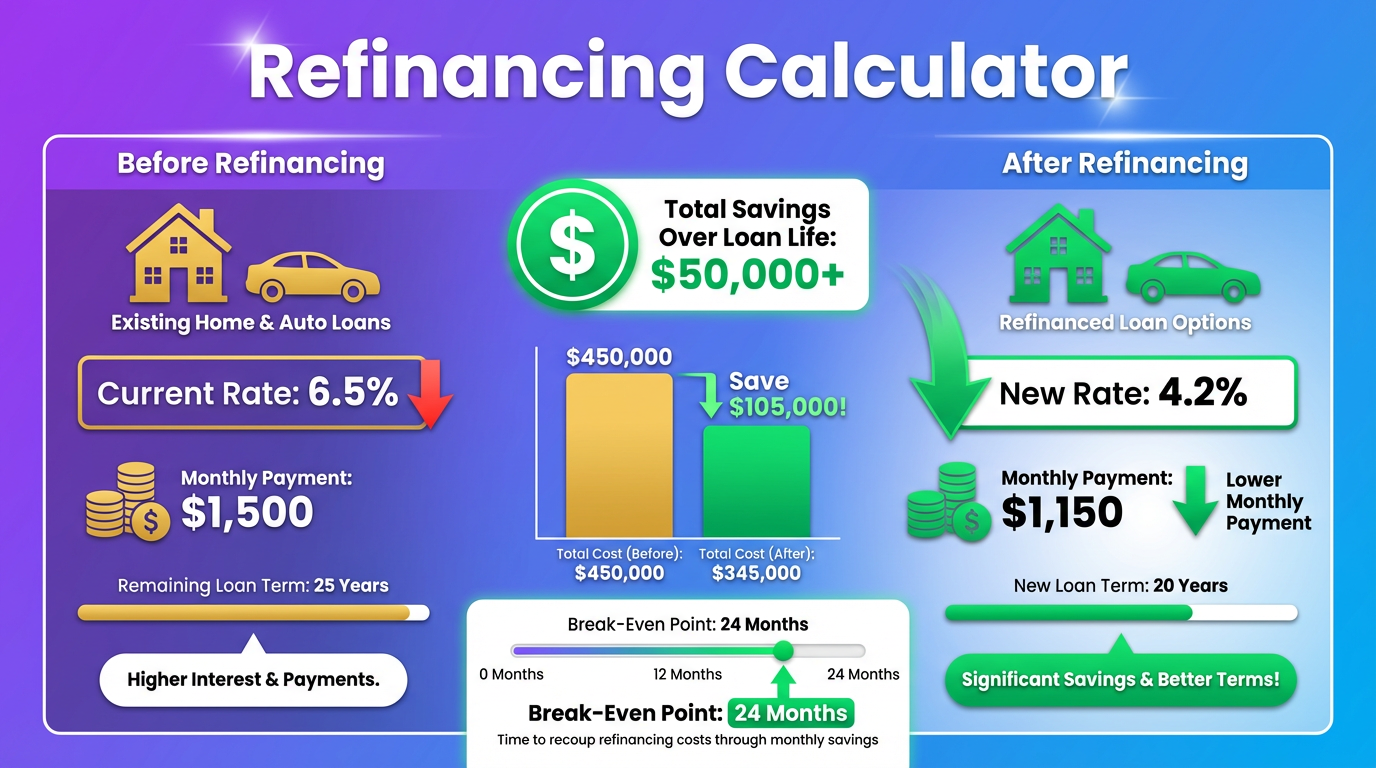
Refinancing Calculator: See If Refinancing Saves You Money
Calculate how much you could save by refinancing your auto, mortgage, or personal loan.
How This Refinancing Calculator Works
Our refinancing calculator shows you exactly how much you can save by refinancing to a lower rate. Enter your current loan details and potential new terms to see:
- Monthly payment change – How much less (or more) you’ll pay
- Total interest savings – Money saved over the loan’s life
- Break-even point – When savings exceed refinancing costs
- Payoff date comparison – Original vs. new timeline
- True cost analysis – Including all fees and costs
See if refinancing makes sense for your auto loan, mortgage, or personal loan.
What Is Refinancing✓
The Basic Concept
Refinancing means replacing your current loan with a new loan, typically to:
- Lower your interest rate – Pay less over time
- Lower your monthly payment – Improve cash flow
- Shorten your term – Pay off faster
- Switch loan types – (e.g., variable to fixed rate)
- Cash out equity – (mortgages and some auto loans)
How Refinancing Works
- Apply with new lender (can be same or different)
- Get approved based on current credit and income
- New loan pays off old loan directly
- You make payments on new loan going forward
Types of Loans You Can Refinance
| Loan Type | Common Reasons | Typical Savings |
|---|---|---|
| Mortgage | Lower rate, remove PMI, cash out | $100-$500/month |
| Auto Loan | Lower rate, extend term | $25-$150/month |
| Student Loans | Lower rate, change servicer | $50-$200/month |
| Personal Loan | Lower rate, consolidate | $50-$150/month |
Refinancing Examples: Real Savings Scenarios
Example 1: Auto Loan Refinance ($22,000 remaining)
Scenario: Marcus bought a car 18 months ago at a high rate and his credit has improved.
Current Loan: – Remaining Balance: $22,000 – Current APR: 9.9% – Remaining Term: 42 months – Monthly Payment: $612 – Remaining Interest: $3,704
New Loan Option: – New APR: 5.9% – New Term: 42 months (same as remaining) – Refinance Fees: $0 (many auto refis have no fees)
Refinance Results:
| Metric | Current Loan | Refinanced | Difference |
|---|---|---|---|
| Monthly Payment | $612 | $567 | -$45/month |
| Total Interest | $3,704 | $1,814 | -$1,890 |
| Total Cost | $25,704 | $23,814 | -$1,890 |
Savings Breakdown: – Monthly savings: $45 – Total interest saved: $1,890 – Break-even: Immediate (no fees)
Verdict: ✓ Refinance – No downside with fee-free auto refi and lower rate.
Example 2: Mortgage Refinance ($280,000 remaining)
Scenario: The Johnsons bought their home 5 years ago and rates have dropped.
Current Mortgage: – Remaining Balance: $280,000 – Current APR: 6.75% – Remaining Term: 25 years (300 months) – Monthly Payment: $2,034 (P&I) – Remaining Interest: $330,200
New Mortgage Option: – New APR: 5.75% – New Term: 25 years (match remaining) – Closing Costs: $6,500 (fees, appraisal, title)
Refinance Results:
| Metric | Current | Refinanced | Difference |
|---|---|---|---|
| Monthly Payment | $2,034 | $1,833 | -$201/month |
| Total Interest | $330,200 | $269,900 | -$60,300 |
| Total Cost | $610,200 | $556,400 | -$53,800 |
Savings Breakdown: – Monthly savings: $201 – Total interest saved: $60,300 – Closing costs: $6,500 – Net savings: $53,800 – Break-even: 32 months ($6,500 ÷ $201)
Verdict: ✓ Refinance – Substantial savings if staying in home 3+ years.
Example 3: Mortgage Refinance (Shorter Term Strategy)
Scenario: Same Johnsons, but considering a 15-year term instead.
Current Mortgage: – Remaining Balance: $280,000 – Current APR: 6.75% – Remaining Term: 25 years – Monthly Payment: $2,034
New Mortgage Option (15-year): – New APR: 5.25% (shorter terms often have lower rates) – New Term: 15 years (180 months) – Closing Costs: $6,500
Refinance Results:
| Metric | Current (25yr) | Refinanced (15yr) | Difference |
|---|---|---|---|
| Monthly Payment | $2,034 | $2,264 | +$230/month |
| Total Interest | $330,200 | $127,520 | -$202,680 |
| Total Cost | $610,200 | $414,020 | -$196,180 |
| Payoff Date | 25 years | 15 years | -10 years |
Trade-off Analysis: – Pay $230 more per month – Save $202,680 in interest – Debt-free 10 years sooner – Be mortgage-free at age 52 instead of 62
Verdict: ✓ Refinance to shorter term if budget allows $230 extra/month.
Example 4: Student Loan Refinance ($45,000 federal loans)
Scenario: Jennifer has federal student loans and is considering private refinancing.
Current Federal Loans: – Total Balance: $45,000 – Average APR: 6.8% – Standard 10-year plan – Monthly Payment: $518 – Remaining Interest: $17,160
Private Refinance Option: – New APR: 4.5% – New Term: 10 years – No fees (most student loan refis)
Refinance Results:
| Metric | Federal | Private Refi | Difference |
|---|---|---|---|
| Monthly Payment | $518 | $466 | -$52/month |
| Total Interest | $17,160 | $10,920 | -$6,240 |
| Total Cost | $62,160 | $55,920 | -$6,240 |
But Wait – What You Lose:
| Federal Benefit | Lost with Private Refi |
|---|---|
| Income-driven repayment | Yes – lose flexibility |
| Public Service Loan Forgiveness | Yes – lose forgiveness option |
| Federal forbearance | Yes – limited options |
| Interest subsidy | Yes – if applicable |
| Death/disability discharge | Yes – varies by lender |
Verdict: ⚠ Proceed with caution – Save $6,240 but lose federal protections. Best for: – High income, stable job – Not pursuing PSLF – Strong emergency fund – Want to pay off aggressively
Example 5: Personal Loan Refinance ($15,000)
Scenario: David got a personal loan when his credit was poor. Now it’s improved.
Current Personal Loan: – Remaining Balance: $15,000 – Current APR: 24.99% – Remaining Term: 36 months – Monthly Payment: $597 – Remaining Interest: $6,492
New Personal Loan Option: – New APR: 12.99% – New Term: 36 months – Origination Fee: 2% ($300)
Refinance Results:
| Metric | Current | Refinanced | Difference |
|---|---|---|---|
| Monthly Payment | $597 | $506 | -$91/month |
| Total Interest | $6,492 | $3,216 | -$3,276 |
| Fees | $0 | $300 | +$300 |
| Net Savings | — | — | $2,976 |
Savings Breakdown: – Monthly savings: $91 – Total interest saved: $3,276 – Fees: $300 – Net savings: $2,976 – Break-even: 3 months ($300 ÷ $91)
Verdict: ✓ Refinance – Significant savings even with origination fee.
The Break-Even Point Explained
What Is Break-Even✓
Break-even is when your savings exceed your costs. After break-even, you’re purely saving money.
Formula:
Break-Even (months) = Total Refinancing Costs ÷ Monthly SavingsBreak-Even Examples
| Loan Type | Costs | Monthly Savings | Break-Even |
|---|---|---|---|
| Auto (no fees) | $0 | $45 | Immediate |
| Mortgage | $6,500 | $201 | 32 months |
| Student (no fees) | $0 | $52 | Immediate |
| Personal (2% fee) | $300 | $91 | 3 months |
When Break-Even Matters
Rule of thumb: Plan to keep the loan longer than break-even period.
| Situation | Refinance✓ |
|---|---|
| Moving in 2 years, 32-month break-even | ✗ No |
| Staying 5+ years, 32-month break-even | ✓ Yes |
| Selling car in 6 months | ✗ No |
| Keeping car 2+ years | ✓ Yes |
When to Refinance
Signs It’s Time to Refinance
✓ Rates have dropped – 0.5-1%+ lower than your current rate ✓ Your credit improved – Higher score = lower rates available ✓ Your income increased – May qualify for better terms ✓ You want to change terms – Shorter/longer payoff ✓ Monthly payment is straining budget – Extend term for lower payment ✓ You have equity – For cash-out refinancing
Signs to Wait or Skip Refinancing
✗ Near the end of your loan – Most interest already paid ✗ Planning to sell soon – Won’t reach break-even ✗ Rates haven’t changed much – Savings may not justify costs ✗ Your credit has dropped – May not qualify for better rate ✗ High closing costs – Extended break-even period ✗ You’d lose valuable benefits – Federal student loan protections
Refinancing by Loan Type
Auto Loan Refinancing
Best candidates: – Credit improved since purchase – Dealer financing was above market – 0.5%+ rate reduction available – At least 12-24 months remaining
What to know: – Usually no fees – Quick process (days, not weeks) – Can refinance almost immediately after purchase – Some mileage/age restrictions
Where to refinance: – Credit unions (often best rates) – Online lenders – Banks – Auto refinance specialists
Mortgage Refinancing
Best candidates: – Rate reduction of 0.75-1%+ – Plan to stay 3-5+ years – Good equity (better rates) – Improved credit since purchase
What to know: – Closing costs: 2-5% of loan amount – Appraisal required – Process takes 30-45 days – Can remove PMI if 20%+ equity
Types of mortgage refinance: – Rate-and-term (change rate and/or term) – Cash-out (take equity as cash) – Streamline (FHA/VA simplified process)
Student Loan Refinancing
Best candidates: – Not pursuing Public Service Loan Forgiveness – Strong income and job stability – Good credit (or cosigner) – Private loans (no federal protections to lose)
What to know: – Usually no fees – Lose federal benefits when refinancing federal loans – Can refinance multiple loans into one – Variable vs. fixed rate options
Personal Loan Refinancing
Best candidates: – Credit improved significantly – Current rate is 5%+ higher than available – Significant balance remaining – Current payment straining budget
What to know: – May have origination fees (1-8%) – Process is quick (days) – Shop multiple lenders – Debt consolidation is a form of refinancing
Frequently Asked Questions
How much can I save by refinancing✓
Savings depend on:
| Factor | Impact on Savings |
|---|---|
| Rate reduction | Higher = more savings |
| Loan balance | Higher = more savings |
| Remaining term | Longer = more savings |
| Refinancing costs | Higher = less net savings |
Examples: – 1% rate drop on $20,000 auto loan: ~$500-$1,000 total savings – 1% rate drop on $300,000 mortgage: ~$50,000-$70,000 total savings
When should I refinance my car loan✓
Best timing:
| Situation | Refinance✓ |
|---|---|
| Credit improved since purchase | ✓ Yes |
| Rates have dropped | ✓ Yes |
| At least 12 months remaining | ✓ Yes |
| Only 6 months remaining | ✗ No |
| Underwater on loan | ⚠ Difficult |
| Car has 100,000+ miles | ⚠ Limited options |
Most auto refinances have no costs, so the bar is low.
Is it worth refinancing for 0.5%✓
It depends on:
| Loan Size | 0.5% Rate Drop | Worth It✓ |
|---|---|---|
| $10,000 | ~$250-$500 savings | Maybe if no fees |
| $50,000 | ~$1,500-$3,000 savings | Usually yes |
| $300,000 | ~$15,000-$25,000 savings | Definitely |
Rule of thumb: – Auto/personal loans (no fees): Even 0.25% can be worth it – Mortgages (with costs): Usually need 0.75-1%+ to be worthwhile
Does refinancing hurt your credit✓
Short-term impact: – Hard inquiry: -5 to -10 points – New account: -5 to -10 points
Long-term impact: – Often neutral or positive – Reduces debt faster (if same/shorter term) – Payment history continues building
Tip: Rate shop within 14-45 days. Multiple inquiries for same loan type count as one.
Can I refinance with bad credit✓
Options by credit score:
| Credit Score | Options |
|---|---|
| 720+ | Best rates from all lenders |
| 680-719 | Good rates from most lenders |
| 620-679 | Higher rates, fewer options |
| Below 620 | Very limited, may need cosigner |
If credit is poor: – Improve credit first, then refinance – Use a cosigner – Try credit unions (more flexible) – Consider secured loan options
How long does refinancing take✓
Typical timelines:
| Loan Type | Timeline |
|---|---|
| Auto loan | 1-3 days |
| Personal loan | 1-7 days |
| Student loans | 1-2 weeks |
| Mortgage | 30-45 days |
Online lenders are generally fastest.
Should I refinance federal student loans✓
Consider refinancing if: – Not pursuing PSLF – Don’t need income-driven repayment – Stable, high income – Rate savings are significant
Don’t refinance if: – May need federal protections – Working toward PSLF – Income is uncertain – Rate difference is minimal
Lost by refinancing: IDR plans, PSLF eligibility, federal forbearance, potential forgiveness.
What are refinancing closing costs✓
By loan type:
| Loan Type | Typical Costs |
|---|---|
| Auto | Usually $0 |
| Personal | 0-8% origination |
| Student | Usually $0 |
| Mortgage | 2-5% of loan ($3,000-$15,000) |
Mortgage closing costs include: appraisal, title, recording, lender fees, prepaid items.
Can I refinance multiple times✓
Yes, but consider: – Each mortgage refi has closing costs – Auto loans may have mileage/age limits – Makes sense if significant rate drops – Some lenders have waiting periods
Reality: Most people refinance once per loan, but there’s no legal limit.
Is “no closing cost” refinancing really free✓
Usually not truly free. “No closing cost” mortgages typically: – Roll costs into loan balance (you pay interest on them) – Have higher interest rate (lender recoups costs) – May have lender credits covering some but not all
Calculate both ways: Sometimes paying closing costs upfront saves more long-term.
What does “rate and term” refinance mean✓
Rate and term refinance: Only changing: – Interest rate – Loan term – (Not taking cash out)
Compared to cash-out refinance: – Cash-out: Borrow more than you owe, receive difference in cash – Usually higher rates on cash-out – Rate and term generally has better terms
When is the best time to refinance a mortgage✓
Best conditions: – Rates are 0.75-1%+ lower than your current rate – You’ll stay in home 3-5+ years (past break-even) – Your credit has improved since purchase – Home has appreciated (better equity = better rates) – You have stable income
Avoid refinancing when: – Rates have only slightly dropped – Moving within 1-2 years – Credit has worsened – Underwater on mortgage
Related Calculators
Plan your complete loan strategy:
- Loan Amortization Calculator – See payment breakdown over time
- Debt Consolidation Calculator – Combine multiple debts
- Personal Loan vs Credit Card Calculator – Compare financing options
- Credit Card Payoff Calculator – Plan debt elimination
This calculator provides estimates based on the information entered. Actual rates, fees, and savings depend on your credit profile, lender terms, and market conditions. Always compare offers from multiple lenders.