

You filled out the application, hoping for relief. You imagined consolidating your credit card debt into one manageable payment at a lower rate. You waited anxiously for the decision.
Then came the email: “We’re unable to approve your application at this time.”
That rejection feels like a door slamming shut on your path to financial freedom. But for thousands of people who eventually found solutions through LendWyse, loan rejection became something unexpected: the turning point that led them to better options than they’d originally sought.
Let’s explore why loan rejection, as painful as it feels, often redirects people toward debt relief solutions that actually work better for their situations than the loans they were denied.
Table Of Contents:
- The Universal Experience: Rejection Hurts
- What Loan Rejection Actually Means (And Doesn’t Mean)
- Why Traditional Loan Applications Often Fail
- The Rejection That Redirects: Real Stories
- What Opens Up After Loan Rejection
- Why Rejection Can Be a Blessing in Disguise
- The Income Reality That Lenders Miss
- The Psychological Shift: From Seeking Loans to Seeking Solutions
- What Happens When Someone Actually Listens After Rejection
- The Alternative Program Discovery
- Why Some Debt Relief Programs Work Better Than Loans Anyway
- The Rejection-to-Relief Pipeline
- The Numbers That Matter More Than Credit Scores
- When Rejection Saves You From Bad Decisions
- The Follow-Through That Makes Rejection Worthwhile
- The Bottom Line: Rejection as Redirection
- Ready to Explore What Rejection Opens Up?
The Universal Experience: Rejection Hurts
When you’re already stressed about debt and gather the courage to apply for help, rejection hits hard. It feels personal, even though it’s just an algorithm evaluating numbers.

LendWyse customer LaDora Lewis captured the anxiety many feel even before potential rejection: “I was nervous making the phone call after an application had been completed.”
That nervousness stems from fear — fear of judgment, fear of rejection, fear that you’re out of options. When the rejection actually comes, it confirms your worst fears: you’re trapped with no way out.
Or so it seems.
What Loan Rejection Actually Means (And Doesn’t Mean)
What rejection tells you:
- Your credit score doesn’t meet that lender’s specific criteria
- Your debt-to-income ratio exceeds their guidelines
- Their algorithm flagged something in your application
- You don’t fit their particular loan product
What rejection does NOT mean:
- You’re financially hopeless
- No solutions exist for your situation
- You’ll never get out of debt
- You’re a bad person or a failure
JANET RANK’s experience perfectly illustrates this distinction: “Maurice was so helpful and kind. I did not qualify for a personal loan and he helped me understand what alleviate could do to help me. And for the first time in a while, I feel very positive about the process.”
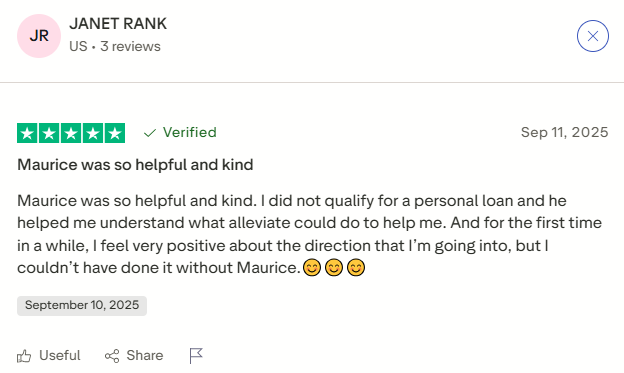 She didn’t qualify for a personal loan. But instead of that being the end, it was the beginning of finding a solution that actually fit her situation better.
Why Traditional Loan Applications Often Fail
Most people apply for debt consolidation loans when they’re already in financial distress:
- High credit card balances (hurting credit utilization)
- Maxed out credit lines (signaling financial stress)
- Multiple recent inquiries (from desperately seeking solutions)
- Possibly missed payments (from juggling too many bills)
These are exactly the signs that make traditional lenders reject applications. The irony is brutal: the people who most need help are the ones least likely to qualify through traditional lending criteria.
The algorithm doesn’t see:
- Your steady $5,000/month income
- Your three years at the same job
- That your debt came from medical emergencies, not irresponsibility
- Your genuine commitment to getting out of debt
- That you’ve never missed a payment despite juggling multiple cards
It only sees a number: your credit score.
The Rejection That Redirects: Real Stories
Christopher Browning’s experience reveals the pattern: “We called about an offer we got in the mail, was not able to get approved for that so he suggested a consolidation plan, and we have called several other mail offers, and no one else bothered to help us.”
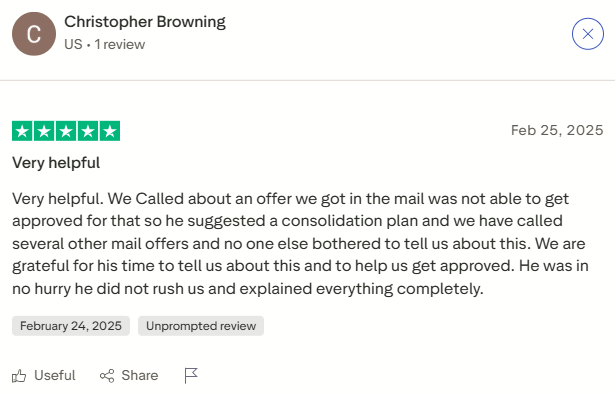
Notice the journey:
- Received loan offer in the mail (hope!)
- Called, couldn’t get approved (rejection)
- The representative suggested an alternative consolidation plan (redirection)
- Other companies they’d called had simply rejected them (comparison)
Most companies stop at rejection. LendWyse representatives ask: “If this doesn’t work, what else can we explore?”
What Opens Up After Loan Rejection
Cosette’s experience shows this redirection: “Due to my credit issues, Taj the representative, explained beyond finance. A program that helps with debt reduction and settlement.”
She had credit issues, likely rejected or offered terrible terms for traditional loans. But Taj didn’t end the conversation there. He explained alternative debt relief programs designed specifically for people with challenged credit.
Debt relief options that don’t require loan approval:
1. Debt Management Programs (DMPs)
- Work with credit counseling agencies
- Negotiate lower interest rates directly with creditors
- Create a single monthly payment without new loans
- Don’t require good credit for enrollment
- Help rebuild credit through consistent payments
2. Debt Settlement Programs
- Negotiate to pay less than the full balance owed
- Designed for overwhelming debt situations
- Work when income can’t support full repayment
- Don’t require loan approval
- Provide a path to debt freedom in 2-4 years
3. Hybrid Solutions
- A combination of strategies based on specific debts
- Personalized to individual circumstances
- Flexible based on what you can afford
- Adapted as your situation changes
David North discovered this flexibility: “Well, I was a little skeptical at first, but he made a lot of sense in what he was saying as far as me trying to pay two cards off and going with beyond in order to make everything work out very comfortably.”
The solution that “made a lot of sense” wasn’t the loan he’d initially sought. It was an alternative program designed for his actual situation.
Why Rejection Can Be a Blessing in Disguise
Here’s an uncomfortable truth: sometimes loan rejection protects you from taking on debt you couldn’t actually afford.
Consider this scenario:
- You have $20,000 in credit card debt at 24% APR
- Your credit score is 580 due to high utilization
- A subprime lender approves you at 28% APR
- You’re excited to consolidate despite barely better rates
What you didn’t realize:
- That 28% loan barely helps (saves only 4% vs. the current rate)
- The monthly payment might actually increase
- If you can’t afford it, you damage your credit further with a new loan default
- You’d have been better off with debt settlement at a 50% reduction
The rejection from better lenders actually steered you away from a bad solution disguised as help.
The Income Reality That Lenders Miss
Traditional lenders obsess over credit scores. But stable income often predicts repayment ability better than past credit history.
Amy Barnard’s experience captures the dignity-focused approach: “I wasn’t made to feel like I was an awful person, very understanding and personable.”
This understanding approach recognizes that:
- Medical emergencies damage credit but don’t predict future behavior
- Job loss during a recession doesn’t reflect current employment stability
- Divorce might tank your credit while you’re now financially stable
- Your $6,000/month income matters more than your 590 credit score
Debt relief programs can consider:
- Current monthly income
- Employment stability
- Living expenses and budget capacity
- Commitment to repayment
- Complete financial picture
Traditional lenders reduce you to a credit score. Debt relief services evaluate your whole situation.
The Psychological Shift: From Seeking Loans to Seeking Solutions
Loan rejection forces a crucial question: “What am I actually trying to accomplish?”
Most people initially think: “I need a loan to consolidate my debt.”
But what they actually need: “I need to get out of debt in a way I can realistically afford.”
Jorge’s clarity shows this reframing: “Speaking to Kevin today felt like a great relief to taking the next step into setting me up in a plan to reduce and finalize my accumulated dept. I can’t wait for these next 3 years to go by and be debt free!”
Notice: he’s not excited about getting a loan. He’s excited about having “a plan to reduce and finalize” his debt with a clear “3 years to be debt-free” timeline.
The shift:
- From seeking products (loans) to seeking outcomes (debt freedom)
- From focusing on immediate relief to long-term solutions
- From hoping for approval to understanding all options
Mother of the groom captured this transformation: “Stress is horrible and after everything was explained the instant relief and looking forward to a resolution has made a lighter load.”
That relief came not from loan approval, but from understanding comprehensive options after initial rejection redirected the conversation.
What Happens When Someone Actually Listens After Rejection
Grace D’s experience reveals why post-rejection consultation matters: “Kameel was the reason I was even open about this company. Not only did he take the time to help me understand the whole process, he was very kind about it. His expertise was obviously on point and there were no questions he was unable to answer.”
What made the difference:
1. Time and Patience: “Took the time to help me understand the whole process” —not rushing to next sale
2. Comprehensive Expertise: “No questions he was unable to answer” —understanding multiple debt relief options
3. Kindness Despite Circumstances: “Very kind about it” — not treating rejection as a reflection of worth
4. Complete Education: “Understand the whole process” — explaining all options, not just pushing one product
This comprehensive approach after loan rejection is what separates companies that truly want to help from those that just want to sell loans.
The Alternative Program Discovery
Most people applying for debt consolidation loans have no idea that alternative debt relief programs exist. Rejection becomes a learning moment.
What customers discovered:
Nalz appreciated: “Almas was so efficient in what he does, very knowledgeable in all aspects…able to answer patiently all my queries….understood my doubts….definitely, he earned my trust and vote of confidence.”
That “knowledgeable in all aspects” suggests expertise across multiple debt relief strategies, not just loans.
The programs that many people learn about only after loan rejection:
- Beyond Finance – Mentioned in multiple reviews, a debt settlement program
- Alleviate – Debt management program for those not qualifying for loans
- Debt Management Plans – Through credit counseling agencies
- Hybrid Approaches – Combining strategies for different debts
Another customer expressed the relief of finding alternatives: “Everyone I spoke with were very understanding, helpful and treated me with such respect. We all encounter some sort of hardship and don’t want to be judged for decisions that were made.”
That respect and lack of judgment create space for honest conversation about which debt relief approach actually fits.
Why Some Debt Relief Programs Work Better Than Loans Anyway
For many people who get rejected for debt consolidation loans, those loan rejections actually saved them from inappropriate solutions.
When debt relief programs outperform loans:
1. Debt Is Overwhelming Relative to Income: If your debt equals your annual income, loans might not be affordable. Settlement programs that reduce principal often work better.
2. Credit Is Severely Damaged: If you can only qualify for 25-30% APR loans, settlement programs that negotiate a 40-50% reduction provide better financial outcomes.
3. Spending Behavior Needs Addressing: Loans just move debt around. Debt management programs include financial counseling and behavior modification.
4. Multiple Debt Types Need Different Approaches: Some debts might benefit from negotiation, others from structured repayment. Hybrid approaches customize solutions.
5. Income Is Strong But Credit Is Weak: Income-based debt relief programs can work when credit-based lending won’t.
The Rejection-to-Relief Pipeline
Based on customer experiences, here’s the typical journey:
Step 1: Initial Application/Inquiry: Apply for a debt consolidation loan or inquire about options
Step 2: Assessment: Credit and financial review (may result in loan rejection)
Step 3: The Critical Moment: Most companies end the conversation. The LendWyse approach: “If that doesn’t work, let’s explore alternatives.”
Step 4: Comprehensive Options Review: Explanation of debt management, settlement, and hybrid approaches.
Step 5: Personalized Recommendation: Based on a complete financial picture, not just credit score
Step 6: Education and Enrollment: Thorough explanation of chosen program, realistic expectations
Linda Gilbreath noted: “Everyone I spoke with was kind and courteous. Very refreshing. My wait time was not long. Taj was extremely helpful and patient. I felt comfortable discussing my situation with him.”
That comfort “discussing my situation” is what allows the rejection-to-relief pipeline to function — an honest conversation about what actually works.
The Numbers That Matter More Than Credit Scores
While traditional loans focus obsessively on credit scores, comprehensive debt relief services evaluate:
- Monthly Income: Can you afford structured payments?
- Employment Stability: How reliable is that income?
- Total Debt Amount: Is it manageable or overwhelming?
- Debt-to-Income Ratio: What percentage of income goes to debt?
- Living Expenses: What’s realistically available for debt repayment?
- Payment History: Have you been trying to stay current despite challenges
- Commitment Level: Are you ready to make necessary changes?
Paula Siwek appreciated: “ALEN is a human being, and made me feel informed and comfortable. I didn’t know what expect from our conversation, and he made the terms clear and realistic.”
Those “clear and realistic” terms come from evaluating complete financial pictures rather than reducing applicants to credit scores.
When Rejection Saves You From Bad Decisions
Sometimes rejection from predatory lenders is the best thing that could happen:
Red Flag Loans Often Approved When Others Reject:
- Interest rates of 35%+ (barely better than credit cards)
- Excessive origination fees (5-10% upfront)
- Short terms with unaffordable payments
- Prepayment penalties trapping you in bad terms
- Hidden fees not disclosed until signing
The pattern: Reputable lenders reject you → Predatory lenders approve you → Trap you in terrible terms
Better pattern: Reputable lenders reject you → Debt relief services redirect you → Find appropriate non-loan solutions
Darrell experienced this positive redirection: “Carmelo was great to work with. He was able to help me understand exactly how the program works because I was under the impression that going this route was bad.”
That “impression that going this route was bad” often keeps people chasing loan approvals from progressively worse lenders instead of exploring better alternatives.
The Follow-Through That Makes Rejection Worthwhile
Getting rejected for a loan but redirected to debt relief only works if the support continues. Multiple customers mentioned ongoing assistance:
Anthony D shared: “I just signed up and so far the process has been great! Chad B. is awesome he’s been answering all my questions quickly. He even followed up which was a nice touch.”
That follow-up after enrollment shows the relationship continues beyond the initial sale, whether that sale was a loan or enrollment in an alternative program.
Why continued support matters:
Debt relief programs take 2-4 years. You need:
- Answers when questions arise
- Support when circumstances change
- Encouragement when motivation wavers
- Guidance on staying on track
Loan rejection that leads to these supportive programs often produces better outcomes than loan approval followed by being left alone to figure it out.
The Bottom Line: Rejection as Redirection
Loan rejection feels like failure. But for thousands of people, it became the moment that redirected them toward solutions that actually worked better than the loans they sought.
What rejection reveals:
- You don’t fit traditional lending boxes
- Your situation needs customized solutions
- Your credit score doesn’t tell your complete story
- Alternative paths exist beyond conventional loans
What happens when someone keeps helping after rejection:
- Discovery of options you didn’t know existed
- Assessment of the complete financial picture
- Solutions matched to actual circumstances
- Support throughout the debt relief journey
Tamaira Barnes-Hart’s joy captures the transformation: “I can’t even thank you enough for taking care of my debt….I should have done this along time ago. I’m so happy, this made my day!!!!”
That gratitude comes from finding real solutions after loan rejection. Solutions that worked better than the loans she’d initially sought.
Ready to Explore What Rejection Opens Up?
If you’ve been rejected for debt consolidation loans and feel hopeless about options, discover what thousands of others learned: rejection isn’t the end of the road—it’s often the beginning of finding solutions that actually fit.
What LendWyse customers discovered after loan rejection:
- Alternative debt relief programs designed for challenged credit
- Evaluation based on complete circumstances, not just scores
- Multiple pathways to debt freedom beyond traditional loans
- Support and guidance throughout the journey
- Respect and understanding despite financial difficulties
Stop letting loan rejection convince you there’s no way out. Discover what opens up when someone asks: “If that doesn’t work, what else can we try?”
Your loan rejection might be the best thing that happened on your debt relief journey, if it connects you with comprehensive solutions designed for your actual situation.