
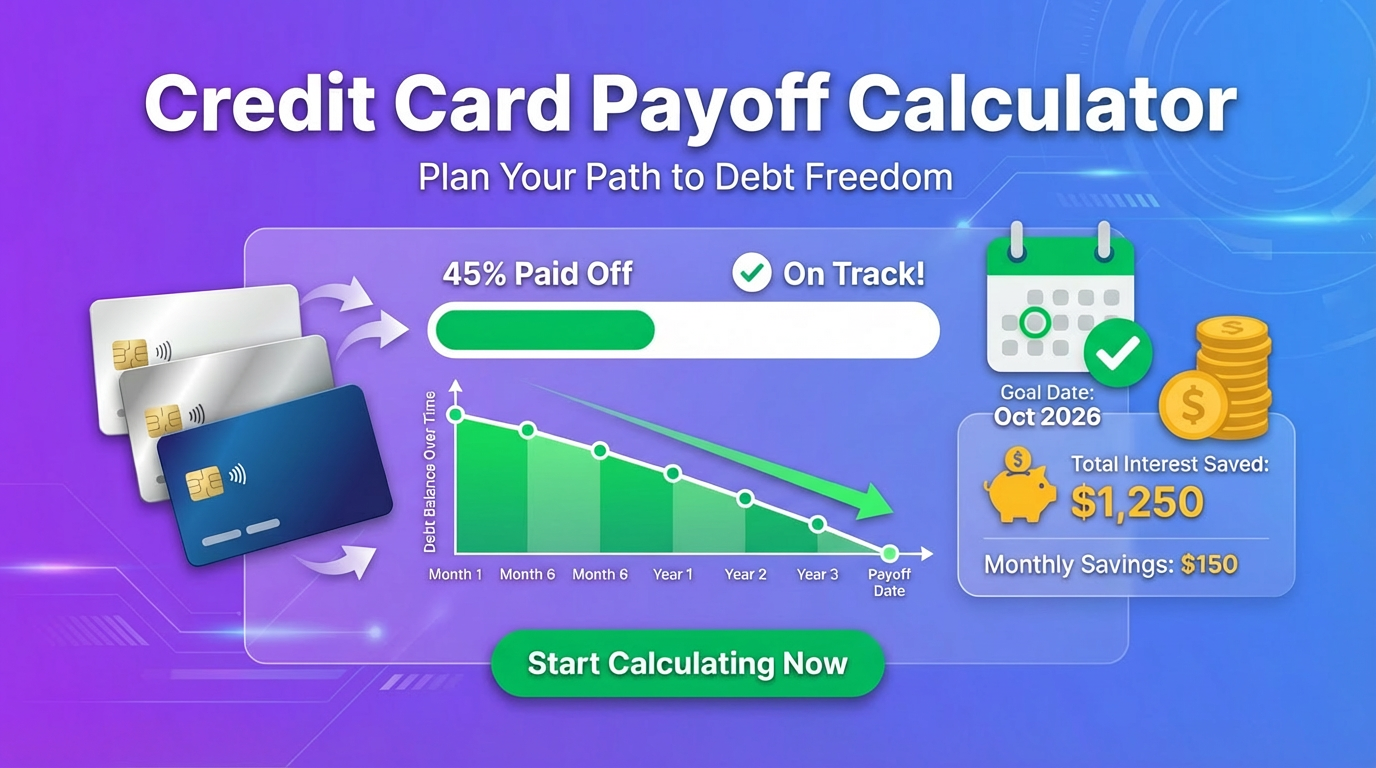
Credit Card Payoff Calculator: Plan Your Debt-Free Journey
Calculate how long it will take to pay off your credit card and how much you can save with extra payments.
How This Credit Card Payoff Calculator Works
Our credit card payoff calculator shows you exactly how long it will take to eliminate your credit card balance and how much total interest you’ll pay. Enter your current balance, interest rate (APR), and monthly payment to see your payoff timeline. Then add an extra payment amount to see how accelerating your payments can save you thousands in interest and years of payments.
The calculator provides:
- Months to payoff with your current payment
- Total interest paid over the life of the debt
- Payoff date so you can mark your calendar
- Savings from extra payments showing time and money saved
- Side-by-side comparison of current vs. accelerated payoff
Understanding Credit Card Interest
Credit card interest is calculated daily using your Annual Percentage Rate (APR) divided by 365. This daily rate compounds on your balance, which is why credit card debt grows so quickly and takes so long to pay off with minimum payments.
According to the Federal Reserve, the average credit card APR in 2024 is 22.63%—the highest on record. At this rate, a $5,000 balance with minimum payments takes over 17 years to pay off and costs more than $7,000 in interest alone.
How Credit Card Interest Compounds
Here’s why credit card debt is so expensive:
| Balance | APR | Daily Rate | Daily Interest | Monthly Interest |
|---|---|---|---|---|
| $5,000 | 22.63% | 0.062% | $3.10 | $94.29 |
| $10,000 | 22.63% | 0.062% | $6.20 | $188.58 |
| $15,000 | 22.63% | 0.062% | $9.30 | $282.88 |
| $20,000 | 22.63% | 0.062% | $12.40 | $377.17 |
When your minimum payment barely covers the monthly interest, almost nothing goes toward your actual balance—this is the minimum payment trap.
Minimum Payment Math
Most credit cards calculate minimum payments as: – 2-3% of your balance, or – $25-$35 fixed minimum, whichever is greater
On a $10,000 balance at 22% APR: – Minimum payment (2%): $200 – Monthly interest: $183 – Principal paid: Only $17!
At this rate, it takes 346 months (nearly 29 years) to pay off $10,000.
Credit Card Payoff Calculator Examples: Real Numbers
Example 1: Average Credit Card Balance ($6,501)
Scenario: The average American credit card balance according to Experian.
Starting Point: – Balance: $6,501 – APR: 22.63% (national average) – Minimum Payment: $195 (3% of balance)
Minimum Payment Only Results: – Time to Payoff: 186 months (15.5 years) – Total Interest Paid: $8,234 – Total Amount Paid: $14,735
With $100 Extra Per Month ($295 total): – Time to Payoff: 27 months (2.25 years) – Total Interest Paid: $1,612 – Total Amount Paid: $8,113 – Interest Saved: $6,622 – Time Saved: 159 months (13+ years)
Example 2: Moderate Credit Card Debt ($12,000)
Scenario: Lisa has $12,000 on a rewards card she’s been carrying for years.
Starting Point: – Balance: $12,000 – APR: 24.99% – Current Payment: $300/month
Current Payment Results: – Time to Payoff: 62 months (5.2 years) – Total Interest Paid: $6,554 – Total Amount Paid: $18,554
With $200 Extra Per Month ($500 total): – Time to Payoff: 29 months (2.4 years) – Total Interest Paid: $2,847 – Total Amount Paid: $14,847 – Interest Saved: $3,707 – Time Saved: 33 months (2.75 years)
Aggressive Payoff ($750/month): – Time to Payoff: 18 months (1.5 years) – Total Interest Paid: $1,746 – Total Amount Paid: $13,746 – Interest Saved: $4,808 – Time Saved: 44 months (3.7 years)
Example 3: High-Interest Store Card ($3,500)
Scenario: Marcus has a store credit card with a particularly high rate.
Starting Point: – Balance: $3,500 – APR: 29.99% (common for store cards) – Minimum Payment: $105 (3%)
Minimum Payment Only Results: – Time to Payoff: 155 months (12.9 years) – Total Interest Paid: $5,672 – Total Amount Paid: $9,172 – You pay 2.6x the original purchase!
With $50 Extra Per Month ($155 total): – Time to Payoff: 29 months (2.4 years) – Total Interest Paid: $1,032 – Total Amount Paid: $4,532 – Interest Saved: $4,640 – Time Saved: 126 months (10.5 years)
Example 4: Large Balance Payoff ($25,000)
Scenario: Jennifer accumulated $25,000 during a financial hardship.
Starting Point: – Balance: $25,000 – APR: 21.99% – Current Payment: $500/month
Current Payment Results: – Time to Payoff: 82 months (6.8 years) – Total Interest Paid: $15,847 – Total Amount Paid: $40,847
With $250 Extra Per Month ($750 total): – Time to Payoff: 44 months (3.7 years) – Total Interest Paid: $7,892 – Total Amount Paid: $32,892 – Interest Saved: $7,955 – Time Saved: 38 months (3.2 years)
With $500 Extra Per Month ($1,000 total): – Time to Payoff: 30 months (2.5 years) – Total Interest Paid: $5,147 – Total Amount Paid: $30,147 – Interest Saved: $10,700 – Time Saved: 52 months (4.3 years)
Example 5: Low Balance Quick Win ($2,000)
Scenario: David has a small balance he wants to eliminate quickly.
Starting Point: – Balance: $2,000 – APR: 19.99% – Minimum Payment: $60 (3%)
Minimum Payment Only Results: – Time to Payoff: 119 months (9.9 years) – Total Interest Paid: $2,138 – Total Amount Paid: $4,138 – You pay over double the original balance!
Fixed $100/Month Payment: – Time to Payoff: 24 months (2 years) – Total Interest Paid: $396 – Total Amount Paid: $2,396 – Interest Saved: $1,742 – Time Saved: 95 months (7.9 years)
Aggressive $250/Month Payment: – Time to Payoff: 9 months – Total Interest Paid: $153 – Total Amount Paid: $2,153 – Interest Saved: $1,985 – Time Saved: 110 months (9.2 years)
The Power of Extra Payments: A Visual Comparison
Here’s how extra payments impact a $10,000 balance at 22% APR:
| Monthly Payment | Months to Payoff | Total Interest | Total Paid | Interest Saved |
|---|---|---|---|---|
| $200 (minimum) | 108 months (9 yrs) | $11,680 | $21,680 | — |
| $300 | 47 months (3.9 yrs) | $4,023 | $14,023 | $7,657 |
| $400 | 32 months (2.7 yrs) | $2,608 | $12,608 | $9,072 |
| $500 | 24 months (2 yrs) | $1,916 | $11,916 | $9,764 |
| $750 | 15 months (1.25 yrs) | $1,198 | $11,198 | $10,482 |
| $1,000 | 11 months | $873 | $10,873 | $10,807 |
Key Insight: Doubling your payment from $200 to $400 saves you $9,072 in interest and 6.3 years of payments.
Strategies to Pay Off Credit Cards Faster
1. Pay More Than the Minimum
Even small increases make a huge difference: – $25 extra/month on $5,000 debt saves ~$3,000 in interest – $50 extra/month cuts payoff time nearly in half – $100 extra/month can eliminate debt in 2-3 years instead of 15+
2. Use the Debt Avalanche Method
Pay minimums on all cards, then put every extra dollar toward the highest APR card first. This mathematically minimizes total interest paid.
3. Use the Debt Snowball Method
Pay minimums on all cards, then attack the smallest balance first. The quick wins provide psychological motivation to keep going.
4. Make Bi-Weekly Payments
Instead of one $300 monthly payment, pay $150 every two weeks. This results in 26 half-payments (13 full payments) per year instead of 12—an extra payment annually without feeling it.
5. Apply Windfalls to Debt
Tax refunds, bonuses, cash gifts, and side hustle income can dramatically accelerate payoff when applied directly to principal.
6. Consider Balance Transfer
If you have good credit, a 0% APR balance transfer lets 100% of your payment go to principal for 15-21 months. See our Balance Transfer Calculator for details.
When to Prioritize Credit Card Payoff
Pay off credit cards aggressively when:
✓ Your APR exceeds 15-20% (guaranteed “return” on your money)
✓ You have a stable emergency fund (1-3 months expenses)
✓ You’re not missing employer 401(k) match (that’s free money)
✓ The debt causes stress affecting your life quality
✓ You’re ready to stop using cards during payoff
Consider other priorities first when:
⚠ You have no emergency fund (build $1,000 first)
⚠ You’re missing employer retirement match
⚠ You have higher-interest debt (payday loans at 400%+)
⚠ You’re facing foreclosure or repossession
How to Get Started
Step 1: Know Your Numbers Log into each credit card account and note: – Current balance – APR (check your statement) – Minimum payment – Available credit
Step 2: Find Extra Money Review your budget for cuts: – Unused subscriptions – Dining out reduction – Entertainment scaling back – Temporary lifestyle adjustments
Step 3: Choose Your Strategy – Avalanche: Highest rate first (saves most money) – Snowball: Smallest balance first (fastest wins) – Hybrid: Pay off one small debt for motivation, then switch to avalanche
Step 4: Automate Payments Set up automatic payments for at least the minimum, then manually add extra payments when possible.
Step 5: Track Progress Use our calculator monthly to see your updated payoff date. Watching the timeline shrink is powerful motivation.
Frequently Asked Questions
How long will it take to pay off my credit card✓
Payoff time depends on your balance, APR, and payment amount. As a general guide:
| Balance | Minimum Only | $100 Extra | $250 Extra |
|---|---|---|---|
| $2,000 | 10+ years | 2 years | 9 months |
| $5,000 | 15+ years | 3 years | 18 months |
| $10,000 | 20+ years | 4 years | 2.5 years |
| $20,000 | 25+ years | 7 years | 4 years |
Use our calculator above with your exact numbers for a precise timeline.
How much interest will I pay on my credit card✓
At the average APR of 22.63%, you’ll pay significant interest over time: – $5,000 balance, minimum payments: ~$7,200 in interest – $10,000 balance, minimum payments: ~$14,500 in interest – $15,000 balance, minimum payments: ~$22,000 in interest
The formula: Higher balance × Higher APR × Longer payoff time = More interest. Increasing your payment is the fastest way to reduce total interest.
Should I pay off the highest balance or highest interest rate first✓
Highest interest rate first (Avalanche method) saves the most money mathematically. A $5,000 card at 25% APR costs you more in daily interest than a $7,000 card at 15% APR.
However, smallest balance first (Snowball method) provides faster psychological wins. Research shows people who feel progress are more likely to stay motivated and complete their debt payoff.
Choose avalanche if you’re numbers-driven. Choose snowball if you need motivation from quick wins.
How much extra should I pay on my credit card✓
Pay as much extra as you can afford after covering essentials and maintaining a small emergency fund. General guidelines:
- Minimum viable: $25-50 extra makes a noticeable difference
- Moderate acceleration: $100-200 extra significantly cuts payoff time
- Aggressive payoff: $300+ extra or doubling your minimum payment
Even $25/month extra on a $5,000 balance at 22% APR saves $3,200 in interest and 8+ years of payments.
Why does my balance barely go down when I make payments✓
This is the minimum payment trap. When your APR is high and payment is low, most of your payment goes to interest, not principal.
Example: $10,000 balance at 22% APR with $200 minimum payment – Monthly interest charged: ~$183 – Principal paid: ~$17 – Balance after payment: $9,983
Only $17 actually reduced your debt! This is why minimum payments take decades. Increase your payment so more goes to principal.
Is it better to pay off credit cards or save money✓
Generally, pay off high-interest credit cards first. Here’s the math:
- Credit card APR: 22%
- Savings account APY: 4-5%
Paying off the card is a guaranteed 22% return on your money. No savings account matches that.
Exception: Keep a small emergency fund ($1,000-$2,000) before aggressive debt payoff. Without it, emergencies force you back into credit card debt.
Will paying off my credit card hurt my credit score✓
No—paying off credit cards typically helps your credit score by lowering your credit utilization ratio (the percentage of available credit you’re using).
- Utilization above 30%: Hurts score
- Utilization below 30%: Helps score
- Utilization below 10%: Optimal
Keep the account open after paying off to maintain your available credit and account age. Just don’t use it (or pay in full monthly).
Should I close my credit card after paying it off✓
Usually no. Closing cards: – Reduces available credit (raises utilization) – Shortens credit history if it’s an older account – Removes that credit line from your mix
Instead: – Keep the card open – Cut up the physical card or freeze it – Set up a small recurring charge (like Netflix) paid automatically – Use the card once every 6-12 months to prevent closure
Exception: Close cards with annual fees you don’t want to pay.
How do I pay off credit cards with no extra money✓
Even without extra income, you can accelerate payoff:
- Review subscriptions: Cancel unused services ($20-100/month)
- Reduce dining out: Cook more meals at home
- Negotiate bills: Call providers for better rates
- Sell unused items: Turn clutter into debt payments
- Use cash back: Apply any credit card rewards to your balance
- Round up payments: Pay $150 instead of $143.27
Also consider a balance transfer to 0% APR, which lets 100% of payments go to principal.
What happens if I only pay the minimum on my credit card✓
Paying only minimums means: – Decades of payments: 15-25+ years to pay off moderate balances – Paying 2-3x the original amount: $5,000 purchase becomes $12,000+ – Minimal principal reduction: Most payment goes to interest – Vulnerability to rate increases: Variable APRs can rise
On $10,000 at 22% APR with minimum payments: – Time to payoff: 27 years – Total interest: $17,500+ – Total paid: $27,500+
Can I negotiate a lower interest rate on my credit card✓
Yes! Call your card issuer and ask. Success tips:
- Have a good payment history (6+ months on-time)
- Know your credit score (mention if it’s improved)
- Research competitor rates to cite
- Be polite but persistent
- Ask for the retention department if initially refused
- Try again in 3-6 months if denied
Average rate reduction when successful: 3-6 percentage points. On $10,000 balance, lowering from 24% to 18% APR saves ~$600/year in interest.
How do I calculate my credit card payoff date✓
The formula involves compound interest and is complex to calculate manually:
Months to Payoff = [-log(1 – (r × B / P))] / log(1 + r)
Where: – r = monthly interest rate (APR ÷ 12) – B = current balance – P = monthly payment
Or simply use our calculator above—enter your balance, APR, and payment amount for an instant payoff date.
Related Calculators
Continue planning your debt-free journey:
- Debt Consolidation Calculator – See if combining debts saves you money
- Minimum Payment Trap Calculator – Visualize the true cost of minimums
- Debt Snowball vs Avalanche Calculator – Compare payoff strategies for multiple cards
- Balance Transfer Calculator – Analyze 0% APR transfer offers
This calculator provides estimates for educational purposes only. Actual payoff times may vary based on payment timing, rate changes, and additional charges. Contact your card issuer for precise payoff information.