
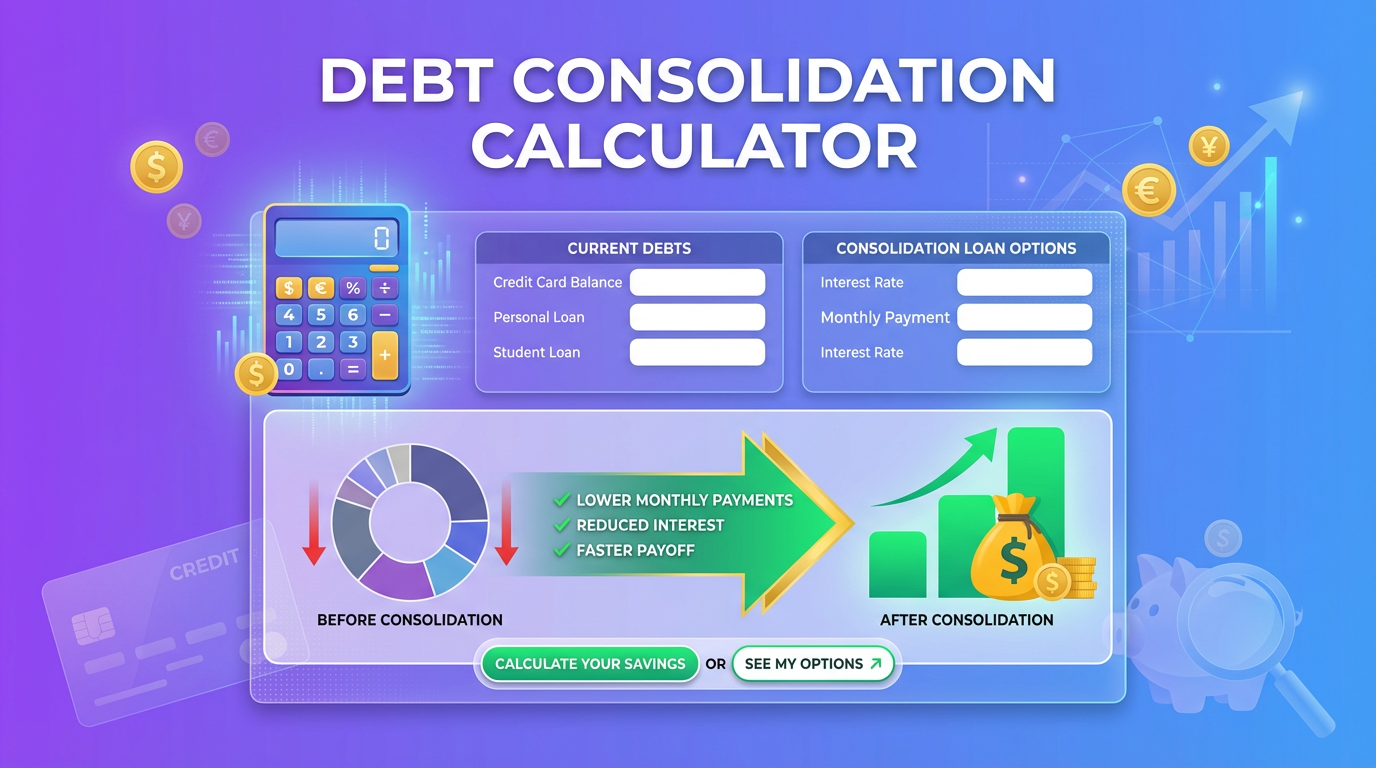
Debt Consolidation Calculator: Calculate Your Potential Savings
See how much you could save by combining high-interest debts into one lower-rate loan.
How This Debt Consolidation Calculator Works
Our debt consolidation calculator helps you determine whether combining multiple high-interest debts into a single loan could save you money. Simply enter each of your current debts—including balances, interest rates, and monthly payments—then input the terms of a potential consolidation loan to see your projected savings.
The calculator compares your current total monthly payments and interest costs against what you’d pay with a consolidated loan, showing you:
- Monthly payment difference (potential savings each month)
- Total interest savings over the life of the loan
- Time saved reaching debt freedom
- New single payment amount
Understanding Debt Consolidation
Debt consolidation combines multiple debts—typically credit cards, personal loans, and other unsecured debts—into one new loan with a single monthly payment. The goal is to secure a lower interest rate than the weighted average of your existing debts, reducing both your monthly payment and total interest paid.
According to the Federal Reserve, the average credit card APR reached 22.63% in 2024, while debt consolidation loans average between 8% and 15% for borrowers with good credit. This rate difference is where potential savings come from.
How Debt Consolidation Works
- Calculate your total debt: Add up all balances you want to consolidate
- Apply for a consolidation loan: Personal loans, home equity loans, or balance transfer cards
- Pay off existing debts: Use the new loan to pay off all individual debts
- Make one payment: Pay the single new loan until it’s paid off
Types of Debt Consolidation
| Type | Typical APR | Best For | Considerations |
|---|---|---|---|
| Personal Loan | 8-36% | Good credit, $5K-$50K debt | Fixed rate, fixed term |
| Balance Transfer Card | 0-5% (promo) | Excellent credit, payoff within 12-21 months | Reverts to high APR after promo |
| Home Equity Loan | 7-12% | Homeowners with equity | Risk losing home if default |
| 401(k) Loan | Prime + 1-2% | Emergency only | Risk retirement savings |
Debt Consolidation Calculator Examples: Real Numbers
Example 1: Credit Card Debt ($8,500)
Scenario: Sarah has three credit cards with a combined balance of $8,500.
| Debt | Balance | APR | Min Payment |
|---|---|---|---|
| Visa | $3,200 | 24.99% | $96 |
| Mastercard | $2,800 | 22.49% | $84 |
| Store Card | $2,500 | 27.99% | $75 |
| Total | $8,500 | 24.82% avg | $255/mo |
Consolidation Loan Terms: $8,500 at 11.5% APR for 48 months
Results: – New Monthly Payment: $221/month – Monthly Savings: $34/month – Total Interest (Current Path): $6,847 – Total Interest (Consolidated): $2,108 – Total Interest Saved: $4,739 – Time to Payoff: 48 months (vs. 76 months paying minimums)
Example 2: Mixed Debt ($18,000)
Scenario: Marcus has accumulated $18,000 across credit cards and a personal loan.
| Debt | Balance | APR | Monthly Payment |
|---|---|---|---|
| Chase Freedom | $5,500 | 21.99% | $165 |
| Citi Card | $4,200 | 23.74% | $126 |
| Capital One | $3,800 | 26.99% | $114 |
| Personal Loan | $4,500 | 15.99% | $175 |
| Total | $18,000 | 21.68% avg | $580/mo |
Consolidation Loan Terms: $18,000 at 10.5% APR for 60 months
Results: – New Monthly Payment: $386/month – Monthly Savings: $194/month – Total Interest (Current Path): $14,892 – Total Interest (Consolidated): $5,160 – Total Interest Saved: $9,732 – Annual Savings: $2,328
Example 3: High Debt Load ($35,000)
Scenario: Jennifer and David have $35,000 in combined credit card debt from medical bills and overspending.
| Debt | Balance | APR | Monthly Payment |
|---|---|---|---|
| Amex | $12,000 | 19.99% | $360 |
| Discover | $8,500 | 24.49% | $255 |
| Wells Fargo | $6,000 | 21.99% | $180 |
| Medical Card | $5,500 | 26.99% | $165 |
| Store Cards | $3,000 | 29.99% | $90 |
| Total | $35,000 | 23.12% avg | $1,050/mo |
Consolidation Loan Terms: $35,000 at 9.99% APR for 60 months
Results: – New Monthly Payment: $743/month – Monthly Savings: $307/month – Total Interest (Current Path): $31,456 – Total Interest (Consolidated): $9,580 – Total Interest Saved: $21,876 – 5-Year Savings: $18,420 (payments) + $21,876 (interest)
Example 4: Excellent Credit Scenario ($12,000)
Scenario: Michael has good payment history and a 760 credit score.
| Debt | Balance | APR | Monthly Payment |
|---|---|---|---|
| Credit Card 1 | $7,000 | 18.99% | $210 |
| Credit Card 2 | $5,000 | 20.99% | $150 |
| Total | $12,000 | 19.82% avg | $360/mo |
Consolidation Loan Terms: $12,000 at 7.49% APR for 48 months (excellent credit rate)
Results: – New Monthly Payment: $290/month – Monthly Savings: $70/month – Total Interest (Current Path): $7,234 – Total Interest (Consolidated): $1,920 – Total Interest Saved: $5,314
Example 5: Fair Credit Scenario ($15,000)
Scenario: Amanda has a 640 credit score and qualifies for higher rates.
| Debt | Balance | APR | Monthly Payment |
|---|---|---|---|
| Various Cards | $15,000 | 24.99% avg | $450 |
Consolidation Loan Terms: $15,000 at 18.99% APR for 60 months (fair credit rate)
Results: – New Monthly Payment: $391/month – Monthly Savings: $59/month – Total Interest (Current Path): $12,847 – Total Interest (Consolidated): $8,460 – Total Interest Saved: $4,387
Note: Even with fair credit, consolidation can still save money if your current rates exceed the consolidation rate.
When Debt Consolidation Makes Sense
Debt consolidation typically benefits you when:
✓ Your credit score qualifies you for a lower rate – Generally, you need a score of 670+ to get rates significantly below credit card APRs. Scores of 720+ unlock the best rates (7-12%).
✓ Your total debt is manageable – Consolidation works best for $5,000-$50,000 in unsecured debt. Larger amounts may require home equity or other secured options.
✓ You can pay off the loan in 3-5 years – Extending repayment beyond 5 years often negates interest savings due to longer compounding.
✓ You won’t rack up new debt – Consolidation fails if you continue using credit cards after paying them off with the loan.
✓ Your debt-to-income ratio is under 40% – Lenders typically require DTI below 40-43% for approval.
When to Consider Alternatives
Debt consolidation isn’t always the best solution:
Balance Transfer Cards may be better if: – You have excellent credit (740+) – Your debt is under $10,000 – You can pay it off within 15-21 months – You qualify for 0% APR promotional offers
Debt Snowball/Avalanche may be better if: – You can’t qualify for lower rates – You have 2-3 small debts you can quickly eliminate – You need psychological wins to stay motivated
Debt Management Plans may be better if: – Your credit is too low for consolidation loans – You’re already behind on payments – You need structured support and creditor negotiations
Debt Settlement or Bankruptcy may be better if: – Your debt exceeds 50% of annual income – You’re already severely delinquent – You have no assets to protect
How to Get Started with Debt Consolidation
Step 1: Know Your Numbers List all debts with balances, interest rates, and monthly payments. Calculate your weighted average interest rate.
Step 2: Check Your Credit Score Free services like Credit Karma or AnnualCreditReport.com show your score. This determines what rates you’ll qualify for.
Step 3: Shop Multiple Lenders Compare offers from: – Banks and credit unions – Online lenders (SoFi, LightStream, Discover) – Peer-to-peer platforms (LendingClub, Prosper)
Step 4: Get Pre-Qualified Most lenders offer soft-pull pre-qualification that doesn’t affect your credit score. Compare rates before applying.
Step 5: Apply and Fund Once approved, many lenders pay your creditors directly. Others deposit funds for you to pay off debts yourself.
Step 6: Close or Freeze Old Accounts Prevent future overspending by closing or freezing paid-off credit cards (keep oldest accounts open for credit score).
Frequently Asked Questions
What credit score do I need for debt consolidation✓
Most lenders require a minimum credit score of 580-620 for debt consolidation loans, but you’ll need 670 or higher to qualify for competitive rates. Borrowers with scores of 720+ typically receive the best rates between 7-12% APR. If your score is below 580, consider a secured loan, credit union, or debt management plan instead.
How much can I save with debt consolidation✓
Savings depend on the rate difference between your current debts and the consolidation loan. On average, borrowers consolidating $15,000 in credit card debt at 22% APR into a loan at 11% APR save approximately $6,000-$8,000 in interest over a 5-year term. Use our calculator above with your specific numbers for an accurate estimate.
Does debt consolidation hurt my credit score✓
Initially, your score may drop 5-10 points due to the hard inquiry and new account. However, consolidation typically improves your score over time by: – Reducing credit utilization (if you keep cards open) – Establishing consistent payment history – Diversifying your credit mix
Most borrowers see score improvements within 3-6 months of consolidating.
What’s the difference between debt consolidation and debt settlement✓
Debt consolidation means taking a new loan to pay off existing debts in full—you repay 100% of what you owe at a lower interest rate. Your credit remains intact.
Debt settlement means negotiating with creditors to pay less than you owe—typically 40-60% of the balance. This severely damages your credit (100+ point drop) and may have tax consequences on forgiven debt.
Can I consolidate debt with bad credit✓
Yes, but options are limited: – Secured loans: Use a car or savings as collateral for lower rates – Credit unions: Often more flexible than banks for members – Co-signer loans: A creditworthy co-signer can help you qualify – Debt management plans: Nonprofit credit counselors negotiate lower rates with creditors without a loan
Avoid high-interest “bad credit” loans that charge 25%+ APR—these rarely save money versus your current debts.
How long does debt consolidation take✓
The application process takes 1-7 days depending on the lender. Online lenders often provide same-day approval and funding within 1-3 business days. Banks and credit unions may take 1-2 weeks. The actual debt payoff depends on your loan term—typically 36-60 months for most consolidation loans.
Should I close credit cards after consolidating✓
Generally, no. Closing cards reduces your available credit and increases utilization ratio, which can hurt your score. Instead: – Keep accounts open, especially older ones – Cut up the physical cards or freeze them – Set up a small recurring charge (like Netflix) to keep accounts active – Pay in full each month to avoid new debt
Exception: Close cards with annual fees you no longer want to pay.
What debts can I consolidate✓
Most commonly consolidated debts include: – ✓ Credit cards – ✓ Personal loans – ✓ Medical bills – ✓ Store credit cards – ✓ Payday loans – ✓ Private student loans (sometimes)
Debts typically not consolidated: – ✗ Federal student loans (use federal programs instead) – ✗ Mortgages (refinance instead) – ✗ Auto loans (refinance instead) – ✗ Tax debt (IRS has payment plans) – ✗ Court-ordered payments
Is debt consolidation the same as a personal loan✓
Debt consolidation is a use for a personal loan, not a different product. When you take a personal loan specifically to pay off multiple debts, that’s debt consolidation. The loan itself is the same fixed-rate, fixed-term installment loan used for home improvements, large purchases, or other purposes.
Will I actually save money with debt consolidation✓
You’ll save money if: 1. Your consolidation APR is lower than your current weighted average APR 2. You don’t extend your repayment timeline significantly 3. You avoid accumulating new debt on paid-off cards
You won’t save money if: 1. The new rate is similar to or higher than current rates 2. You extend repayment from 3 years to 7+ years 3. Fees (origination, prepayment) are excessive 4. You continue spending on credit cards
Use our calculator to compare your specific scenario.
What are the risks of debt consolidation✓
Potential risks include: – Extended repayment: Longer terms mean more total interest despite lower rates – Fees: Some loans charge 1-8% origination fees – Collateral loss: Secured loans (home equity) risk losing your asset – New debt accumulation: Paid-off cards tempt overspending – Credit score dip: Temporary decrease from hard inquiry
Mitigation strategies: – Choose shortest affordable term – Compare total cost including fees – Avoid secured loans if possible – Cut up or freeze old cards – Monitor credit for 6 months post-consolidation
How do I calculate if debt consolidation is worth it✓
Follow this formula:
- Current total interest: Add up interest you’ll pay on all debts if you continue current payments
- Consolidated interest: Calculate interest on the new loan (payment × months – principal)
- Fees: Add any origination fees to consolidated cost
- Compare: If (Consolidated interest + Fees) < Current total interest, consolidation saves money
Our calculator does this math automatically—enter your debts above to see your personalized results.
Related Calculators
Explore these tools to optimize your debt payoff strategy:
- Credit Card Payoff Calculator – See how extra payments accelerate your payoff
- Debt Snowball vs Avalanche Calculator – Compare debt payoff strategies
- Debt-to-Income Calculator – Check if you qualify for a consolidation loan
- Balance Transfer Calculator – Compare 0% APR transfer offers
This calculator provides estimates for educational purposes only. Actual rates, terms, and savings depend on your credit score, income, and lender requirements. Consult a financial advisor for personalized advice.