
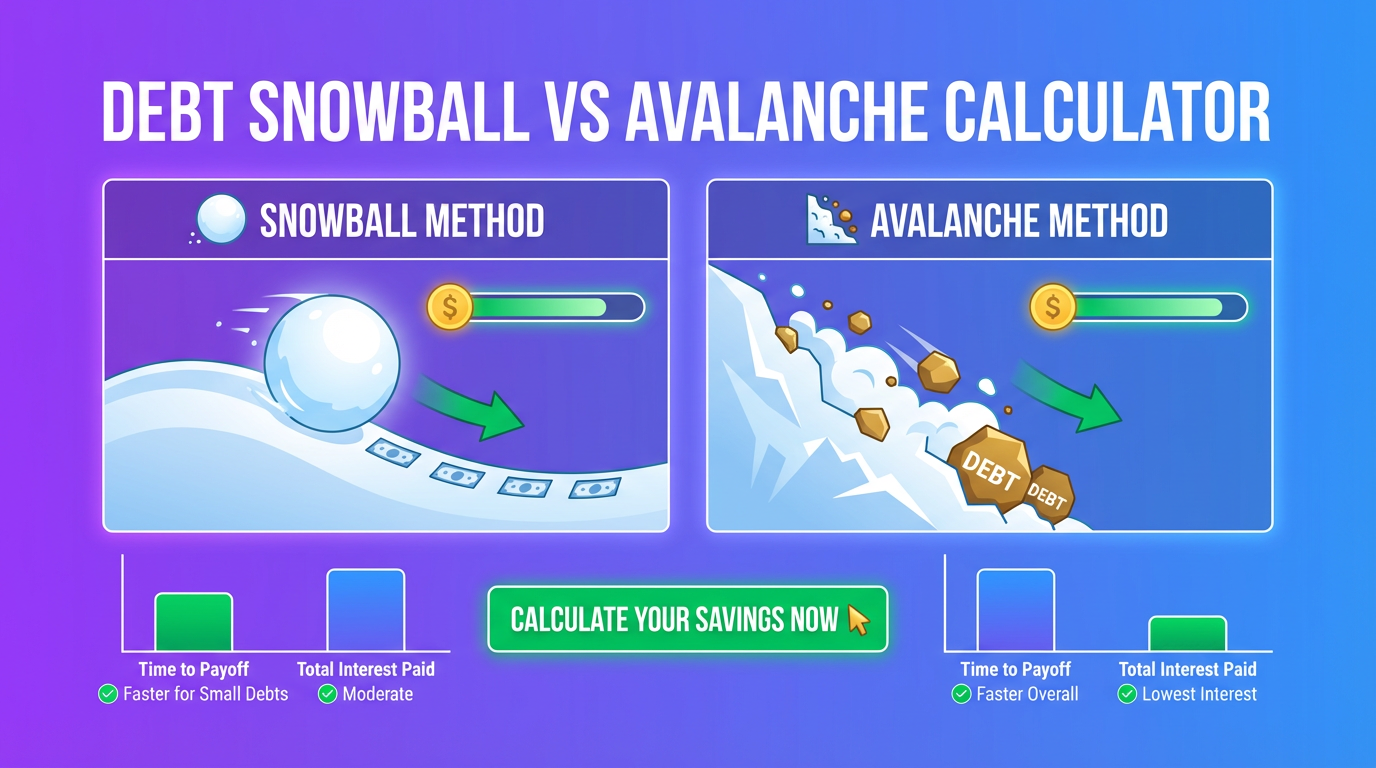
Debt Snowball vs Avalanche Calculator: Find Your Best Strategy
Compare the debt snowball (smallest first) and avalanche (highest rate first) methods to find your best strategy.
How This Debt Snowball vs Avalanche Calculator Works
Our calculator compares two proven debt payoff strategies side-by-side using your actual debt information. Enter each of your debts—including balances, interest rates, and minimum payments—plus any extra monthly amount you can pay, and instantly see:
- Total payoff time for each strategy
- Total interest paid with snowball vs avalanche
- Money saved by choosing one method over the other
- Payoff order showing which debts to attack first
- Monthly payment schedule for each approach
The calculator shows you exactly how much the “mathematically optimal” avalanche method saves versus the “psychologically motivating” snowball method—so you can make an informed choice.
Understanding Debt Snowball vs Avalanche
Both strategies share the same core principle: pay minimums on all debts, then focus all extra money on one debt at a time until it’s eliminated. The difference is which debt you target first.
The Debt Snowball Method
Strategy: Pay off debts from smallest balance to largest, regardless of interest rate.
How it works: 1. List all debts from smallest to largest balance 2. Pay minimums on everything 3. Put all extra money toward the smallest balance 4. When that’s paid off, roll that payment to the next smallest 5. Repeat until debt-free
Why it works: Quick wins create momentum. Eliminating a debt in 2-3 months feels rewarding and motivates you to continue. Behavioral economists call this the “progress principle.”
The Debt Avalanche Method
Strategy: Pay off debts from highest interest rate to lowest, regardless of balance.
How it works: 1. List all debts from highest to lowest APR 2. Pay minimums on everything 3. Put all extra money toward the highest-APR debt 4. When that’s paid off, roll that payment to the next highest APR 5. Repeat until debt-free
Why it works: Mathematics. Attacking the highest rate first minimizes total interest paid over time. This is the optimal strategy for saving money.
Head-to-Head Comparison
| Factor | Snowball | Avalanche |
|---|---|---|
| First Target | Smallest balance | Highest APR |
| Interest Saved | Less | More |
| Psychological Wins | Faster, more frequent | Slower, less frequent |
| Time to First Payoff | Usually shorter | Often longer |
| Total Payoff Time | Slightly longer | Slightly shorter |
| Best For | Motivation-driven people | Numbers-driven people |
Debt Snowball vs Avalanche Examples: Real Numbers
Example 1: Classic 4-Debt Scenario ($18,500 Total)
Scenario: Amanda has four debts and can pay $600/month total.
| Debt | Balance | APR | Minimum | Snowball Order | Avalanche Order |
|---|---|---|---|---|---|
| Store Card | $1,200 | 26.99% | $36 | 1st | 1st |
| Visa | $4,300 | 22.49% | $129 | 2nd | 2nd |
| Personal Loan | $5,500 | 11.99% | $125 | 3rd | 4th |
| Mastercard | $7,500 | 19.99% | $225 | 4th | 3rd |
| Total | $18,500 | — | $515 | — | — |
Extra Payment Available: $85/month ($600 – $515 minimums)
Snowball Results (Smallest to Largest): – Order: Store Card → Visa → Personal Loan → Mastercard – Time to Debt-Free: 38 months (3.2 years) – Total Interest Paid: $5,147 – First Debt Eliminated: Month 6
Avalanche Results (Highest APR to Lowest): – Order: Store Card → Visa → Mastercard → Personal Loan – Time to Debt-Free: 37 months (3.1 years) – Total Interest Paid: $4,821 – First Debt Eliminated: Month 6
Comparison: – Avalanche saves: $326 in interest – Avalanche saves: 1 month – First payoff is the same (Store Card is both smallest AND highest APR)
Example 2: When Snowball and Avalanche Differ Dramatically ($25,000 Total)
Scenario: Marcus has debts where the smallest balance has the lowest rate.
| Debt | Balance | APR | Minimum | Snowball Order | Avalanche Order |
|---|---|---|---|---|---|
| Credit Union Loan | $2,000 | 8.99% | $75 | 1st | 4th |
| Medical Bill | $3,500 | 0% | $100 | 2nd | 5th |
| Chase Card | $6,000 | 24.99% | $180 | 3rd | 1st |
| Discover Card | $5,500 | 21.99% | $165 | 4th | 2nd |
| Car Loan | $8,000 | 14.99% | $200 | 5th | 3rd |
| Total | $25,000 | — | $720 | — | — |
Extra Payment Available: $280/month ($1,000 total budget – $720 minimums)
Snowball Results: – Order: Credit Union → Medical → Chase → Discover → Car – Time to Debt-Free: 32 months (2.7 years) – Total Interest Paid: $6,892 – First Debt Eliminated: Month 4 ✓ Quick win! – Second Debt Eliminated: Month 9
Avalanche Results: – Order: Chase → Discover → Car → Credit Union → Medical – Time to Debt-Free: 30 months (2.5 years) – Total Interest Paid: $5,634 – First Debt Eliminated: Month 11 (longer wait)
Comparison: – Avalanche saves: $1,258 in interest – Avalanche saves: 2 months – Snowball advantage: First payoff 7 months sooner (Month 4 vs Month 11)
The Psychological Trade-off: Is $1,258 in savings worth waiting 7 extra months for your first win✓ For some people, the early snowball wins prevent giving up entirely.
Example 3: High-Interest Credit Card Heavy ($32,000 Total)
Scenario: Jennifer has mostly high-interest credit card debt.
| Debt | Balance | APR | Minimum | Snowball Order | Avalanche Order |
|---|---|---|---|---|---|
| Amazon Card | $1,800 | 27.99% | $54 | 1st | 2nd |
| Best Buy Card | $2,400 | 29.99% | $72 | 2nd | 1st |
| Amex | $8,500 | 22.49% | $255 | 3rd | 3rd |
| Capital One | $9,300 | 24.99% | $279 | 4th | 4th |
| Student Loan | $10,000 | 6.99% | $115 | 5th | 5th |
| Total | $32,000 | — | $775 | — | — |
Extra Payment Available: $425/month ($1,200 total budget)
Snowball Results: – Time to Debt-Free: 34 months (2.8 years) – Total Interest Paid: $8,234 – First Debt Eliminated: Month 3 – Second Debt Eliminated: Month 6
Avalanche Results: – Time to Debt-Free: 33 months (2.75 years) – Total Interest Paid: $7,891 – First Debt Eliminated: Month 4 – Second Debt Eliminated: Month 7
Comparison: – Avalanche saves: $343 in interest – Avalanche saves: 1 month – Snowball advantage: First payoff 1 month sooner
Key Insight: When APRs are clustered together (all high), the difference between methods shrinks. Both work well here.
Example 4: Mixed Debt with Low Extra Payment ($15,000 Total)
Scenario: David has limited extra money to throw at debt.
| Debt | Balance | APR | Minimum | Snowball Order | Avalanche Order |
|---|---|---|---|---|---|
| Dental Bill | $800 | 0% | $50 | 1st | 4th |
| Store Card | $1,500 | 28.99% | $45 | 2nd | 1st |
| Visa | $5,200 | 19.99% | $156 | 3rd | 2nd |
| Auto Loan | $7,500 | 7.49% | $175 | 4th | 3rd |
| Total | $15,000 | — | $426 | — | — |
Extra Payment Available: Only $74/month ($500 total budget)
Snowball Results: – Time to Debt-Free: 42 months (3.5 years) – Total Interest Paid: $3,287 – First Debt Eliminated: Month 7
Avalanche Results: – Time to Debt-Free: 40 months (3.3 years) – Total Interest Paid: $2,845 – First Debt Eliminated: Month 14
Comparison: – Avalanche saves: $442 in interest – Avalanche saves: 2 months – Snowball advantage: First payoff 7 months sooner
Key Insight: With limited extra funds, avalanche savings are more significant because it takes longer to pay off any debt. But waiting 14 months for a win is psychologically difficult.
Example 5: Near-Identical Results ($20,000 Total)
Scenario: Sarah’s debts happen to align where both methods are similar.
| Debt | Balance | APR | Minimum | Order (Both) |
|---|---|---|---|---|
| Card A | $3,000 | 24.99% | $90 | 1st |
| Card B | $5,000 | 22.99% | $150 | 2nd |
| Card C | $5,500 | 20.99% | $165 | 3rd |
| Card D | $6,500 | 18.99% | $195 | 4th |
| Total | $20,000 | — | $600 | — |
Extra Payment Available: $200/month ($800 total)
Both Methods: Because debts are ordered from smallest-to-largest AND highest-to-lowest APR, the methods produce identical results!
- Time to Debt-Free: 30 months (2.5 years)
- Total Interest Paid: $5,124
- First Debt Eliminated: Month 7
Key Insight: When your smallest debts also have your highest rates, you get the best of both worlds. If this isn’t your situation, consider which factor matters more to you: savings or motivation.
Which Strategy Is Right for You✓
Choose Debt Snowball If:
✓ You need quick wins to stay motivated – If seeing progress keeps you going, snowball delivers faster emotional rewards.
✓ You’ve tried and failed before – Past debt payoff attempts that fizzled may indicate you need the psychological boost of early wins.
✓ Your smallest debts aren’t much smaller than others – If eliminating them only takes 1-2 months longer than avalanche, the motivation benefit may outweigh the cost.
✓ You’re an emotional decision-maker – Nothing wrong with this! Financial success requires sticking with a plan, and snowball increases follow-through.
✓ The interest difference is small – If avalanche only saves a few hundred dollars over 3+ years, choose whichever keeps you committed.
Choose Debt Avalanche If:
✓ You’re motivated by math and efficiency – If seeing “optimal” calculations drives you, avalanche satisfies that need.
✓ You have high discipline – If you’ll stick with a plan regardless of quick wins, capture the extra savings.
✓ The interest difference is significant – When avalanche saves $1,000+ over snowball, the math is hard to ignore.
✓ Your highest-rate debt is also high-balance – This means you’d be waiting a long time for a snowball win anyway.
✓ You have a long payoff timeline – The longer you’re in debt, the more avalanche savings compound.
Consider a Hybrid Approach If:
✓ You want one quick win, then optimization – Pay off one small debt for momentum, then switch to avalanche for the rest.
✓ You have a tiny debt under $500 – Eliminate it immediately regardless of rate, then use avalanche.
✓ Two debts have similar rates – Pay the smaller one first (acts as both snowball and avalanche).
The Research: What Studies Say
Dave Ramsey’s Snowball Success
Financial educator Dave Ramsey popularized the snowball method, citing thousands of success stories from his followers. His argument: “Personal finance is 80% behavior, 20% math.” The best plan is the one you’ll actually complete.
Harvard Business Review Study (2016)
Researchers found that people who focused on paying off small debts first were more likely to eliminate their overall debt. The study of 6,000 HelloWallet users showed that the psychological benefit of “small wins” increased persistence.
Northwestern University Study (2012)
This study found that consumers with larger numbers of accounts (not larger balances) were more likely to be in debt. Eliminating accounts—which snowball does faster—may provide psychological closure that helps overall financial behavior.
The Mathematical Reality
Pure math favors avalanche. A 2019 analysis found that avalanche saves the average debtor $1,000-$2,000 over snowball for typical debt loads. However, this assumes perfect adherence—which studies show is less likely with avalanche.
The Verdict: Avalanche is mathematically superior, but snowball has higher completion rates. Choose based on self-knowledge.
How to Get Started
Step 1: List All Debts Gather account information: – Creditor name – Current balance – Interest rate (APR) – Minimum payment
Step 2: Determine Extra Payment Amount Review your budget. How much beyond minimums can you commit monthly✓ Even $50-$100 makes a significant difference.
Step 3: Run Both Scenarios Use our calculator above to compare snowball vs avalanche with your actual numbers. Note the difference in time, interest, and first payoff date.
Step 4: Choose Your Strategy Consider: – How much does avalanche save✓ – How much longer until avalanche’s first payoff✓ – What’s your track record with financial goals✓
Step 5: Execute Relentlessly Whichever method you choose, success requires: – Paying minimums on all debts (on time!) – Applying all extra money to your target debt – Rolling payments to the next debt when one is eliminated – Avoiding new debt accumulation
Step 6: Celebrate Milestones When you pay off a debt, celebrate! Then immediately redirect that payment to your next target.
Frequently Asked Questions
What is the debt snowball method✓
The debt snowball method is a debt payoff strategy where you pay off debts in order from smallest balance to largest, regardless of interest rate. You pay minimums on all debts, then put every extra dollar toward the smallest debt. When it’s paid off, you “roll” that payment to the next smallest debt, creating a snowball effect of increasingly larger payments.
The snowball method was popularized by Dave Ramsey and is designed for psychological motivation—quick wins from eliminating small debts build momentum to tackle larger ones.
What is the debt avalanche method✓
The debt avalanche method pays off debts in order from highest interest rate to lowest, regardless of balance size. You pay minimums on all debts, then direct all extra money toward the highest-APR debt first. When it’s eliminated, you move to the next highest rate.
The avalanche method is mathematically optimal—it minimizes total interest paid over time. Financial advisors often recommend this approach for pure savings, though it may take longer to see your first debt eliminated.
Which method saves more money: snowball or avalanche✓
Avalanche always saves more money (or ties with snowball). By attacking the highest interest rate first, you reduce the amount of interest that compounds over time.
Typical savings range from $300 to $2,000+ depending on: – Total debt amount – Spread between highest and lowest APRs – How different the balance order is from the APR order – Payoff timeline length
Use our calculator to see the exact difference for your situation.
Which method is faster: snowball or avalanche✓
Avalanche is usually faster by 1-3 months for most debt loads, because you’re paying less total interest.
However, snowball produces faster first wins. You might eliminate your first debt in 3 months with snowball versus 8 months with avalanche—even though total payoff takes slightly longer.
If “faster” means “first debt gone sooner,” snowball often wins. If “faster” means “completely debt-free sooner,” avalanche usually wins.
Can I switch between snowball and avalanche✓
Absolutely! Many people use a hybrid approach:
- Start with snowball – Pay off 1-2 small debts for quick wins and motivation
- Switch to avalanche – Once you have momentum, optimize for savings
This captures the psychological benefit of early wins while still saving money on remaining high-interest debt. There’s no rule requiring you to stick with one method forever.
What if my smallest debt has the highest interest rate✓
Lucky you—both methods are identical! When your smallest balance also has the highest APR, snowball and avalanche produce the same payoff order. You get quick wins AND optimal savings.
This alignment happens more often than you’d think, especially if you have store credit cards (typically small balances, high rates).
How much extra should I pay toward debt✓
Any extra helps, but more is better:
| Extra Monthly | Impact on $15,000 Debt |
|---|---|
| $50 | Saves ~$2,500 interest, 12+ months |
| $100 | Saves ~$4,000 interest, 18+ months |
| $200 | Saves ~$5,500 interest, 24+ months |
| $300 | Saves ~$6,500 interest, 30+ months |
Even $25/month extra makes a difference. The key is consistency—pick an amount you can sustain for years.
Does the snowball method work for large debts✓
Yes, but it requires patience. If your smallest debt is $5,000, it might take 8-12 months to eliminate—not exactly a “quick win.”
Strategies for large debts: – Find any tiny debt (even $200) to knock out first – Set intermediate milestones (celebrate every $1,000 paid) – Consider one 0% balance transfer to create a “smallest debt” – Use avalanche if no small wins are available
What debts should I include in snowball/avalanche✓
Include all debts where you control the payment amount: – ✓ Credit cards – ✓ Personal loans – ✓ Medical debt – ✓ Student loans (private and federal) – ✓ Auto loans – ✓ Store credit cards – ✓ Family loans
Typically exclude: – ✗ Mortgage (too large, handled separately) – ✗ 0% promotional debts (may be strategic to pay last)
Should I include my mortgage in debt snowball✓
Most experts say no for the initial snowball/avalanche plan. Mortgages are: – Much larger than consumer debts – Lower interest rates (often 3-7%) – Provide tax deductions – Secured by an appreciating asset
Recommended approach: 1. Pay off all consumer debt first (snowball or avalanche) 2. Build emergency fund (3-6 months expenses) 3. Increase retirement savings 4. Then consider extra mortgage payments
Exception: If your mortgage rate is higher than investment returns (rare), prioritizing it may make sense.
What if I can only afford minimum payments✓
If you have zero extra money, neither snowball nor avalanche helps immediately. Focus on:
- Increasing income – Side hustles, overtime, selling items
- Cutting expenses – Cancel subscriptions, reduce dining out
- Balance transfers – Move debt to 0% APR cards
- Debt consolidation – Lower your overall rate
- Debt management plan – Nonprofit credit counselors may negotiate lower rates
Even $25-$50/month extra starts the snowball or avalanche rolling.
How do I stay motivated during debt payoff✓
For snowball users: – Celebrate each debt elimination – Track the number of debts remaining (watching it decrease) – Visualize with a chart or thermometer
For avalanche users: – Track total interest saved versus original projection – Calculate your “hourly wage” from interest savings – Focus on the finish line, not individual debts
For everyone: – Tell someone your goal (accountability) – Automate payments (removes decision fatigue) – Review progress monthly – Remember why you started
Related Calculators
Explore more tools for your debt-free journey:
- Credit Card Payoff Calculator – See how extra payments accelerate a single card
- Debt Consolidation Calculator – Compare consolidating versus snowball/avalanche
- Multiple Debt Optimizer – Advanced algorithm for optimal payoff order
- Financial Freedom Date Calculator – Calculate your exact debt-free date
This calculator provides estimates for educational purposes only. Actual results depend on consistent payments and avoiding new debt. The best debt payoff strategy is the one you’ll actually complete.