
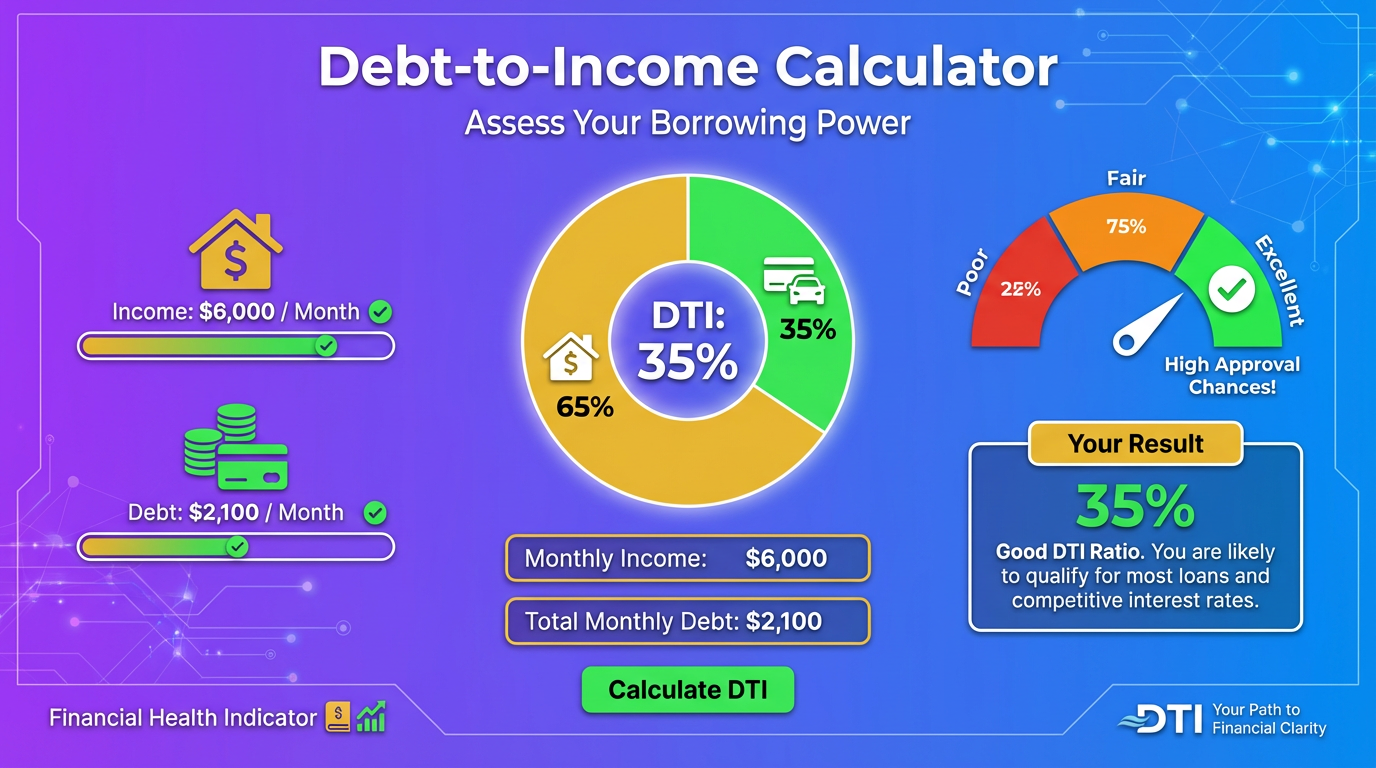
Debt-to-Income Ratio Calculator: Know Where You Stand
Calculate your debt-to-income ratio to understand your financial health and loan eligibility.
How This Debt-to-Income Ratio Calculator Works
Our DTI calculator determines what percentage of your gross monthly income goes toward debt payments. Enter your monthly income and all recurring debt obligations to instantly see:
- Your DTI ratio as a percentage
- How lenders view your ratio (excellent, good, fair, or needs improvement)
- Loan qualification likelihood for mortgages, auto loans, and personal loans
- How much room you have for additional borrowing
- Specific recommendations to improve your ratio
Understanding your DTI is crucial for qualifying for loans, especially mortgages, where lenders have strict DTI requirements.
Understanding Debt-to-Income Ratio
Your debt-to-income ratio compares your total monthly debt payments to your gross monthly income (before taxes). It’s expressed as a percentage and is one of the most important numbers lenders use to evaluate your ability to manage monthly payments.
The DTI Formula
DTI = (Total Monthly Debt Payments ÷ Gross Monthly Income) × 100
Example: – Monthly debt payments: $2,000 – Gross monthly income: $6,000 – DTI = ($2,000 ÷ $6,000) × 100 = 33.3%
Two Types of DTI
Lenders often calculate two versions:
Front-End DTI (Housing Ratio) – Only includes housing costs (mortgage/rent, property taxes, insurance, HOA) – Used primarily for mortgage qualification – Ideal: Below 28%
Back-End DTI (Total DTI) – Includes ALL monthly debt obligations – The number most commonly referenced – Ideal: Below 36%
What Counts as Debt for DTI✓
Included in DTI: – ✓ Mortgage or rent payment – ✓ Property taxes and homeowner’s insurance – ✓ HOA fees – ✓ Car payments – ✓ Student loan payments – ✓ Credit card minimum payments – ✓ Personal loan payments – ✓ Child support/alimony – ✓ Other loan payments
NOT Included in DTI: – ✗ Utilities (electric, gas, water) – ✗ Phone and internet bills – ✗ Groceries and food – ✗ Health insurance premiums – ✗ Car insurance – ✗ Entertainment and subscriptions – ✗ Savings contributions
DTI Ratio Ranges: What Lenders Want
DTI Rating Scale
| DTI Range | Rating | Loan Qualification | Lender Perception |
|---|---|---|---|
| Below 20% | Excellent | Easy approval, best rates | Low risk borrower |
| 20-35% | Good | Likely approval, competitive rates | Manageable debt load |
| 36-43% | Fair | Approval possible, may need strong factors | Moderate risk |
| 44-49% | Needs Work | Difficult approval, limited options | Higher risk |
| 50%+ | Poor | Unlikely approval without changes | Too much debt |
Lender-Specific Requirements
Conventional Mortgages: – Maximum DTI: 43-45% (with strong credit) – Preferred DTI: 36% or below – Front-end (housing): 28% or below
FHA Loans: – Maximum DTI: 43% standard, up to 50% with compensating factors – More flexible for lower credit scores – Front-end: 31% or below
VA Loans: – No official maximum DTI – Guideline: 41% but exceptions common – Residual income matters more than DTI
Personal Loans: – Maximum DTI: 40-50% depending on lender – Online lenders may accept higher DTI – Credit score often matters more
Auto Loans: – Maximum DTI: 45-50% typically – More flexible than mortgages – Income verification may be less strict
Debt-to-Income Calculator Examples: Real Numbers
Example 1: Excellent DTI – First-Time Homebuyer ($75,000 Income)
Scenario: Jessica earns $75,000/year and wants to know if she can qualify for a mortgage.
Monthly Income: – Gross Monthly Income: $6,250
Current Monthly Debts: | Debt | Monthly Payment | |——|—————–| | Car Payment | $385 | | Student Loans | $275 | | Credit Card Minimums | $120 | | Total Debt Payments | $780 |
Current DTI Calculation: – DTI = $780 ÷ $6,250 = 12.5%
Rating: Excellent ✓
Mortgage Qualification: – Available DTI room (to reach 43%): 43% – 12.5% = 30.5% – Maximum housing payment: $6,250 × 30.5% = $1,906/month – Estimated home price (at 7% rate, 30-year): $285,000-$300,000
Jessica is in an excellent position to buy a home with plenty of room for a mortgage payment.
Example 2: Good DTI – Considering Debt Consolidation ($60,000 Income)
Scenario: Marcus earns $60,000/year and wants to know if he qualifies for a consolidation loan.
Monthly Income: – Gross Monthly Income: $5,000
Current Monthly Debts: | Debt | Monthly Payment | |——|—————–| | Rent | $1,200 | | Car Payment | $425 | | Credit Cards | $380 | | Student Loans | $200 | | Total Debt Payments | $2,205 |
Current DTI Calculation: – DTI = $2,205 ÷ $5,000 = 44.1%
Rating: Needs Work ⚠
Consolidation Loan Qualification: – Many lenders cap DTI at 40-45% for personal loans – Marcus is at the edge—approval depends on credit score – If credit score is 700+: Likely approved – If credit score is below 670: May be declined
If Marcus Consolidates $8,000 in Credit Cards at Lower Payment: – Old credit card payments: $380/month – New consolidation loan payment: $185/month (60 months at 11%) – New Total Debt: $2,010/month – New DTI: 40.2% (improved by 4 percentage points)
Example 3: Borderline DTI – Mortgage Stretch ($95,000 Income)
Scenario: The Johnsons earn $95,000 combined and want to buy a $400,000 home.
Monthly Income: – Gross Monthly Income: $7,917
Current Monthly Debts: | Debt | Monthly Payment | |——|—————–| | Car Payment #1 | $475 | | Car Payment #2 | $380 | | Student Loans | $450 | | Credit Cards | $185 | | Total Current Debt | $1,490 |
Current DTI (before mortgage): – DTI = $1,490 ÷ $7,917 = 18.8%
Proposed Mortgage Payment: – Home Price: $400,000 – Down Payment: $40,000 (10%) – Loan Amount: $360,000 – Rate: 7% – Monthly P&I: $2,395 – Taxes & Insurance: $450 – Total Housing Payment: $2,845
DTI with New Mortgage: – Total Debt: $1,490 + $2,845 = $4,335 – DTI = $4,335 ÷ $7,917 = 54.8%
Rating: Too High ✗
The Problem: At 54.8% DTI, they won’t qualify for this mortgage.
Solutions: 1. Smaller home: $300,000 home = $2,150 payment = 46% DTI (still high) 2. Pay off car: Eliminate $475 payment = 48.8% DTI (borderline) 3. Larger down payment: $80,000 down = $2,480 payment = 50.2% DTI 4. Wait and pay down debt: Reduce current debts by $800/month first
Example 4: High DTI – Warning Signs ($52,000 Income)
Scenario: Amanda is struggling with payments and wants to understand why.
Monthly Income: – Gross Monthly Income: $4,333
Current Monthly Debts: | Debt | Monthly Payment | |——|—————–| | Rent | $1,400 | | Car Payment | $520 | | Credit Cards | $475 | | Personal Loan | $325 | | Student Loans | $280 | | Total Debt Payments | $3,000 |
Current DTI Calculation: – DTI = $3,000 ÷ $4,333 = 69.2%
Rating: Critical 🚨
Analysis: – Nearly 70% of gross income goes to debt – After taxes (~25%), take-home is ~$3,250 – Debt payments ($3,000) leave only $250 for everything else – Utilities, food, gas, insurance must come from somewhere – This situation is unsustainable
Immediate Actions Needed: 1. Increase income: Side hustle, overtime, second job 2. Reduce housing cost: Find roommate, move to cheaper place 3. Sell the car: Replace with cheaper transportation 4. Debt management plan: Nonprofit credit counseling 5. Consider all options: Including debt settlement or bankruptcy consultation
Example 5: Improving DTI for Future Goals ($85,000 Income)
Scenario: David wants to buy a house in 12 months and needs to improve his DTI.
Current Situation:
Monthly Income: – Gross Monthly Income: $7,083
Current Monthly Debts: | Debt | Balance | Monthly Payment | |——|———|—————–| | Rent | — | $1,500 | | Car Payment | $18,000 | $485 | | Credit Card 1 | $4,500 | $135 | | Credit Card 2 | $3,200 | $96 | | Student Loans | $32,000 | $340 | | Total | — | $2,556 |
Current DTI: – DTI = $2,556 ÷ $7,083 = 36.1%
Target Mortgage: – Home Price: $350,000 – Estimated Payment: $2,400 – Required DTI: Under 43% – Available Room: 43% – 36.1% = 6.9% = $489/month – Problem: Can’t fit $2,400 mortgage into $489 of DTI room
12-Month Improvement Plan:
Step 1: Pay Off Credit Cards (Months 1-8) – Focus extra $500/month on cards – After 8 months: Both cards paid off – Monthly payments eliminated: $231
Step 2: Continue Car Payments – After 12 months: ~$12,000 remaining – Monthly payment: $485 (unchanged)
Step 3: New DTI at Month 12 – Debts: $1,500 (rent) + $485 (car) + $340 (student loans) = $2,325 – DTI without mortgage: 32.8% – Room for mortgage: 43% – 32.8% = 10.2% = $722
Still Not Enough!
Enhanced Plan – Also Pay Down Car: – Extra $500 to cards (months 1-8) – Extra $500 to car (months 9-12) – Car balance at month 12: ~$10,000 – Refinance car: $200/month payment
Final DTI at Month 12: – Debts: $1,500 + $200 + $340 = $2,040 – DTI: 28.8% – Room for mortgage: 14.2% = $1,005/month
Better, but still tight. David may need to: – Consider a less expensive home ($250,000-$280,000) – Save a larger down payment – Wait 18-24 months instead of 12
How to Lower Your Debt-to-Income Ratio
Strategy 1: Pay Down Debt (Reduces Numerator)
Impact: Every debt you pay off directly reduces your DTI.
Priority Order for DTI Improvement: 1. Small balances you can eliminate quickly – Removes entire payment from calculation 2. High-payment debts – $400 car payment vs. $50 credit card minimum 3. Debts with few payments left – If you have 6 payments left, knock it out
Example: – Current DTI: 42% on $6,000 income – Pay off $3,000 credit card (was $90/month minimum) – New DTI: 40.5% (1.5 percentage points better)
Strategy 2: Increase Income (Increases Denominator)
Impact: Higher income lowers your DTI even without paying off debt.
Options: – Negotiate a raise – Take on overtime – Start a side hustle – Get a second part-time job – Rent out a spare room (counts as income)
Example: – Current: $2,500 debt ÷ $5,000 income = 50% DTI – Add $1,000/month income: $2,500 ÷ $6,000 = 41.7% DTI – Same debt, but now qualifies for loans
Strategy 3: Refinance to Lower Payments
Impact: Lower monthly payments mean lower DTI, even if balance stays the same.
Options: – Refinance auto loan to longer term – Refinance student loans for lower payment – Consolidate credit cards at lower rate – Switch to income-driven student loan plan
Example: – Car payment: $550/month (48 months remaining) – Refinance to 72 months: $380/month – DTI reduction: $170/month = 2.8 percentage points on $6,000 income
Caution: Extending loan terms means more total interest paid.
Strategy 4: Avoid New Debt
Impact: Every new loan increases your DTI.
Before Major Purchases: – Will this new payment push DTI over lender limits✓ – Can I delay until after mortgage approval✓ – Is this purchase necessary right now✓
Timing Tip: Don’t buy a car, furniture, or other financed items right before applying for a mortgage.
Strategy 5: Add a Co-Borrower
Impact: A co-borrower’s income is added to the calculation.
Example: – Your income: $5,000/month – Combined debts: $2,500/month – Your DTI: 50% (too high) – Add spouse with $4,000/month income – Combined DTI: $2,500 ÷ $9,000 = 27.8% (excellent)
Caution: Co-borrower is equally responsible for the debt.
DTI for Different Loan Types
Mortgage DTI Requirements
Conventional Loans (Fannie Mae/Freddie Mac): – Maximum: 43-45% with strong compensating factors – Preferred: 36% or below – Front-end (housing only): 28% ideal
Compensating Factors That Allow Higher DTI: – Credit score above 740 – Large cash reserves (6+ months payments) – Down payment of 20%+ – Stable employment history (2+ years) – Low loan-to-value ratio
FHA Loans: – Standard maximum: 43% – With compensating factors: Up to 50% – More lenient for first-time buyers – Manual underwriting may allow exceptions
VA Loans: – No hard DTI limit – Guideline: 41% – Residual income requirement matters more – Very flexible for veterans
Jumbo Loans: – Stricter requirements: 38-43% typically – Higher credit score requirements – Larger reserves required
Personal Loan DTI Requirements
| Lender Type | Typical Max DTI | Notes |
|---|---|---|
| Banks | 35-40% | Most conservative |
| Credit Unions | 40-45% | Member-focused, flexible |
| Online Lenders | 40-50% | Varies widely by lender |
| Peer-to-Peer | 45-50%+ | Highest DTI tolerance |
Auto Loan DTI Requirements
Auto lenders are generally more flexible: – Typical maximum: 45-50% – Subprime lenders: May accept 50%+ – Focus more on payment-to-income for the specific car – May approve high DTI with large down payment
Credit Card DTI Requirements
Credit card issuers don’t publish DTI limits, but they consider: – Total debt relative to income – Existing credit utilization – Payment history – Credit score is primary factor
Frequently Asked Questions
What is a good debt-to-income ratio✓
A good DTI is 35% or below. Here’s the breakdown:
| DTI | Rating | What It Means |
|---|---|---|
| Below 20% | Excellent | Very low debt, easy loan approval |
| 20-35% | Good | Healthy finances, competitive rates |
| 36-43% | Fair | Manageable, may limit options |
| 44-49% | High | Difficult approvals, higher rates |
| 50%+ | Too High | Unlikely approval, financial stress |
For mortgage qualification specifically, lenders prefer 43% or below, with 36% or below considered ideal.
How do I calculate my debt-to-income ratio✓
Formula: (Total Monthly Debt Payments ÷ Gross Monthly Income) × 100
Step 1: Add up all monthly debt payments: – Mortgage/rent – Car payments – Student loans – Credit card minimums – Personal loans – Child support/alimony
Step 2: Determine gross monthly income (before taxes): – Annual salary ÷ 12, or – Hourly rate × hours × 4.33
Step 3: Divide and multiply by 100
Example: $2,000 debts ÷ $5,500 income = 0.364 × 100 = 36.4% DTI
What is the maximum DTI for a mortgage✓
Maximum DTI varies by loan type:
- Conventional: 43-45% (50% with strong compensating factors)
- FHA: 43% standard, up to 50% with compensating factors
- VA: No official maximum, 41% guideline
- USDA: 41% standard, up to 44% with compensating factors
- Jumbo: 38-43% typically
Most borrowers should target 36% or below for the best rates and easiest approval process.
Does rent count in debt-to-income ratio✓
For mortgage applications: Your current rent is not counted because it will be replaced by the mortgage payment. Lenders calculate DTI using the proposed mortgage payment instead.
For other loans (personal, auto, credit cards): Yes, rent is included in your DTI because you’ll continue paying it.
Key distinction: When you’re applying for a mortgage, lenders care about what your DTI will be after you have the mortgage, not before.
What debts are included in DTI✓
Included: – Mortgage or rent (for non-mortgage loans) – Car loans/leases – Student loans (federal and private) – Credit card minimum payments – Personal loans – Home equity loans/HELOCs – Child support and alimony – Any other installment loans – Co-signed loan payments
Not Included: – Utilities (electric, gas, water, trash) – Cell phone bills – Internet/cable – Insurance premiums (except homeowner’s if bundled with mortgage) – Groceries and household expenses – Entertainment subscriptions – Gym memberships – Savings contributions
How can I lower my DTI quickly✓
Fastest methods:
Pay off small debts entirely – Eliminating a $1,500 credit card removes that $45 minimum from your DTI immediately
Increase income – A raise, bonus, or side income increases the denominator
Refinance to lower payments – Extending an auto loan term reduces monthly payment (but costs more total interest)
Pay down credit cards – Lower balances = lower minimum payments = lower DTI
Avoid new debt – Don’t finance anything new before a major loan application
Example quick win: Pay off a $2,000 credit card with $60 minimum payment. On $5,000 monthly income, that’s a 1.2 percentage point DTI reduction.
Does DTI affect my credit score✓
No, DTI does not directly affect your credit score. Credit bureaus don’t know your income, so they can’t calculate DTI.
However, related factors do affect your score: – Credit utilization (balance vs. credit limit) – Similar concept, major score factor – Payment history – Missing payments due to high DTI hurts your score – New credit inquiries – Applying for loans to manage DTI creates hard pulls
Think of DTI and credit score as two separate qualifications lenders evaluate.
What’s the difference between DTI and credit utilization✓
| Factor | DTI | Credit Utilization |
|---|---|---|
| Formula | Debt payments ÷ Income | Credit card balance ÷ Credit limit |
| Measures | Ability to afford payments | How much credit you’re using |
| Ideal | Below 36% | Below 30% (under 10% is best) |
| Affects Credit Score | No | Yes (major factor) |
| Includes Income | Yes | No |
| Used By | Lenders for loan decisions | Credit bureaus for scoring |
Both matter for loan approval, but they measure different things.
Can I get a mortgage with 50% DTI✓
It’s difficult but possible in specific circumstances:
FHA Loans: May allow up to 50% DTI with: – Credit score of 580+ – Significant cash reserves – Stable employment history – Low loan-to-value ratio – Manual underwriting approval
Compensating Factors That Help: – Credit score above 720 – Large down payment (20%+) – 6+ months of mortgage payments in savings – Minimal payment shock (new payment similar to current rent) – Additional income sources
Better Strategy: Work to lower DTI below 43% before applying. You’ll get better rates and easier approval.
Should I pay off debt or save for a down payment✓
It depends on your current DTI:
If DTI is above 43%: – Focus on paying down debt first – You won’t qualify for most mortgages anyway – Lower DTI = better rates when you do qualify
If DTI is below 36%: – Balance between debt payoff and saving – A larger down payment can mean better terms – Consider paying off small debts while saving
If DTI is 36-43%: – Pay off debts that would push you under 36% – Then focus on down payment – Eliminate any payments you can before applying
General Rule: Every $100 in monthly debt payments reduces your buying power by approximately $15,000-$20,000 in home price.
How much house can I afford based on DTI✓
Quick Calculation:
- Find your gross monthly income
- Multiply by 0.28 (front-end ratio) for housing payment estimate
- Multiply by 0.36 (back-end ratio) and subtract current debts for maximum housing
Example: $7,000 monthly income, $1,000 in current debts – Front-end (28%): $7,000 × 0.28 = $1,960 max housing – Back-end (36%): $7,000 × 0.36 = $2,520 – $1,000 debts = $1,520 max housing – Conservative estimate: $1,520/month for mortgage
Home Price Estimate: At 7% interest rate, $1,520/month (including taxes/insurance) supports approximately: – 30-year mortgage: $220,000-$240,000 home price – 15-year mortgage: $160,000-$180,000 home price
What if my spouse has high DTI but good income✓
Options when applying together:
- Apply jointly anyway – Combined income may overcome
combined debt
- Your income: $5,000, DTI: 25%
- Spouse income: $4,000, DTI: 55%
- Combined: $9,000, DTI: ~38% (may work)
- One spouse applies alone – Use only the lower-DTI
spouse’s income
- Works if that spouse qualifies alone
- Other spouse can still be on title
- May limit loan amount
- Pay down spouse’s debt first – Get their DTI in
line before applying
- Focus extra money on their highest-payment debts
- May delay purchase by 6-12 months
Consult a lender to run scenarios with your specific numbers.
Related Calculators
Explore more financial planning tools:
- Debt Consolidation Calculator – See if consolidation can lower your DTI
- Budget Optimizer Calculator – Find money to pay down debt faster
- Credit Card Payoff Calculator – Plan to eliminate credit card debt
- Loan vs Credit Card Calculator – Compare financing options for purchases
This calculator provides estimates for educational purposes only. Actual loan qualification depends on multiple factors including credit score, employment history, assets, and lender requirements. Consult with a mortgage professional or lender for personalized guidance.