
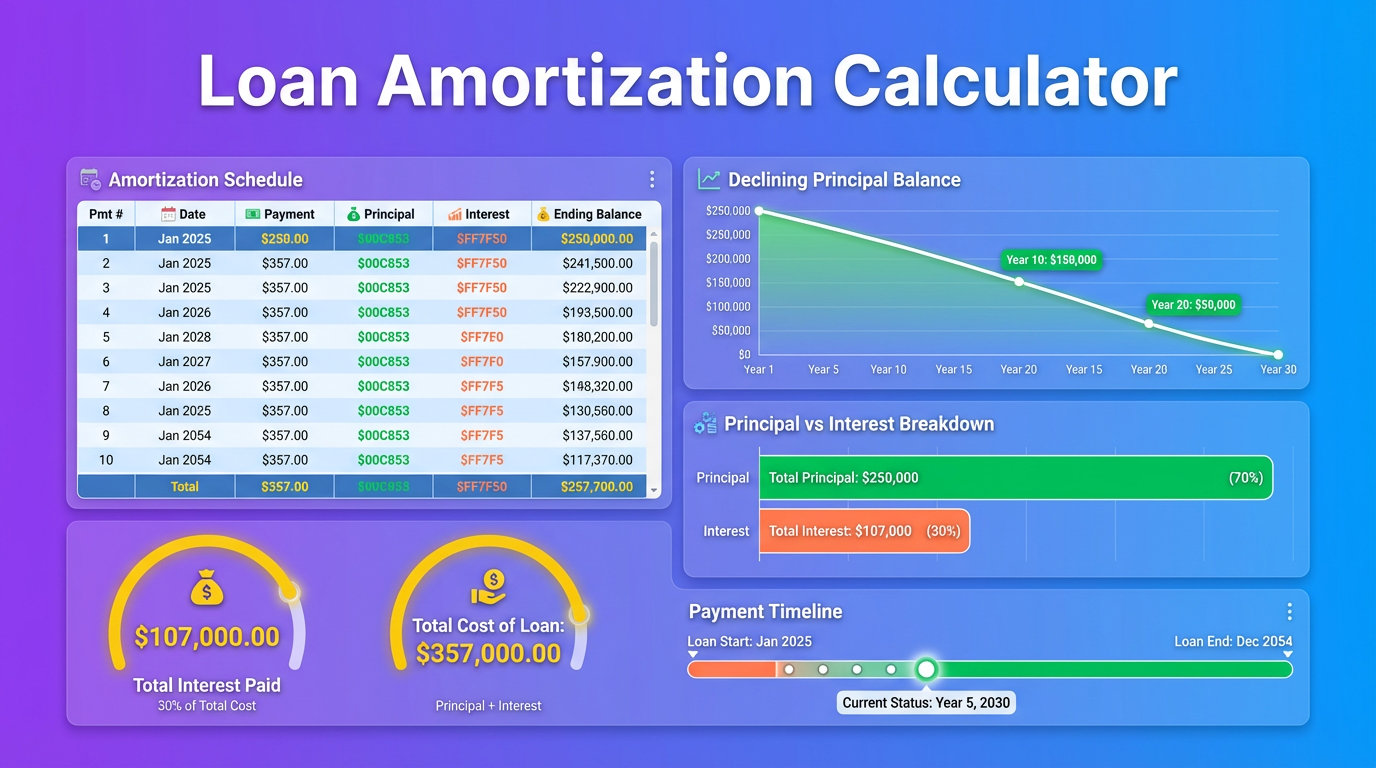
Loan Amortization Calculator: Understand Your Payments
See your complete loan payment schedule and how extra payments accelerate payoff.
How This Loan Amortization Calculator Works
Our amortization calculator creates a complete payment schedule for any loan, showing:
- Payment breakdown – Principal vs. interest each month
- Remaining balance – After each payment
- Total interest paid – Over the life of the loan
- Extra payment impact – How additional payments shorten your loan
- Visual charts – See your payoff progress
Understand exactly where your money goes with every single payment.
What Is Loan Amortization✓
The Basic Concept
Amortization is the process of spreading loan payments over time with a specific structure:
- Early payments: Mostly interest, little principal
- Later payments: Mostly principal, little interest
- Payment amount: Stays the same (for fixed-rate loans)
- Composition: Shifts from interest-heavy to principal-heavy
Why Amortization Matters
Understanding amortization helps you:
- See the true cost of borrowing – Total interest over the loan’s life
- Understand why balances drop slowly at first – Front-loaded interest
- Make strategic extra payments – Know when they help most
- Compare loan options – Term length impact
- Plan refinancing decisions – When it makes sense
The Amortization Formula
For the mathematically curious:
Monthly Payment = P × [r(1+r)^n] / [(1+r)^n - 1]

Where:
P = Principal (loan amount)
r = Monthly interest rate (annual rate ÷ 12)
n = Total number of payments
Amortization Examples: Visualizing Your Payments
Example 1: Auto Loan ($28,000 over 5 years)
Loan Details: – Principal: $28,000 – APR: 6.5% – Term: 60 months – Monthly Payment: $548
Amortization Snapshot:
| Payment # | Payment | Principal | Interest | Balance |
|---|---|---|---|---|
| 1 | $548 | $396 | $152 | $27,604 |
| 12 | $548 | $423 | $125 | $23,057 |
| 24 | $548 | $453 | $95 | $17,850 |
| 36 | $548 | $485 | $63 | $12,362 |
| 48 | $548 | $519 | $29 | $6,579 |
| 60 | $548 | $545 | $3 | $0 |
Key Observations: – Payment 1: 28% goes to principal, 72% to interest – Payment 60: 99% goes to principal, 1% to interest
Totals: – Total Paid: $32,880 – Total Interest: $4,880 – Principal: $28,000
Example 2: Mortgage ($320,000 over 30 years)
Loan Details: – Principal: $320,000 – APR: 6.5% – Term: 360 months – Monthly Payment: $2,022
Amortization Snapshot:
| Year | Payment | Principal | Interest | Balance |
|---|---|---|---|---|
| 1 | $2,022 | $288 | $1,734 | $316,535 |
| 5 | $2,022 | $350 | $1,672 | $299,257 |
| 10 | $2,022 | $461 | $1,561 | $273,456 |
| 15 | $2,022 | $607 | $1,415 | $237,872 |
| 20 | $2,022 | $799 | $1,223 | $189,003 |
| 25 | $2,022 | $1,052 | $970 | $121,576 |
| 30 | $2,022 | $2,011 | $11 | $0 |
The Shocking Reality: – Year 1: Only 14% of payment reduces principal – After 10 years (⅓ of loan): Still owe 85% of original balance – After 15 years (½ of loan): Still owe 74% of original balance
Totals: – Total Paid: $727,920 – Total Interest: $407,920 – Principal: $320,000
You pay 127% of the home’s price in interest alone!
Example 3: 30-Year vs 15-Year Mortgage ($320,000)
30-Year Mortgage: – APR: 6.5% – Monthly Payment: $2,022 – Total Interest: $407,920
15-Year Mortgage: – APR: 6.0% (shorter terms often have lower rates) – Monthly Payment: $2,700 – Total Interest: $165,993
Comparison:
| Metric | 30-Year | 15-Year | Difference |
|---|---|---|---|
| Monthly Payment | $2,022 | $2,700 | +$678 |
| Total Interest | $407,920 | $165,993 | -$241,927 |
| Total Paid | $727,920 | $485,993 | -$241,927 |
| Payoff Date | 30 years | 15 years | -15 years |
Trade-off: Pay $678 more per month, save $241,927 and 15 years.
Example 4: Personal Loan ($15,000 over 3 years)
Loan Details: – Principal: $15,000 – APR: 12% – Term: 36 months – Monthly Payment: $498
Amortization Snapshot:
| Payment # | Payment | Principal | Interest | Balance |
|---|---|---|---|---|
| 1 | $498 | $348 | $150 | $14,652 |
| 6 | $498 | $366 | $132 | $13,122 |
| 12 | $498 | $391 | $107 | $10,571 |
| 18 | $498 | $418 | $80 | $7,786 |
| 24 | $498 | $446 | $52 | $4,754 |
| 30 | $498 | $477 | $21 | $1,458 |
| 36 | $498 | $493 | $5 | $0 |
Totals: – Total Paid: $17,928 – Total Interest: $2,928 – Principal: $15,000
Interest as % of principal: 19.5%
Example 5: Impact of Extra Payments ($320,000 mortgage)
Base Loan: – Principal: $320,000 – APR: 6.5% – Term: 30 years – Payment: $2,022
Extra Payment Scenarios:
| Strategy | Monthly Extra | Total Extra | Time Saved | Interest Saved |
|---|---|---|---|---|
| No extra | $0 | $0 | 0 | $0 |
| +$100/mo | $100 | $26,400 | 4 yrs 2 mo | $74,234 |
| +$200/mo | $200 | $44,800 | 7 yrs 3 mo | $123,456 |
| +$500/mo | $500 | $78,500 | 12 yrs 1 mo | $199,789 |
| +1 extra payment/year | $168 | $50,568 | 5 yrs 6 mo | $89,456 |
Best ROI: Each $100 extra saves nearly $75,000 in a typical mortgage!
Early vs. Late Extra Payments: – $10,000 extra in Year 1: Saves ~$42,000 in interest – $10,000 extra in Year 15: Saves ~$12,000 in interest
Why✓ Early extra payments avoid compounding interest for longer.
Understanding Your Amortization Schedule
The First Payment Problem
Your first mortgage payment on a $320,000 loan at 6.5%: – Total payment: $2,022 – To principal: $288 (14%) – To interest: $1,734 (86%)
After your first payment, you’ve paid $2,022 but only reduced your debt by $288.
The Turning Point
The “crossover point” is when more goes to principal than interest.
| Loan Type | Typical Crossover |
|---|---|
| 30-year mortgage | Year 19-22 |
| 15-year mortgage | Year 6-8 |
| 5-year auto loan | Month 28-32 |
| 3-year personal loan | Month 14-18 |
Why This Matters
Refinancing consideration: If you’re 15 years into a 30-year mortgage, you’ve paid most of the interest. Refinancing to a new 30-year restarts the clock on interest.
Example: – Original loan: $320,000, 30 years, 6.5% – After 15 years: Balance is $237,872, paid $147,036 in interest – New 30-year at same rate: Adds $235,000 MORE in interest
Extra Payment Strategies
Strategy 1: Fixed Monthly Extra
Add a fixed amount to every payment:
| Extra Amount | Best For |
|---|---|
| $25-$50 | Tight budget, starting out |
| $100-$200 | Moderate savings goal |
| $500+ | Aggressive payoff goal |
Benefit: Simple, automatic, consistent results
Strategy 2: One Extra Payment Per Year
Pay 13 payments instead of 12:
Methods: – Divide monthly payment by 12, add to each payment – Make full extra payment annually (tax refund, bonus) – Bi-weekly payments (26 half-payments = 13 full payments)
Impact on $320,000 mortgage: Saves ~$89,000, pays off 5.5 years early
Strategy 3: Lump Sum Payments
Apply windfalls directly to principal:
| Windfall | Typical Amount | Impact on $320K Mortgage |
|---|---|---|
| Tax refund | $3,000 | Saves $9,000+ |
| Work bonus | $5,000 | Saves $15,000+ |
| Inheritance | $10,000 | Saves $30,000+ |
| Side gig income | $500/mo | Saves $150,000+ |
Key: Apply to principal, not escrow or next payment
Strategy 4: Bi-Weekly Payments
Pay half your payment every two weeks:
- 26 half-payments per year
- Equals 13 full payments (vs. 12 monthly)
- Same as one extra payment annually
Warning: Some lenders charge fees for bi-weekly programs. You can achieve the same result by adding 1/12 to each monthly payment.
Amortization by Loan Type
Mortgage Amortization
Typical terms: 15, 20, 30 years Key considerations: – Front-loaded interest makes early payoff valuable – PMI can be removed at 80% LTV – Refinancing restarts amortization clock
Auto Loan Amortization
Typical terms: 36, 48, 60, 72, 84 months Key considerations: – Depreciation vs. amortization (underwater risk) – Shorter terms = less total interest – Longer terms = lower payments but more interest
Personal Loan Amortization
Typical terms: 12, 24, 36, 60 months Key considerations: – Higher rates = more front-loaded interest – Origination fees affect true cost – Prepayment penalties may apply
Student Loan Amortization
Typical terms: 10, 20, 25 years Key considerations: – Standard 10-year minimizes interest – Extended terms lower payments but increase total cost – Income-driven plans have different structures
Frequently Asked Questions
What does amortization mean✓
Amortization is the process of paying off debt through regular payments over time. Each payment covers: 1. Interest on the remaining balance 2. Principal to reduce the balance
The schedule shows how each payment splits between interest and principal over the loan’s life.
Why do early payments have so much interest✓
Interest is calculated on the remaining balance: – Large balance = large interest charge – As balance decreases, interest decreases – Fixed payment means more goes to principal over time
Example: $300,000 at 6% = $1,500/month interest. After balance drops to $150,000, interest is only $750/month.
How do extra payments help✓
Extra payments go directly to principal: – Reduce balance immediately – Lower all future interest calculations – Shorten loan term – Save more when made early
Compounding effect: $100 extra on a mortgage can save $300+ in avoided interest.
Is it better to pay extra or invest✓
Compare rates: – Mortgage rate: 6.5% (guaranteed “return” by paying off) – Investment return: 7-10% (historical average, not guaranteed)
Considerations: | Factor | Favor Payoff | Favor Investing | |——–|————–|—————–| | Risk tolerance | Low | High | | Rate difference | Loan rate high | Investment return higher | | Tax situation | Non-deductible interest | Tax-advantaged accounts | | Psychology | Debt-free peace of mind | Wealth building |
Balanced approach: Fund retirement match, then attack debt, then invest more.
What happens to my schedule if I refinance✓
Refinancing resets your amortization: – New loan starts with front-loaded interest – Previous progress on principal/interest shift lost – Lower rate may still save money overall
Consider: If 15 years into 30-year mortgage, much interest already paid. Refinancing to new 30-year extends interest payments.
How do I calculate my own amortization✓
For each payment: 1. Interest = Balance × (Annual Rate ÷ 12) 2. Principal = Payment – Interest 3. New Balance = Balance – Principal 4. Repeat for next payment
Or use this calculator for instant results!
Does paying principal-only help✓
Yes! Principal-only payments: – Reduce balance without paying interest – Lower all future interest charges – Must specify “apply to principal” with most lenders
Some lenders apply extra payments to future payments instead. Always confirm how extra payments are applied.
Why does my balance barely decrease at first✓
Example on $300,000 mortgage at 6.5%:
| Month | Payment | To Principal | Balance Reduction % |
|---|---|---|---|
| 1 | $1,896 | $271 | 0.09% |
| 60 | $1,896 | $358 | 0.13% |
| 120 | $1,896 | $474 | 0.19% |
Early payments: 85%+ goes to interest, not principal. This is normal for amortization—but frustrating!
What is negative amortization✓
Negative amortization occurs when payments don’t cover interest: – Unpaid interest adds to balance – Balance grows instead of shrinking – Common in some adjustable-rate mortgages
Avoid loans with negative amortization risk unless you fully understand the structure.
How does loan term affect total interest✓
Dramatic impact:
| $300K Loan at 6.5% | Monthly | Total Interest |
|---|---|---|
| 15-year | $2,613 | $170,406 |
| 20-year | $2,242 | $237,961 |
| 30-year | $1,896 | $382,633 |
30-year costs 2.2× more interest than 15-year!
Can I create my own amortization schedule✓
Yes, using spreadsheet:
Column A: Payment number Column B: Beginning balance Column C: Payment amount Column D: Interest (B × rate/12) Column E: Principal (C – D) Column F: Ending balance (B – E)
Copy formulas down for each payment period.
What’s the difference between amortization and depreciation✓
| Term | Applies To | Meaning |
|---|---|---|
| Amortization | Loans/Intangible assets | Spreading cost over time |
| Depreciation | Physical assets | Decline in value over time |
For vehicles: Your loan amortizes (balance decreases) while the car depreciates (loses value). If depreciation outpaces amortization, you’re “underwater.”
Related Calculators
Understand your complete loan picture:
- Refinancing Calculator – See if refinancing saves money
- Debt Consolidation Calculator – Combine multiple loans
- Personal Loan vs Credit Card – Compare financing options
- Credit Card Payoff Calculator – Plan debt elimination
This calculator provides amortization schedules based on standard loan calculations. Actual payments may vary based on fees, escrow, and lender-specific terms. Always verify with your lender.