
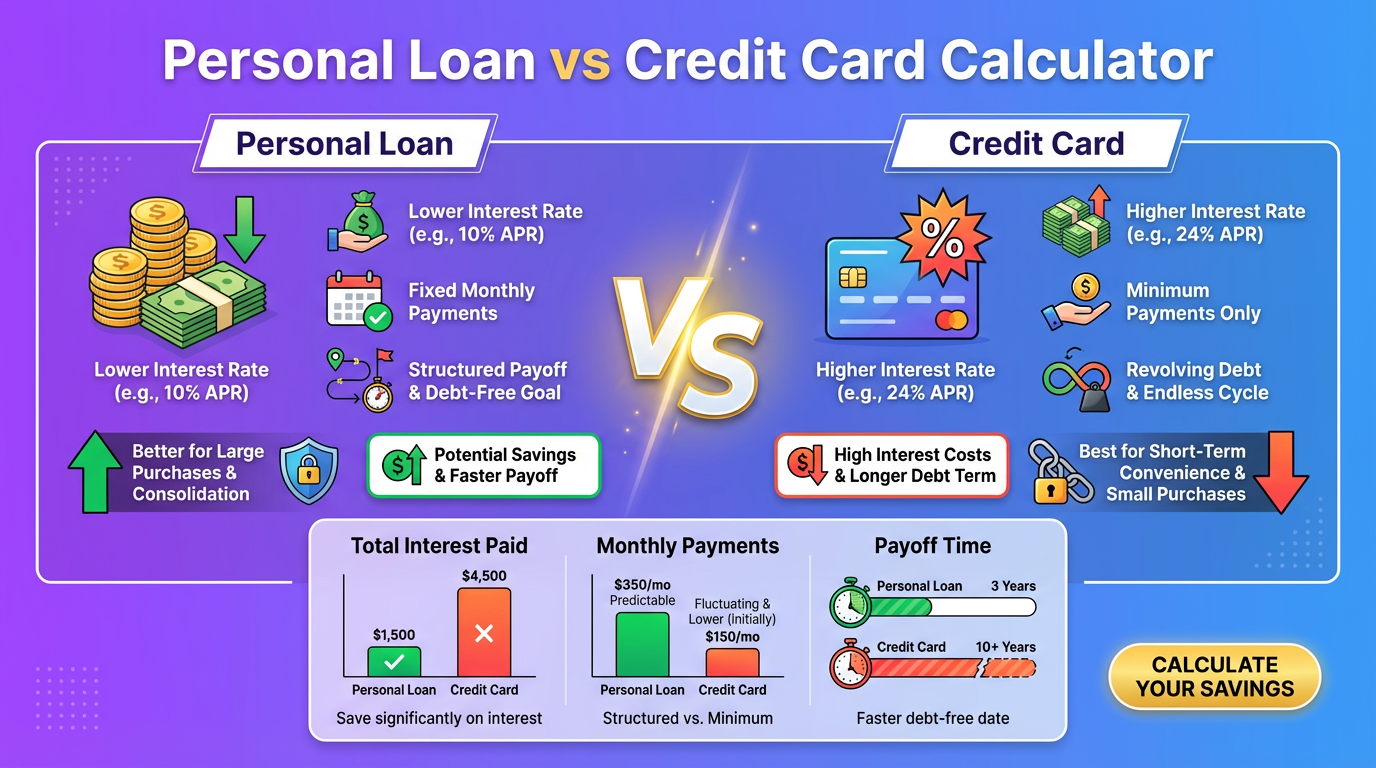
Personal Loan vs Credit Card: Find the Cheaper Option
Compare the true cost of paying with a personal loan vs credit card.
How This Loan vs Credit Card Calculator Works
Our comparison calculator helps you decide between a personal loan and credit card for financing by showing:
- Total cost comparison – Interest paid over the life of each option
- Monthly payment differences – What you’ll pay each month
- Payoff timeline – How long each option takes
- Break-even analysis – When one option becomes better than the other
- Recommendation – Which option makes sense for your situation
Stop guessing. See the actual numbers for your specific situation.
Personal Loans vs Credit Cards: Key Differences
At a Glance
| Factor | Personal Loan | Credit Card |
|---|---|---|
| Interest Rate | 6-36% (fixed) | 15-30% (variable) |
| Payment | Fixed monthly | Flexible minimum |
| Term | 1-7 years | Indefinite |
| Credit Impact | Hard inquiry + new account | Hard inquiry (if new) |
| Funds | Lump sum upfront | Revolving credit |
| Fees | Origination (0-8%) | Annual (some cards) |
| Best For | Large, planned expenses | Smaller, flexible needs |
How Personal Loans Work
- Apply and get approved for specific amount
- Receive lump sum deposited to your account
- Fixed monthly payments over set term (12-84 months)
- Loan closed when paid off
Pros: – Lower interest rates (typically) – Fixed payment = predictable budgeting – Set payoff date – Can’t re-borrow (prevents debt cycling)
Cons: – Origination fees (1-8% common) – Less flexible – Hard inquiry affects credit – Can’t access more if needed
How Credit Cards Work
- Get approved for credit limit
- Spend up to limit as needed
- Pay any amount above minimum
- Revolving credit – can reuse as you pay down
Pros: – Flexible spending – Rewards possible (cash back, points) – 0% intro APR offers available – Use only what you need
Cons: – Higher interest rates – Variable rates can increase – Minimum payments extend debt – Easy to overspend
Personal Loan vs Credit Card Examples: Real Comparisons
Example 1: Home Improvement Project ($15,000)
Scenario: The Smiths need to replace their HVAC system and are comparing financing options.
Option A: Personal Loan – Amount: $15,000 – APR: 10.99% – Term: 48 months – Origination fee: 3% ($450)
| Metric | Value |
|---|---|
| Monthly Payment | $388 |
| Total Interest | $3,174 |
| Total Cost | $18,624 |
| Payoff Date | 48 months |
Option B: Credit Card – Amount: $15,000 – APR: 21.99% – Minimum Payment: 2% or $25 (whichever is greater)
| Payment Strategy | Monthly | Total Interest | Total Cost | Payoff Time |
|---|---|---|---|---|
| Minimums only | Starts $300, decreases | $21,456 | $36,456 | 15+ years |
| Fixed $388 (matching loan) | $388 | $6,234 | $21,234 | 54 months |
| Fixed $500 | $500 | $4,287 | $19,287 | 38 months |
Comparison Summary:
| Factor | Personal Loan | Credit Card (Fixed $388) |
|---|---|---|
| Monthly Payment | $388 | $388 |
| Total Interest | $3,174 | $6,234 |
| Total Cost | $18,624 | $21,234 |
| Savings | $2,610 | — |
Winner: Personal Loan saves $2,610 in interest with same monthly payment.
Example 2: Debt Consolidation ($12,000)
Scenario: Maria has $12,000 in credit card debt at 24.99% APR and is considering a consolidation loan.
Current Situation: – Balance: $12,000 – APR: 24.99% – Monthly payment: $350 – Time to payoff: 49 months – Total interest: $5,067
Option A: Personal Loan – Amount: $12,000 – APR: 12.99% – Term: 36 months – Origination fee: 2% ($240)
| Metric | Value |
|---|---|
| Monthly Payment | $404 |
| Total Interest | $2,304 |
| Total Cost | $14,544 |
| Payoff Date | 36 months |
Option B: Balance Transfer Card – Amount: $12,000 – 0% APR for 18 months – Transfer fee: 3% ($360) – Regular APR after promo: 22.99%
| Scenario | Total Cost | Notes |
|---|---|---|
| Pay off in 18 months ($667/mo) | $12,360 | Best outcome |
| $400/mo (balance remains after promo) | $14,892 | $4,800 remains at 22.99% |
| $350/mo (current payment) | $16,234 | $5,700 remains at 22.99% |
Comparison Summary:
| Option | Total Cost | Monthly Payment | Risk Level |
|---|---|---|---|
| Current (stay) | $17,067 | $350 | Medium |
| Personal Loan | $14,544 | $404 | Low |
| Balance Transfer (pay in 18mo) | $12,360 | $667 | Medium |
| Balance Transfer ($400/mo) | $14,892 | $400 | High |
Winner depends on discipline: – If you can pay $667/mo: Balance transfer saves most – If you prefer certainty: Personal loan is reliable – If minimum budget: Personal loan beats current situation
Example 3: Emergency Medical Bill ($5,000)
Scenario: James received a $5,000 medical bill and needs to finance it.
Option A: Personal Loan – Amount: $5,000 – APR: 14.99% – Term: 24 months – Origination fee: 5% ($250)
| Metric | Value |
|---|---|
| Monthly Payment | $242 |
| Total Interest | $558 |
| Origination Fee | $250 |
| Total Cost | $5,808 |
Option B: Existing Credit Card – Available credit: $6,000 – APR: 19.99%
| Payment Strategy | Monthly | Total Interest | Total Cost | Time |
|---|---|---|---|---|
| Minimum only | Varies | $3,845 | $8,845 | 10+ years |
| Fixed $200 | $200 | $1,024 | $6,024 | 31 months |
| Fixed $242 (matching loan) | $242 | $789 | $5,789 | 25 months |
Option C: Medical Payment Plan – Many providers offer 0% interest payment plans – $5,000 ÷ 24 months = $208/month – Total cost: $5,000
Comparison Summary:
| Option | Total Cost | Monthly | Time |
|---|---|---|---|
| Medical Payment Plan (0%) | $5,000 | $208 | 24 mo |
| Credit Card ($242/mo) | $5,789 | $242 | 25 mo |
| Personal Loan | $5,808 | $242 | 24 mo |
Winner: Medical Payment Plan if available. Otherwise, credit card slightly beats the loan (due to origination fee) if you commit to fixed payments.
Key Insight: For smaller amounts ($5,000 or less), origination fees can make personal loans less attractive.
Example 4: Large Purchase – Furniture ($8,000)
Scenario: The Parkers are furnishing their new home and comparing options.
Option A: Personal Loan – Amount: $8,000 – APR: 11.99% – Term: 36 months – Origination fee: 3% ($240)
| Metric | Value |
|---|---|
| Monthly Payment | $266 |
| Total Interest | $1,336 |
| Total Cost | $9,576 |
Option B: Store Financing (0% for 24 months) – Amount: $8,000 – 0% APR for 24 months – Deferred interest: If not paid in full, ALL interest charged retroactively at 29.99%
| Scenario | Monthly Needed | Total Cost | Risk |
|---|---|---|---|
| Paid in 24 months | $334 | $8,000 | None |
| $100 remaining at month 24 | — | $8,000 + $4,800 retroactive | $12,800 |
Option C: Rewards Credit Card – Amount: $8,000 – APR: 18.99% – Cash back: 2% ($160)
| Payment Strategy | Monthly | Total Interest | Net Cost | Time |
|---|---|---|---|---|
| $266/mo (matching loan) | $266 | $1,698 | $9,538 | 37 mo |
| $334/mo (matching store) | $334 | $1,178 | $9,018 | 28 mo |
Comparison Summary:
| Option | Total Cost | Monthly | Best If… |
|---|---|---|---|
| Store 0% (paid in full) | $8,000 | $334 | Disciplined, can afford $334/mo |
| Personal Loan | $9,576 | $266 | Want lower monthly, guaranteed |
| Credit Card + rewards | $9,018-$9,538 | $266-$334 | Have rewards card, disciplined |
Winner: Store financing IF you’re 100% certain you’ll pay in full. Otherwise, personal loan is safer.
Warning: Deferred interest is a trap. If you’re not certain, avoid it.
Example 5: Wedding Expenses ($20,000)
Scenario: Alex and Jordan need to finance part of their wedding.
Option A: Personal Loan – Amount: $20,000 – APR: 9.99% – Term: 60 months – Origination fee: 2% ($400)
| Metric | Value |
|---|---|
| Monthly Payment | $425 |
| Total Interest | $5,100 |
| Total Cost | $25,500 |
Option B: Multiple Credit Cards – Card 1: $8,000 at 18.99% – Card 2: $7,000 at 21.99% – Card 3: $5,000 at 19.99% – Average APR: ~20%
| Payment Strategy | Monthly | Total Interest | Total Cost | Time |
|---|---|---|---|---|
| Minimums only | Varies | $22,000+ | $42,000+ | 15+ years |
| Fixed $425 (matching loan) | $425 | $10,234 | $30,234 | 70 months |
| Fixed $600 | $600 | $6,123 | $26,123 | 45 months |
Option C: 0% Balance Transfer (post-wedding) – Transfer $20,000 to 0% card – Transfer fee: 3% ($600) – 0% period: 21 months
| Scenario | Monthly Needed | Total Cost |
|---|---|---|
| Paid in 21 months | $952 | $20,600 |
| $600/mo (balance remains) | $600 | ~$23,500 |
Comparison Summary:
| Option | Total Cost | Monthly | Risk |
|---|---|---|---|
| Personal Loan | $25,500 | $425 | Low |
| Credit Cards ($425/mo) | $30,234 | $425 | Medium |
| Balance Transfer (paid in 21mo) | $20,600 | $952 | Medium |
Winner: Balance transfer IF you can afford $952/month. Otherwise, personal loan saves $4,734 over credit cards with same payment.
When to Choose a Personal Loan
Personal Loan Is Better When:
✓ Amount is $5,000+ – Origination fees become proportionally smaller ✓ You want fixed payments – Predictable budgeting ✓ Your credit score qualifies for good rates – Below 12% ✓ You need discipline – Can’t re-borrow on a closed loan ✓ Timeline is 2-5 years – Structured payoff ✓ Current credit card rates are high – 20%+
Personal Loan Advantages
| Advantage | Why It Matters |
|---|---|
| Fixed rate | Know exactly what you’ll pay |
| Set end date | Guaranteed payoff timeline |
| Lower rates | Typically 10-15% less than cards |
| Single payment | Simplifies finances |
| Closed-end | Can’t rack up more debt |
When to Choose a Credit Card
Credit Card Is Better When:
✓ Amount is under $3,000 – Origination fees hurt loan value ✓ 0% intro APR available – Free financing if paid in time ✓ You’ll pay quickly – Under 12 months ✓ You want rewards – Cash back, points on purchase ✓ Need flexibility – Amount may vary ✓ Excellent payment discipline – Won’t carry balance long
Credit Card Advantages
| Advantage | Why It Matters |
|---|---|
| 0% intro offers | True free financing |
| Rewards | Earn cash back on spending |
| Flexibility | Pay any amount above minimum |
| No origination fee | No upfront cost |
| Existing credit | No new application needed |
The Hidden Costs to Consider
Personal Loan Hidden Costs
| Cost | Typical Amount | How to Avoid |
|---|---|---|
| Origination fee | 1-8% of loan | Shop for no-fee lenders |
| Prepayment penalty | Varies | Read terms, ask upfront |
| Late fees | $25-$50 | Set up autopay |
| Application fees | $0-$50 | Most reputable lenders: $0 |
Credit Card Hidden Costs
| Cost | Typical Amount | How to Avoid |
|---|---|---|
| Annual fee | $0-$550 | Use no-annual-fee cards |
| Balance transfer fee | 3-5% | Factor into calculations |
| Cash advance fee | 3-5% + higher APR | Never use cash advances |
| Late fee | $25-$40 | Set up autopay |
| Penalty APR | 29.99% | Never pay late |
| Deferred interest | All interest retroactive | Pay 0% offers in full |
Frequently Asked Questions
Is a personal loan better than a credit card✓
It depends on your situation:
| Scenario | Better Option |
|---|---|
| Large amount ($5,000+) | Personal loan |
| Small amount (<$3,000) | Credit card |
| 0% APR available | Credit card |
| Need fixed payments | Personal loan |
| High credit card rates | Personal loan |
| Want rewards | Credit card |
| Need spending discipline | Personal loan |
Neither is universally better—calculate your specific scenario.
What credit score do I need for a personal loan✓
General guidelines:
| Credit Score | Expected APR | Approval Odds |
|---|---|---|
| 720+ | 6-12% | Excellent |
| 680-719 | 12-18% | Good |
| 640-679 | 18-25% | Fair |
| Below 640 | 25-36% or denied | Poor |
Tip: Check rates without affecting score using prequalification tools.
Does a personal loan hurt your credit✓
Short-term: Small dip (5-10 points) from: – Hard inquiry – New account
Long-term: Can improve credit by: – Adding installment loan diversity – Reducing credit utilization (if consolidating cards) – Building payment history
How much can I borrow with a personal loan✓
Typical ranges:
| Lender Type | Minimum | Maximum |
|---|---|---|
| Online lenders | $1,000 | $50,000 |
| Banks | $2,000 | $100,000 |
| Credit unions | $500 | $50,000 |
Your actual limit depends on income, credit score, and debt-to-income ratio.
What’s the average personal loan interest rate✓
Current averages (2024):
| Credit Score | Average APR |
|---|---|
| Excellent (720+) | 10.3-12.5% |
| Good (690-719) | 13.5-15.5% |
| Fair (630-689) | 17.8-19.9% |
| Poor (300-629) | 28.5-32% |
Compare multiple lenders—rates vary significantly.
Can I use a credit card like a loan✓
Yes, but with cautions:
Approaches: – Balance transfer to 0% card – Large purchase on existing card – New card with introductory offer
Key differences from loan: – Variable rate (can increase) – Minimum payments can extend debt – Temptation to spend more – No fixed end date
Should I consolidate credit card debt with a personal loan✓
Usually yes, if: – Loan rate is significantly lower (5%+ difference) – You won’t rack up new credit card debt – Monthly payment fits your budget – You avoid origination fees or they’re worth it
Be cautious if: – You’ll use freed-up credit – Loan payment strains budget – Rate difference is minimal – You’ve consolidated before and re-accumulated debt
What is an origination fee✓
Definition: Upfront fee charged by lender, typically 1-8% of loan amount.
Example: – Loan amount: $10,000 – Origination fee: 3% – Fee amount: $300 – You receive: $9,700 (or fee added to loan)
Impact: Increases effective APR. A 10% loan with 3% fee is effectively ~11.5% APR.
Are personal loans tax deductible✓
Generally no, with exceptions:
| Use | Deductible✓ |
|---|---|
| Personal expenses | No |
| Home improvement | Possibly (consult tax advisor) |
| Business expenses | Yes (if business loan) |
| Investment | Potentially (investment interest) |
Credit card interest is also not tax deductible for personal use.
How fast can I get a personal loan✓
Typical timelines:
| Lender Type | Application to Funding |
|---|---|
| Online lenders | 1-3 business days |
| Banks | 3-7 business days |
| Credit unions | 2-5 business days |
Fastest options: Some online lenders offer same-day or next-day funding.
What happens if I can’t pay my personal loan✓
Consequences of default:
| Timeline | What Happens |
|---|---|
| 1-29 days late | Late fee, possible rate increase |
| 30+ days late | Reported to credit bureaus |
| 60-90 days | Collections calls, credit damage |
| 90+ days | Charge-off, sent to collections |
| Ongoing | Potential lawsuit, wage garnishment |
If struggling: Contact lender immediately. Many offer hardship programs.
Can I pay off a personal loan early✓
Usually yes, but check for: – Prepayment penalties – Some lenders charge for early payoff – How interest is calculated – Precomputed vs simple interest
Simple interest loans: Pay early, save interest Precomputed interest: May owe all interest regardless
Always ask before signing: “Is there a prepayment penalty✓”
Related Calculators
Make the best financing decision:
- Debt Consolidation Calculator – See full consolidation savings
- Credit Card Payoff Calculator – Plan credit card payoff
- Balance Transfer Calculator – Evaluate 0% offers
- Loan Amortization Calculator – See payment breakdown
This calculator provides estimates for comparison purposes. Actual rates, fees, and terms depend on your credit profile and lender. Always review loan documents carefully before signing.