
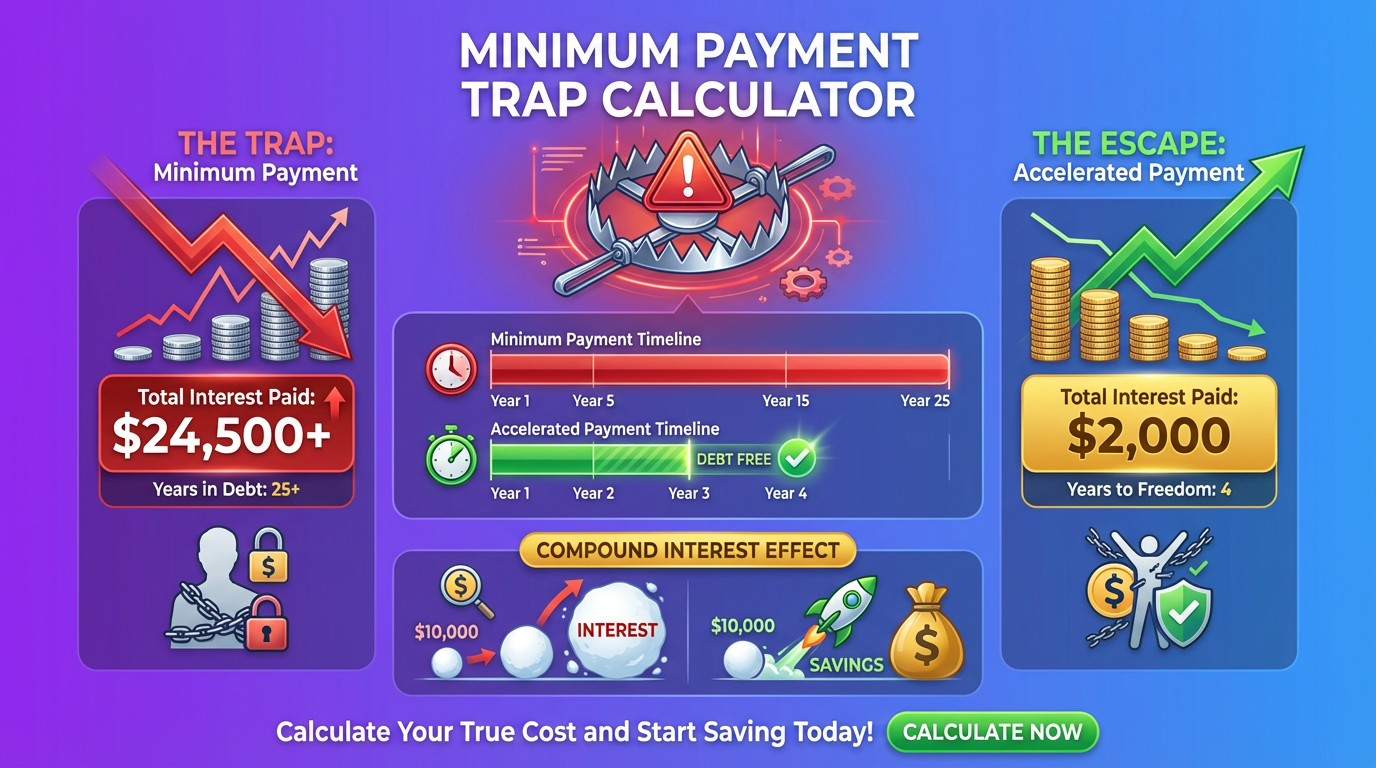
Minimum Payment Trap Calculator: The Hidden Cost of Paying the Minimum
See the shocking truth about paying only minimum payments. Calculate your true cost.
How This Minimum Payment Trap Calculator Works
Our minimum payment trap calculator reveals the shocking reality of paying only the minimum on your credit cards. Enter your balance, interest rate, and minimum payment type to see:
- Actual years to pay off at minimum payments (often 15-30 years)
- Total interest paid over the life of the debt
- Total amount paid (often 2-3x the original balance)
- Comparison to fixed payments showing how much you could save
- Monthly interest charges you’re paying right now
This calculator is designed to be a wake-up call. The numbers may shock you—and that’s the point.
The Minimum Payment Trap Explained
Credit card companies design minimum payments to keep you in debt as long as possible while generating maximum interest revenue. The typical minimum payment is calculated as:
- 2-3% of your balance, or
- $25-$35 fixed amount, whichever is greater
This might seem manageable, but it’s actually a trap designed to extend your debt for decades.
Why Minimum Payments Are Dangerous
The Math of Minimum Payments:
On a $5,000 balance at 22% APR: – Monthly interest: $91.67 – Minimum payment (2%): $100 – Principal paid: Only $8.33!
At this rate, just 8% of your payment goes toward your actual debt. The other 92% is pure profit for the credit card company.
The Shrinking Minimum Problem
As your balance decreases, so does your minimum payment. This sounds good but actually extends your payoff timeline:
| Month | Balance | Minimum (2%) | Interest | Principal Paid |
|---|---|---|---|---|
| 1 | $5,000 | $100 | $91.67 | $8.33 |
| 12 | $4,903 | $98 | $89.90 | $8.10 |
| 24 | $4,795 | $96 | $87.91 | $8.09 |
| 60 | $4,345 | $87 | $79.66 | $7.34 |
| 120 | $3,478 | $70 | $63.76 | $6.24 |
After 10 years of payments, you’ve paid over $7,500 but still owe $3,478!
Minimum Payment Trap Examples: Real Numbers
Example 1: Average Credit Card Balance ($6,501)
Scenario: The average American credit card balance (per Experian 2024 data).
Starting Point: – Balance: $6,501 – APR: 22.63% (national average) – Minimum Payment: 2% of balance or $25
Minimum Payment Results: | Metric | Minimum Only | Fixed $200/mo | |——–|————–|—————| | Time to Payoff | 22 years, 4 months | 3 years, 7 months | | Total Interest | $10,547 | $2,147 | | Total Paid | $17,048 | $8,648 |
The Shocking Truth: – You’ll pay $10,547 in interest—more than the original balance – Total cost is 2.6x the original purchase – You’ll be paying until 2047 for purchases made today – Savings with $200/mo fixed: $8,400
Example 2: Store Credit Card Nightmare ($3,500)
Scenario: A store credit card with a high interest rate used for furniture.
Starting Point: – Balance: $3,500 – APR: 29.99% (typical store card rate) – Minimum Payment: 3% of balance or $35
Minimum Payment Results: | Metric | Minimum Only | Fixed $150/mo | |——–|————–|—————| | Time to Payoff | 14 years, 2 months | 2 years, 6 months | | Total Interest | $5,893 | $969 | | Total Paid | $9,393 | $4,469 |
The Shocking Truth: – That $3,500 furniture set costs $9,393 with minimum payments – You’re paying nearly 3x the original price – The furniture will be worn out or replaced long before you finish paying – Savings with $150/mo fixed: $4,924
Example 3: Post-Holiday Debt ($2,500)
Scenario: Credit card debt from holiday shopping.
Starting Point: – Balance: $2,500 – APR: 24.99% – Minimum Payment: 2% of balance or $25
Minimum Payment Results: | Metric | Minimum Only | Fixed $100/mo | |——–|————–|—————| | Time to Payoff | 18 years, 9 months | 2 years, 7 months | | Total Interest | $4,782 | $589 | | Total Paid | $7,282 | $3,089 |
The Shocking Truth: – Holiday gifts from 2024 won’t be paid off until 2043 – You’ll pay $4,782 in interest on $2,500 of gifts – Total cost is nearly 3x the original spending – Your kids will be adults before you pay off their childhood presents – Savings with $100/mo fixed: $4,193
Example 4: Large Balance Accumulation ($15,000)
Scenario: Multiple cards consolidated onto one with a balance that grew over time.
Starting Point: – Balance: $15,000 – APR: 21.99% – Minimum Payment: 2% of balance or $25
Minimum Payment Results: | Metric | Minimum Only | Fixed $400/mo | |——–|————–|—————| | Time to Payoff | 30+ years | 4 years, 6 months | | Total Interest | $28,342 | $6,482 | | Total Paid | $43,342 | $21,482 |
The Shocking Truth: – You’ll be in debt for 30+ years—nearly a mortgage timeline – Total interest of $28,342 is almost double the original balance – You’ll pay $43,342 for $15,000 in purchases – If you’re 35 now, you’ll be 65 when it’s paid off – Savings with $400/mo fixed: $21,860
Example 5: Medical Debt on Credit Card ($8,000)
Scenario: Emergency medical expenses put on a credit card.
Starting Point: – Balance: $8,000 – APR: 19.99% – Minimum Payment: 2% of balance or $35
Minimum Payment Results: | Metric | Minimum Only | Fixed $250/mo | |——–|————–|—————| | Time to Payoff | 24 years, 8 months | 3 years, 3 months | | Total Interest | $11,876 | $1,723 | | Total Paid | $19,876 | $9,723 |
The Shocking Truth: – A medical emergency from 2024 won’t be paid off until 2049 – You’ll pay $11,876 in interest—more than the medical bills themselves – Total cost is nearly 2.5x the original bill – Savings with $250/mo fixed: $10,153
Better Option: Medical providers often offer 0% payment plans. Always ask before putting medical debt on credit cards.
The Decade-by-Decade Reality
Here’s what happens to a $10,000 balance at 22% APR with minimum payments over time:
Year 1
- Starting Balance: $10,000
- Minimum Payments: ~$200/month (declining)
- Total Paid: ~$2,160
- Interest Paid: ~$2,040
- Balance Remaining: $9,880
- Principal Reduction: Only $120!
Year 5
- Balance Remaining: ~$9,200
- Total Paid So Far: ~$9,800
- Interest Paid: ~$9,000
- You’ve paid almost the original balance but barely made a dent
Year 10
- Balance Remaining: ~$7,800
- Total Paid So Far: ~$16,500
- Interest Paid: ~$14,300
- You’ve paid $16,500 and still owe $7,800
Year 15
- Balance Remaining: ~$5,600
- Total Paid So Far: ~$21,200
- Interest Paid: ~$16,800
- You’ve paid MORE than double the original balance
Year 20
- Balance Remaining: ~$3,100
- Total Paid So Far: ~$24,300
- Interest Paid: ~$17,400
- Still making payments two decades later
Year 25+
- Balance Finally Paid: $0
- Total Paid: ~$26,800
- Total Interest: ~$16,800
- It took 25+ years to pay off $10,000
Why Credit Card Companies Love Minimum Payments
The Business Model
Credit card companies make money from interest. The longer you carry a balance, the more profit they generate.
Annual interest revenue on $10,000 at 22% APR: $2,200
If you pay it off in 2 years, they make ~$2,400 in interest. If you pay minimums for 25 years, they make ~$16,800.
That’s 7x more profit from minimum payment customers.
How Minimums Are Designed
Before 2006, many cards had 1-2% minimums, creating even longer payoff timelines. Regulations now require higher minimums, but they’re still designed to:
- Feel affordable – $100/month seems manageable
- Decline over time – Smaller payments = longer payoff
- Maximize interest – Just enough to not seem predatory
- Keep you borrowing – Low payments leave room for more charges
The “Affordable” Illusion
| Balance | Monthly Interest | Minimum (2%) | “Affordable” Feeling |
|---|---|---|---|
| $5,000 | $92 | $100 | “I can manage $100” |
| $10,000 | $183 | $200 | “It’s like a car payment” |
| $20,000 | $367 | $400 | “I’ll pay it down slowly” |
But “slowly” means decades, and “affordable” means paying 2-3x the original amount.
How to Escape the Minimum Payment Trap
Strategy 1: Fix Your Payment Amount
The single most effective strategy: Pay a fixed amount that doesn’t decrease as your balance drops.
| Balance | Minimum (2%) | Fixed Payment | Time Saved |
|---|---|---|---|
| $5,000 | $100 → $25 | $150 fixed | 12+ years |
| $10,000 | $200 → $25 | $300 fixed | 18+ years |
| $15,000 | $300 → $25 | $400 fixed | 22+ years |
Action: Determine a fixed payment you can afford, then set up autopay for that amount—not the minimum.
Strategy 2: Pay More Than Double the Minimum
If you can’t fix a high payment, aim for at least 2x the minimum:
- Minimum: $100 → Pay: $200
- Cuts payoff time by approximately 60-70%
- Saves thousands in interest
Strategy 3: Attack One Card at a Time
If you have multiple cards: 1. Pay minimums on all cards 2. Put every extra dollar toward one card (highest APR or lowest balance) 3. When that card is paid off, roll the payment to the next card 4. See our Debt Snowball vs Avalanche Calculator
Strategy 4: Balance Transfer to 0% APR
Move your balance to a 0% APR promotional offer: – All payments go to principal – No interest for 15-21 months – Must pay off before promo ends – See our Balance Transfer Calculator
Strategy 5: Debt Consolidation Loan
Replace credit card debt with a lower-rate personal loan: – Fixed payment that doesn’t decline – Lower APR (often 8-15% vs 22%+) – Forced payoff in 3-5 years – See our Debt Consolidation Calculator
The Psychological Trap
Why People Pay Only Minimums
1. “I’ll pay more next month” But next month never comes. Life happens. The minimum becomes routine.
2. “At least I’m paying something” True, but you’re mostly paying interest—not reducing debt. It feels like progress without actual progress.
3. “I can’t afford more” Maybe—but can you afford 25 years of payments✓ Finding even $50 extra saves thousands.
4. “The minimum is what they ask for” Credit card companies want you to pay minimums. It’s their most profitable outcome, not yours.
Breaking the Psychological Pattern
Reframe the minimum payment: – It’s not “what I owe” – it’s “the least they’ll accept” – It’s designed for their benefit, not yours – Every dollar above minimum is money you keep
Create payment commitment: – Automate a fixed payment higher than minimum – Treat credit card payment like rent—non-negotiable – Review progress monthly to stay motivated
Minimum Payment Calculator: True Cost Comparison
What $5,000 Really Costs You
| Payment Strategy | Monthly | Time | Total Interest | Total Paid |
|---|---|---|---|---|
| Minimum (2%) | $100→$25 | 22+ years | $7,234 | $12,234 |
| Fixed $100 | $100 | 7.5 years | $3,856 | $8,856 |
| Fixed $150 | $150 | 3.9 years | $1,893 | $6,893 |
| Fixed $200 | $200 | 2.7 years | $1,246 | $6,246 |
| Fixed $300 | $300 | 1.6 years | $712 | $5,712 |
| Fixed $500 | $500 | 11 months | $411 | $5,411 |
Every $50 increase saves years and thousands of dollars.
What $10,000 Really Costs You
| Payment Strategy | Monthly | Time | Total Interest | Total Paid |
|---|---|---|---|---|
| Minimum (2%) | $200→$25 | 27+ years | $16,823 | $26,823 |
| Fixed $200 | $200 | 9.5 years | $12,847 | $22,847 |
| Fixed $300 | $300 | 4.5 years | $3,847 | $13,847 |
| Fixed $400 | $400 | 3.1 years | $2,547 | $12,547 |
| Fixed $500 | $500 | 2.3 years | $1,847 | $11,847 |
| Fixed $750 | $750 | 1.4 years | $1,147 | $11,147 |
Frequently Asked Questions
What is the minimum payment trap✓
The minimum payment trap is the cycle of paying only the minimum required on credit cards, which results in: – Decades of payments instead of months or years – Paying 2-3x the original balance in total – Most of your payment going to interest rather than principal – Feeling like you’re making progress while barely reducing debt
Credit card companies design minimums (typically 2-3% of balance) to maximize the interest you pay over time. A $5,000 balance at 22% APR with minimum payments takes 22+ years to pay off and costs over $12,000 total.
How is the minimum payment calculated✓
Most credit cards calculate minimum payments as:
Method 1: Percentage of Balance – 2-3% of your current balance – Declines as balance decreases
Method 2: Fixed Floor – $25-$35 minimum regardless of balance – Applies when percentage would be lower
Method 3: Interest + 1% – Some cards require interest charges plus 1% of principal – Slightly faster payoff than pure percentage
Example: $5,000 balance – 2% method: $100 minimum – As balance drops to $1,000: $25 minimum (floor kicks in)
How long will it take to pay off my credit card with minimum payments✓
Payoff time with minimums depends on your balance and APR:
| Balance | APR | Minimum Type | Approximate Payoff Time |
|---|---|---|---|
| $2,500 | 20% | 2% | 15-18 years |
| $5,000 | 22% | 2% | 20-24 years |
| $10,000 | 22% | 2% | 27-32 years |
| $15,000 | 22% | 2% | 30+ years |
| $20,000 | 22% | 2% | 35+ years |
Use our calculator above for your exact timeline.
How much interest will I pay with minimum payments✓
With minimum payments, you’ll typically pay 1.5x to 2.5x your original balance in interest alone:
| Original Balance | Total Interest (Min Payments) | Total Paid |
|---|---|---|
| $2,500 | $3,500 – $5,000 | $6,000 – $7,500 |
| $5,000 | $7,000 – $10,000 | $12,000 – $15,000 |
| $10,000 | $14,000 – $18,000 | $24,000 – $28,000 |
| $15,000 | $22,000 – $28,000 | $37,000 – $43,000 |
The exact amount depends on your APR and how your minimum is calculated.
Why does my balance barely go down with minimum payments✓
Because most of your minimum payment goes to interest, not principal:
Example: $10,000 at 22% APR, $200 minimum – Monthly interest charge: $183 – Amount to principal: $17 – Only 8.5% of your payment reduces debt
As your balance slowly decreases, the minimum payment decreases too—which means the principal portion remains tiny. This creates a cycle where payoff takes decades.
Is it bad to only pay the minimum✓
Yes, paying only minimums is one of the worst financial habits because:
- Time cost: Decades of payments instead of years
- Money cost: Paying 2-3x the original purchase
- Opportunity cost: Money going to interest can’t be saved or invested
- Stress cost: Carrying debt for years causes financial anxiety
- Credit impact: High utilization hurts your credit score
The minimum payment is the least acceptable amount—not the recommended amount.
What happens if I pay more than the minimum✓
Every dollar above the minimum goes directly to principal, which: – Reduces your balance faster – Decreases future interest charges – Shortens payoff time significantly
Example: $5,000 at 22% APR | Payment | Payoff Time | Interest Paid | Total Paid | |———|————-|—————|————| | $100 (min) | 22 years | $7,234 | $12,234 | | $150 (+$50) | 4 years | $1,893 | $6,893 | | $200 (+$100) | 2.7 years | $1,246 | $6,246 |
Just $50 extra saves 18 years and $5,341.
How can I escape the minimum payment trap✓
Five proven strategies:
Fix your payment amount – Pay a set amount (e.g., $200) regardless of what the minimum drops to
Use the debt avalanche/snowball – Focus extra payments on one card at a time
Balance transfer – Move debt to 0% APR and pay it off during the promotional period
Debt consolidation – Replace card debt with a lower-rate personal loan with fixed payments
Increase income temporarily – Use overtime, side hustles, or windfalls to make extra payments
Should I pay off credit cards or save money✓
Generally, pay off high-interest credit cards first:
- Credit card APR: 22%+
- Savings account APY: 4-5%
Paying off a 22% APR card is a guaranteed 22% return—far better than any savings account.
Exception: Keep a small emergency fund ($1,000-$2,000) before aggressive debt payoff. Without it, emergencies force you back into credit card debt.
Why do credit card companies allow minimum payments✓
Because it’s highly profitable for them:
- Minimum payments maximize total interest collected
- A $10,000 balance at minimum payments generates ~$17,000 in interest
- The same balance paid off in 3 years generates only ~$3,500 in interest
Credit card companies make 5x more money from minimum payment customers. The system is designed this way intentionally.
What’s the difference between minimum payment and statement balance✓
| Term | Definition | What Happens If You Pay This |
|---|---|---|
| Minimum Payment | Smallest amount to avoid late fees (2-3% of balance) | Balance remains, interest accrues, debt for decades |
| Statement Balance | Total owed at end of billing cycle | No interest charged, balance paid in full |
| Current Balance | Total including recent transactions | Paid completely, including recent purchases |
To avoid ALL interest: Pay the full statement balance by the due date each month.
How does the minimum payment trap affect my credit score✓
Indirectly, it can hurt your score:
- High utilization: Carrying large balances hurts your credit utilization ratio
- Missed payments: If minimum payments become unaffordable, you may miss payments
- Limited credit access: High balances reduce available credit for emergencies
Paying down debt (not just minimums) improves your utilization ratio and credit score.
Can I negotiate a lower minimum payment✓
Yes, sometimes—but it’s not always helpful:
Hardship programs: If you’re struggling, call your issuer and ask about: – Temporary reduced minimums – Lower interest rate – Payment plans
The catch: Lower minimums mean even longer payoff and more interest. Only use hardship programs if you truly can’t afford payments—then increase payments as soon as possible.
Related Calculators
Break free from the minimum payment trap:
- Credit Card Payoff Calculator – See how extra payments accelerate payoff
- Debt Consolidation Calculator – Compare consolidation loan savings
- Balance Transfer Calculator – Analyze 0% APR transfer offers
- Debt Snowball vs Avalanche Calculator – Find your best payoff strategy
This calculator provides estimates for educational purposes only. Actual payoff timelines depend on your specific APR, minimum payment calculation method, and payment consistency. Contact your credit card issuer for precise information about your account.