

Financial stress doesn’t just affect your bank account. It invades every corner of your life.
It’s the knot in your stomach when checking your mail.
The sleepless nights spent calculating whether you can make all your payments.
The constant background anxiety that makes it hard to focus at work or be fully present with family.
The shame that keeps you from being honest with anyone about your situation.
Real LendWyse clients describe their experiences with debt-related stress in strikingly similar terms: overwhelming, consuming, exhausting, relentless.
But they also describe something remarkable: how quickly that crushing weight begins to lift once they have a clear path forward through debt relief.
Let’s explore the actual stress reduction experiences of people who’ve walked this path.
Table Of Contents:
- The Anatomy of Debt Stress: What People Actually Experience
- Stress Point #1: The Weight of Judgment (Real or Imagined)
- Stress Point #2: The Anxiety of Juggling Multiple Payments
- Stress Point #3: The Hopelessness of Invisible Progress
- Stress Point #4: The Immediate Crisis: Sleepless Nights
- Stress Point #5: The Relationship Strain
- Stress Point #6: The Career and Work Impact
- Stress Point #7: The Future Feels Impossible
- Stress Point #8: The Decision Paralysis
- The Immediate vs. Long-Term Stress Reduction
- The Support Factor: Not Facing It Alone
- The Control Factor: From Victim to Agent
- The Bottom Line: Stress Relief Is Immediate and Sustained
- Ready to Experience Relief?
The Anatomy of Debt Stress: What People Actually Experience
One customer captured the complete picture: “Trying to budget got worse & worse the past few years, and I lost a lot of sleep trying to figure things out. I was making ALL of my payments, every month, on time—but the interest being added back each month was keeping me in a never-ending cycle.”
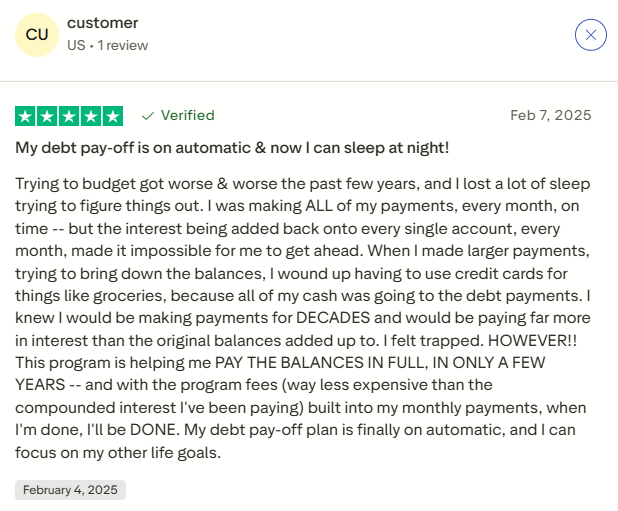
Notice what this reveals about debt stress:
Physical Manifestations:
- Lost sleep (“lost a lot of sleep”)
- Constant mental processing (“trying to figure things out”)
- Exhaustion from effort without progress
Emotional Impact:
- Feeling trapped (“never-ending cycle”)
- Frustration despite doing everything right
- Growing sense of hopelessness over the years
Cognitive Load:
- Budget management is becoming increasingly complex
- Mental energy consumed by financial calculations
- Deteriorating situation despite careful attention
This isn’t just “worry.” It’s chronic stress that affects physical health, mental well-being, relationships, work performance, and quality of life.
Stress Point #1: The Weight of Judgment (Real or Imagined)
Amy Barnard’s relief was palpable: “I wasn’t made to feel like I was an awful person, very understanding and personable.”
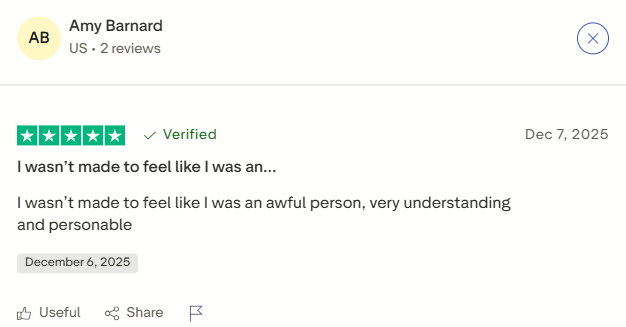
That statement reveals what many people experiencing debt stress internalize: the belief that their financial situation reflects moral failure.
The shame spiral:
- Debt accumulates from circumstances (medical bills, job loss, divorce)
- Society messages: “Responsible people don’t have debt problems.”
- You internalize: “I must be irresponsible/stupid/worthless.”
- Shame prevents seeking help
- Isolation increases stress
- Problem worsens
- Shame intensifies
Kameel’s customer echoed this: “Kameel was very understanding he didn’t make me feel like I was an irresponsible person.”
How debt relief reduces this stress:
Being treated with dignity and understanding by professionals immediately contradicts the internal narrative. When someone knowledgeable about finance treats you with respect despite your debt, it signals: “This situation doesn’t define your worth as a person.”
Another customer expressed the relief: “Everyone I spoke with were very understanding, helpful and treated me with such respect. We all encounter some sort of hardship and don’t want to be judged for decisions that were made.”
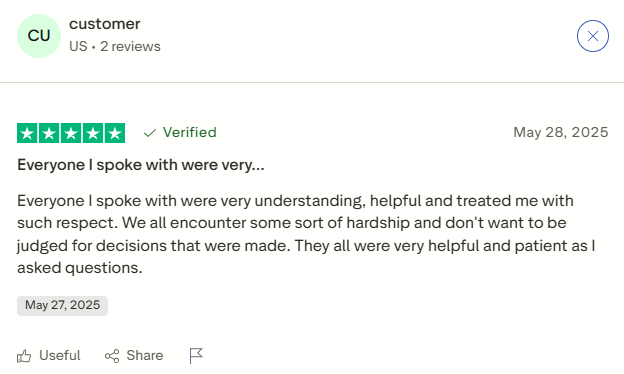
That recognition normalizes your experience. You’re not uniquely flawed; you’re human facing challenging circumstances like millions of others.
Shame diminishes when met with understanding. Isolation ends when someone engages with compassion. The weight of perceived judgment lifts.
Stress Point #2: The Anxiety of Juggling Multiple Payments
Linda Gilbreath noted: “Everyone I spoke with was kind and courteous. Very refreshing. My wait time was not long. Taj was extremely helpful and patient. I felt comfortable discussing my situation with him.”
The fact that she felt “comfortable discussing my situation” suggests relief from the stress of managing complexity alone.
The juggling stress:
Managing multiple credit cards means tracking:
- Different due dates (3rd, 8th, 15th, 22nd)
- Different minimum payments ($125, $89, $156, $213)
- Different interest rates (19.99%, 24.99%, 21.99%, 23.49%)
- Different balances (constantly fluctuating)
- Which cards are near limits
- When payments clear
- Coordinating with paycheck timing
This mental load is constant. Even when you’re not actively managing debt, part of your brain is always tracking these moving pieces.
How debt relief reduces this stress:
Consolidation into one payment means:
- One due date to remember
- One amount that never changes
- One interest rate
- One declining balance
- No more mental juggling
Multiple customers mentioned this simplified management as immediate relief, even before any debt was actually eliminated.
Mental bandwidth is freed. The background anxiety of “am I forgetting something?” disappears. Cognitive load drops dramatically.
Stress Point #3: The Hopelessness of Invisible Progress
The customer who noted that “the interest being added back each month was keeping me in a never-ending cycle” identified one of the most stress-inducing aspects of debt: working hard with nothing to show for it.
The hopelessness cycle:
- Pay $500 toward credit cards
- Watch balance drop by $200 after interest
- Feel like you’re running on a treadmill
- Motivation decreases
- Sense of futility increases
- Stress compounds because the effort isn’t producing results
This creates learned helplessness, the psychological state where you stop trying because you’ve learned that effort doesn’t matter. This breeds depression, anxiety, and even more stress.
How debt relief reduces this stress:
Jorge’s excitement reveals the transformation: “Speaking to Kevin today felt like a great relief to taking the next step into setting me up in a plan to reduce and finalize my accumulated dept. I can’t wait for these next 3 years to go by and be debt free!”
Notice what changed:
- “Reduce and finalize” (endpoint, not endless cycle)
- “3 years” (specific timeline)
- “Debt-free” (clear destination)
- “Can’t wait” (anticipation replacing dread)
Hope replaces hopelessness. Every payment now represents measurable progress toward a specific goal. Effort produces visible results. The treadmill becomes a path with a destination.
Stress Point #4: The Immediate Crisis: Sleepless Nights
The customer mentioned directly: “lost a lot of sleep trying to figure things out.”
Sleep disruption from financial stress is extremely common and creates a vicious cycle:
The sleep-stress cycle:
- Financial anxiety prevents sleep
- Lack of sleep impairs cognitive function
- Impaired thinking makes financial problems feel worse
- Increased stress further disrupts sleep
- Physical health deteriorates
- Stress intensifies
Mother of the groom captured the intensity: “Stress is horrible and after everything was explained the instant relief and looking forward to a resolution has made a lighter load.”
“Stress is horrible” — simple words that encapsulate the physical and emotional toll.
How debt relief reduces this stress:
Notice she said “instant relief” and “after everything was explained.” The stress reduction didn’t wait for debt elimination—it came from understanding the path forward.
Why understanding creates immediate relief:
- Brain stops spinning trying to find solutions (answer exists)
- Anxiety about the unknown diminishes (you know the plan)
- Catastrophic thinking decreases (realistic path visible)
- Sleep becomes possible again (mind can rest)
Sleep improves within days of establishing a debt relief plan. Physical health begins to recover. The vicious cycle breaks.
Stress Point #5: The Relationship Strain
Multiple reviews mention discussing debt with spouses or family, suggesting that debt stress affected entire households.
How debt stress damages relationships:
- Money arguments become frequent
- Shame prevents honest communication
- Different spending philosophies create conflict
- Stress makes you irritable and withdrawn
- Can’t make joint plans because finances are uncertain
- Resentment builds when one partner feels blamed
- Intimacy suffers under constant stress
How debt relief reduces this stress:
Grace D mentioned: “Kameel was the reason I was even open about this company.”
Being “open” to solutions often means family members are ready to address what’s been causing tension.
When couples or families pursue debt relief together:
- Shared goal replaces conflict
- A clear plan removes uncertainty that breeds arguments
- Progress creates positive momentum
- Financial discussions become about solutions, not blame
- Stress decreases for everyone
Relationships begin healing when the constant stressor (unmanageable debt) becomes a managed situation with a clear plan.
Hope is contagious. When one person feels relief, the household atmosphere shifts.
Stress Point #6: The Career and Work Impact
Financial stress doesn’t respect boundaries. It follows you everywhere:
Work performance impacts:
- Difficulty concentrating on tasks
- Mental energy consumed by financial worry
- Decreased productivity
- Avoiding work opportunities (travel, training) due to cost
- Career decisions are limited by debt burden
- Missing advancement opportunities
Nalz appreciated: “Almas was so efficient in what he does, very knowledgeable in all aspects…able to answer patiently all my queries….understood my doubts….definitely, he earned my trust and vote of confidence.”
That thoroughness (“all aspects,” “all my queries”) suggests someone who could finally focus on understanding their situation rather than remaining in constant worried fog.
How debt relief reduces this stress:
With a clear debt management plan:
- Mental clarity returns at work
- Can focus on career advancement
- Freed cognitive bandwidth improves performance
- Career decisions based on goals, not desperation
- Can invest in professional development
Work performance improves. Career opportunities become accessible. The stress of financial instability no longer undermines professional success.
Stress Point #7: The Future Feels Impossible
Debt stress doesn’t just affect the present. It blocks your vision of the future:
Future-blocking effects:
- Can’t save for retirement
- Can’t plan vacations
- Can’t make major purchases (home, car)
- Can’t help children with education
- Feel like life is on hold indefinitely
- Every plan is contingent on “when debt is handled”
How debt relief reduces this stress:
Jorge’s timeline shows restored future vision: “I can’t wait for these next 3 years to go by and be debt free!”
He can now envision life three years from now — debt-free, with options, able to plan. The future exists again.
Paula Siwek valued: “ALEN is a human being, and made me feel informed and comfortable. I didn’t know what expect from our conversation, and he made the terms clear and realistic.”
“Clear and realistic” terms allow future planning. You know what next month looks like, next year, three years from now.
The ability to envision and plan for the future returns. Life resumes rather than remaining on hold. Dreams become possible again rather than feeling permanently deferred.
Stress Point #8: The Decision Paralysis
Financial stress often creates decision paralysis:
- Should I pay the minimum or prioritize one card?
- Should I try balance transfers again?
- Should I take a 401(k) loan?
- Should I work extra hours I don’t have energy for?
- Should I just ignore it and hope for the best?
Every option seems problematic. Uncertainty about the “right” choice increases stress. You freeze, making no decision, which worsens the situation.
How debt relief reduces this stress:
Patricia A Valese appreciated: “This was a great experience because your representative took his time explaining everything to me. He also had much patience since I am hard of hearing. He listened to my financial goals and gave me the tools to complete them.”
“Gave me the tools to complete them” — decision-making shifted from paralysis to action.
Kate similarly noted: “Alen Baits was so incredibly helpful and thorough with everything we discussed! This process, which I was dreading, was extremely easy and stress free because of him. I didn’t have to ask many questions because he explained everything so well.”
Decision paralysis ends when clear options are explained by knowledgeable professionals. The path forward becomes obvious. Action replaces frozen uncertainty.
The Immediate vs. Long-Term Stress Reduction
Phase 1: Immediate Psychological Relief (Within Days)
Mother of the groom: “after everything was explained the instant relief…”
This happens before any debt is paid:
- Understanding replaces confusion
- Hope replaces despair
- Plan replaces uncertainty
- Support replaces isolation
- Action replaces paralysis
Phase 2: Sustained Relief Through Execution (Months to Years)
Jorge: “I can’t wait for these next 3 years to go by and be debt-free!”
This builds over time:
- Monthly progress visible
- Milestones celebrated
- Confidence grows
- Stress continues decreasing
- Freedom date approaches
Tamaira Barnes-Hart’s joy shows the endpoint: “I can’t even thank you enough for taking care of my debt….I should have done this along time ago. I’m so happy, this made my day!!!!”
Immediate relief from having a plan, sustained relief from executing it, ultimate relief from completing it.
The Support Factor: Not Facing It Alone
Multiple customers mentioned the personal connection with representatives:
Marlon White: “Maryam was very professional and knowledgeable. I felt comfortable sharing my identity information with her. She walked me through everything and I am happy to get the financial ease that I needed at this time.”
Ray: “i felt like a valued customer….this being said i HIGHLY recommend this program.”
Why this reduces stress:
Chronic stress thrives in isolation. When you’re facing financial problems alone:
- No one to share the burden with
- No one to problem-solve with
- No accountability partner
- No encouragement when motivation wanes
Having a knowledgeable, supportive professional:
- Shares the mental load
- Provides expertise you lack
- Offers accountability
- Encourages continued progress
- Reminds you you’re not alone
The isolation that amplifies stress dissolves. You have a partner in your journey to debt freedom.
The Control Factor: From Victim to Agent
David North’s transformation: “Well, I was a little skeptical at first, but he made a lot of sense in what he was saying as far as me trying to pay two cards off and going with beyond in order to make everything work out very comfortably.”
Going from “trying to pay cards off” (struggling, uncertain) to “make everything work out very comfortably” (confident, planned) represents regaining control.
Victim mindset (high stress):
- Debt happens TO you
- You’re at the mercy of circumstances
- Powerless to change the situation
- Reactive, always behind
Agent mindset (reduced stress):
- You’re taking action ON debt
- You’re directing the solution
- Empowered to change the situation
- Proactive, planning ahead
How debt relief facilitates this shift:
By providing:
- Clear options you can choose between
- Expert guidance that empowers rather than dictates
- Structured plan you control
- Milestones that show your agency producing results
The helplessness that breeds the deepest stress transforms into empowerment. You’re no longer a victim of debt—you’re the agent of your own financial freedom.
The Bottom Line: Stress Relief Is Immediate and Sustained
Real clients consistently report:
Immediate relief (within days):
- From understanding their situation clearly
- From having a concrete plan
- From being treated with dignity
- From seeing a path forward
- From no longer facing it alone
Sustained relief (ongoing):
- From simplified financial management
- From visible progress each month
- From approaching a specific freedom date
- From regained control over their lives
- From hope replacing despair
Tamaira Barnes-Hart: “I’m so happy, this made my day!!!!”
That joy isn’t theoretical. It’s the lived experience of someone who went from crushing stress to genuine happiness through debt relief.
Ready to Experience Relief?
If you’re living with the constant stress of unmanageable debt — the sleepless nights, the constant worry, the feeling of being trapped — know that relief is possible and often immediate.
What real LendWyse clients experienced:
- Instant psychological relief from having a clear plan
- Simplified financial life reducing daily stress
- Hope and motivation replacing despair
- Support and understanding replacing isolation
- Control and empowerment replacing helplessness
- Sleep and peace of mind returning
The stress won’t fully disappear until the debt is gone, but it begins lifting the moment you understand your path forward. Hundreds of clients describe “instant relief” from their first conversation.
Stop carrying this burden alone. Discover how debt relief reduces stress not just eventually, but immediately — from the moment you have clarity, support, and a plan.