
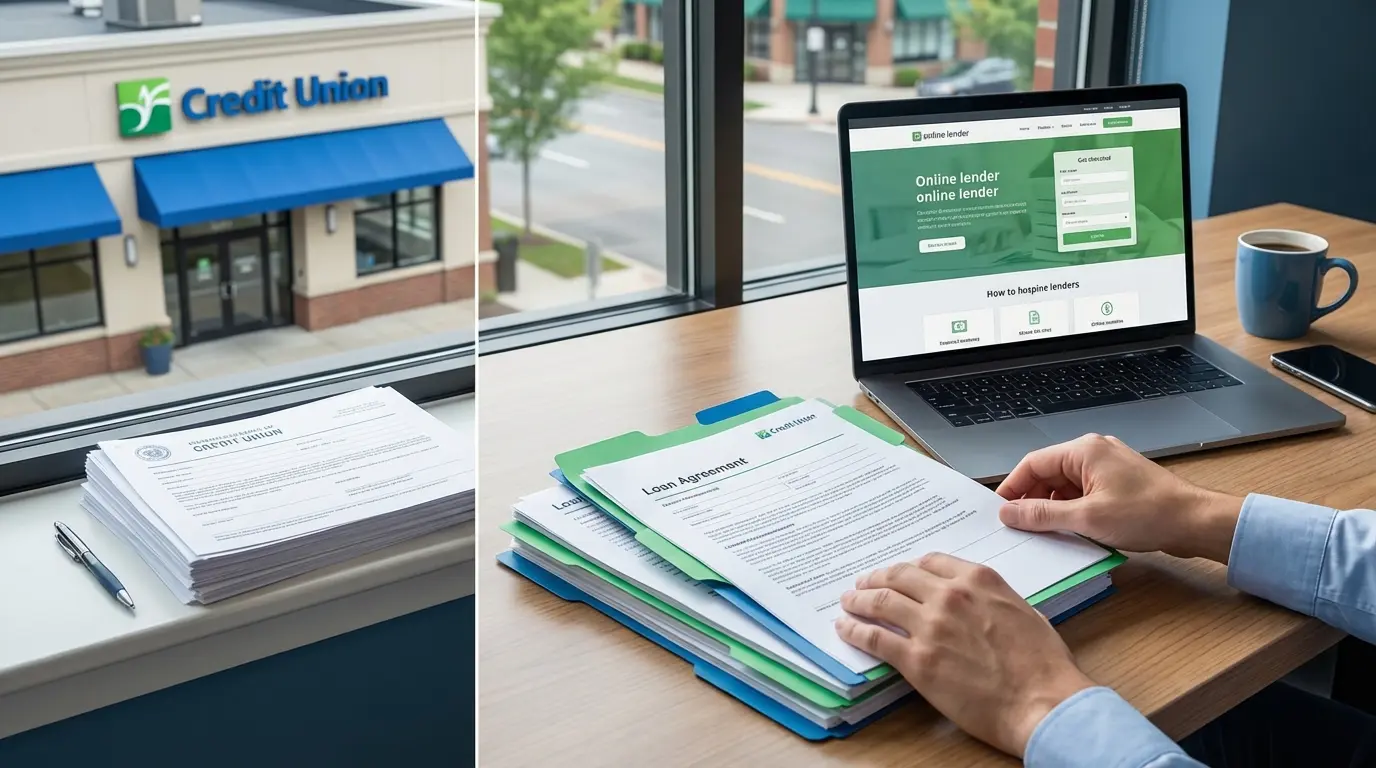
Managing multiple high-interest debts often feels overwhelming and financially draining for the average American consumer. When determining a credit union vs online lender for debt consolidation which is better, you must weigh the benefits of personalized service against digital speed. A debt consolidation loan offers a practical path forward by combining several balances into one manageable monthly payment.
Choosing the right financial institution matters just as much as the initial decision to consolidate your accounts. Borrowers frequently debate whether a traditional credit union or a modern online lender provides the better financial solution. Each option presents distinct advantages and specific drawbacks depending on your financial profile and personal banking preferences.
We will examine the core differences between credit unions and online lenders to help you make an informed choice. You must understand how these institutions process applications, determine interest rates, and handle customer service interactions. This knowledge empowers you to select the lending partner that best supports your long-term financial recovery goals.
Understanding Debt Consolidation Loans: Credit Union vs Online Lender Basics
Debt consolidation simplifies your financial life by merging multiple unsecured debts into one new personal loan. You borrow enough money from a single lender to completely pay off your existing credit cards and medical bills. This leaves you with just one monthly payment to make at a significantly lower interest rate.
The primary goal focuses on reducing the total amount of interest you pay over the life of the loan. By securing a lower annual percentage rate (APR), more of your monthly payment goes directly to the principal balance. This aggressive approach accelerates your debt payoff timeline and frees up cash flow in your monthly household budget.
Both credit unions and online lenders offer personal loans specifically structured for consolidating high-interest consumer debt. The application process requires a thorough review of your credit history, employment income, and existing debt-to-income ratio. Lenders use these financial metrics to determine your borrowing eligibility and set your specific repayment terms.
How Personal Loans for Debt Consolidation Work
Once approved, the lender either deposits the funds into your bank account or pays your creditors directly. Direct payment options eliminate the dangerous temptation to spend the loan funds on non-essential consumer purchases. You then begin making regular monthly payments to your new lender over a fixed and predictable repayment term.
Repayment terms typically range from two to seven years depending on the specific lender and total loan amount. A shorter term means higher monthly payments but substantially less total interest paid over the life of the loan. Conversely, a longer term reduces your monthly financial burden but increases your total borrowing costs over time.
Consolidating your debt also provides significant psychological benefits that help you maintain long-term financial discipline. Seeing one steadily decreasing balance reduces the anxiety associated with juggling multiple aggressive creditor statements every single month. This mental clarity helps you focus on building wealth rather than constantly treading water with minimum payments.
- Debt consolidation merges multiple high-interest balances into a single loan with one predictable monthly payment.
- The primary objective is securing a lower interest rate to save money and accelerate your payoff timeline.
- Direct payment to creditors is the safest way to guarantee the loan funds actually eliminate your existing debt.
The Case for Credit Unions: Low Interest Rates and Debt Consolidation Membership

Credit unions operate as not-for-profit financial cooperatives owned entirely by their members rather than outside corporate shareholders. This structural difference fundamentally changes how they approach consumer lending and customer service compared to traditional banks. They return their profits to members through lower interest rates on personal loans and higher yields on savings accounts.
Federal law actually caps the maximum interest rate that federal credit unions can charge on personal loans at 18 percent. This statutory limit provides a significant layer of financial protection for borrowers with less-than-perfect credit profiles. If your credit score usually triggers astronomical rates elsewhere, a credit union might offer much more affordable terms.
Credit unions also emphasize financial education and community support as part of their core institutional mission. They frequently offer free financial counseling services to help members build better budgeting habits and improve their credit scores. This supportive environment makes them an excellent choice for borrowers who want ongoing guidance during their debt payoff journey.
Membership Requirements and Benefits
You must officially join a credit union before you can apply for their debt consolidation loan products. Membership eligibility usually depends on your employer, geographic location, or affiliation with specific community organizations. Many credit unions have expanded their charters recently, making it incredibly easy for almost anyone to join their ranks.
Opening a simple share savings account with a small deposit of five to twenty dollars establishes your lifetime membership. Once you become a member, you gain full access to their entire portfolio of discounted financial services. Members often report feeling treated like actual human beings rather than just numerical credit scores in a database.
The membership process might add an extra step, but the long-term financial benefits usually outweigh this minor inconvenience. You build a lasting relationship with a local institution that genuinely cares about your overall financial wellbeing. Many members end up moving all their banking activities to the credit union after experiencing their superior customer service.
Relationship Banking Advantages
Credit unions excel at relationship banking by taking a holistic view of your current financial situation. Loan officers frequently have the authority to look beyond an automated credit score during the manual underwriting process. They might consider your employment history, personal character, and long-standing account history when making a final approval decision.
This personalized approach becomes incredibly valuable if you have a thin credit file or recent financial hiccups. You can sit down with a loan officer and explain the exact circumstances behind a past missed payment. An online algorithm simply rejects your application, but a human underwriter might approve it based on proper context.
Building a strong payment history on a consolidation loan can also help you secure better future financing. When you eventually need a mortgage or auto loan, your credit union already knows your reliable payment habits. This established trust often leads to faster approvals and better rates on your future borrowing needs.
Check local community credit unions first when shopping for loans. Even if you do not meet their primary membership criteria, they often allow you to join by making a small five-dollar donation to an affiliated local charity.
Interest Rate Caps and Fees
Credit unions consistently offer some of the lowest average interest rates available for personal debt consolidation loans. According to recent federal data, their personal loan rates frequently undercut traditional banks by several percentage points. This rate advantage directly translates to hundreds or thousands of dollars saved over your entire loan term.
Furthermore, credit unions typically charge significantly fewer and lower fees than their online or big-bank competitors. You will rarely encounter predatory origination fees or punishing prepayment penalties when working with a cooperative financial institution. They genuinely want you to succeed in paying off your debt faster without penalizing your progress.
Late payment fees also tend to be much more forgiving at credit unions compared to aggressive corporate lenders. If you accidentally miss a payment due date, a quick phone call can often get the fee waived entirely. This grace period reflects their fundamentally different approach to treating members with respect and understanding.
The Case for Online Lenders: Speed and Debt Consolidation Technology
Online lenders have completely transformed the personal loan market over the past decade through aggressive technological innovation. These financial technology companies operate entirely on the internet without the massive overhead costs of physical branch networks. They leverage automated underwriting algorithms to process loan applications with incredible speed and remarkable overall efficiency.
If you value absolute convenience and rapid funding, online lenders present a highly compelling option for debt consolidation. You can complete the entire application process from your smartphone while sitting comfortably on your living room couch. The digital-first experience caters perfectly to modern borrowers who prefer avoiding face-to-face banking interactions entirely.
These platforms also provide highly intuitive mobile applications that make managing your loan payments incredibly simple. You can easily set up automatic transfers, check your remaining balance, and track your payoff progress from anywhere. This technological superiority makes the daily management of your consolidated debt feel completely effortless.
Speed and Convenience
The initial application process with an online lender typically takes less than ten minutes to complete. You simply enter your personal information, employment details, and desired loan amount into their secure web portal. Advanced algorithms instantly verify your provided data and can often provide a firm approval decision within seconds.
Funding speeds represent another massive advantage for online platforms compared to traditional brick-and-mortar financial institutions. Many online lenders can deposit the consolidation funds directly into your checking account by the very next business day. Some even offer same-day direct funding if you finalize your application before a specific morning cutoff time.
This rapid turnaround becomes crucial if you face imminent due dates on your high-interest credit card accounts. Waiting weeks for a traditional bank approval could result in additional expensive late fees and unnecessary interest charges. Online lenders solve this timing problem by moving money at the speed of the modern digital internet.
Watch out for high origination fees with online lenders, which can sometimes reach up to 8 percent. These fees are deducted from your loan proceeds before you receive them, meaning you must borrow a larger amount to cover your actual debt balances.
Prequalification and Soft Credit Checks
Almost all reputable online lenders offer a helpful prequalification tool that lets you check potential rates immediately. They perform a soft credit check to accurately estimate your loan terms, interest rate, and maximum borrowing amount. This feature allows you to shop around and compare multiple competing offers completely risk-free.
Traditional credit unions generally require a hard credit pull just to tell you what interest rate you might receive. A hard inquiry temporarily drops your credit score by a few points and stays on your report for two years. The ability to freely comparison shop makes online lenders highly attractive for rate-conscious consumer borrowers.
You can gather five or six different loan estimates from online lenders in less than an hour of browsing. This transparency forces these digital platforms to remain highly competitive with their advertised annual percentage rates. You gain massive leverage by knowing exactly what the broader lending market is willing to offer you.
Flexible Underwriting Standards
Many online platforms specialize entirely in serving borrowers with fair or bad credit who cannot get approved elsewhere. They often use alternative data points like your educational background, earning potential, and bank account cash flow history. This broader perspective helps them approve applicants who fall strictly outside the rigid parameters of traditional lending.
However, this increased accessibility comes with a significant financial tradeoff that borrowers must carefully consider before signing. Online lenders offset the higher statistical risk of default by charging substantially higher interest rates and steep origination fees. You must carefully calculate whether the digital convenience truly justifies the potentially higher cost of borrowing.
Customer service with online lenders relies heavily on automated chatbots and email support ticket systems rather than phone calls. While efficient for simple account questions, resolving complex payment issues can sometimes feel frustrating without a dedicated representative. You trade the personalized touch of a local branch for the silent efficiency of a digital dashboard.
Credit Union vs Online Lender for Debt Consolidation Which is Better: Head-to-Head Comparison
Comparing credit unions and online lenders requires a detailed look at the hard numbers and specific loan conditions. Your current credit tier ultimately dictates which type of institution will offer you the most favorable financial package. Excellent credit borrowers have abundant competitive choices, while those with poor credit face a much narrower field.
Interest rates serve as the absolute most critical factor because they determine the true cost of your debt consolidation. A loan that lowers your monthly payment but extends your term at a high rate might cost you more overall. You must carefully evaluate the annual percentage rate rather than just looking blindly at the monthly payment amount.
It is important to remember that advertised minimum rates are reserved exclusively for borrowers with flawless credit histories. Most average consumers will receive offers somewhere in the middle of a lender’s published interest rate range. Always base your final comparison on the actual firm offers you receive rather than optimistic marketing materials.
Average APR Differences
Borrowers with excellent credit scores above 750 often find highly competitive rates at both types of financial institutions. Online lenders aggressively compete for these prime borrowers by offering rock-bottom single-digit interest rates and zero origination fees. Credit unions also reward excellent credit with their lowest advertised rates and superior long-term customer service.
The divergence becomes massive when examining realistic options for borrowers with fair or poor consumer credit scores. An online lender might approve a subprime borrower but charge an exorbitant interest rate approaching 36 percent annually. Meanwhile, a federal credit union cannot legally charge more than 18 percent, making them the clear mathematical winner.
Origination fees further complicate the direct comparison between these two completely different types of lending institutions. A lower interest rate from an online lender might actually cost more if they attach a massive upfront fee. Credit unions rarely charge origination fees, making their true cost of borrowing much easier to calculate accurately.
Repayment Timelines
Online lenders generally offer highly standardized repayment terms ranging strictly from thirty-six to sixty months. They prefer predictable, medium-term lending structures that package well for their massive institutional Wall Street investors. If you need a very short or unusually long repayment period, you might struggle to find it online.
Credit unions tend to offer much more flexibility regarding exactly how long you have to repay the borrowed funds. They might approve a very short twelve-month loan or extend terms up to eighty-four months for much larger balances. This flexibility allows you to structure the monthly payment to fit perfectly within your realistic household budget.
Some credit unions also offer secured personal loans backed by your existing savings account or physical vehicle equity. Secured options drastically lower your interest rate because the collateral reduces the risk for the lending institution. Online lenders rarely offer secured personal loans, limiting your options if you want to leverage your existing assets.
- Credit unions are legally capped at charging 18% APR, making them ideal for borrowers with lower credit scores.
- Online lenders dominate in speed and convenience, often funding approved consolidation loans within 24 hours.
- Always calculate the impact of origination fees, as online lenders frequently use them to offset lower advertised interest rates.
How to Choose the Best Personal Loans: Credit Union vs Online Lender for Debt Consolidation
Making the right choice between a credit union and an online lender depends entirely on your specific personal priorities. You must weigh the importance of securing the absolute lowest rate against the desire for a fast, digital process. No single answer applies universally to every consumer seeking a reliable debt consolidation strategy.
Begin your decision-making process by gathering all the hard facts about your current financial standing and existing obligations. Calculate the exact total amount of debt you need to consolidate and the average interest rate you currently pay. This baseline data gives you a clear numerical target to beat when evaluating new loan offers.
You should also assess your own behavioral tendencies regarding money management and customer service preferences. Do you prefer talking to a real person when problems arise, or do you prefer handling everything through an app? Honest answers to these basic questions will naturally guide you toward the right institutional fit.
Assessing Your Credit Score
Your current credit score acts as the primary gatekeeper for the absolute best debt consolidation loan terms. Pull your free credit reports from all three major bureaus and check your FICO score before applying anywhere. Dispute any obvious errors you find on your reports, as these mistakes can artificially depress your score.
If your score falls below 680, prioritize local credit unions for your primary debt consolidation strategy. Their willingness to look past the raw numbers gives you the highest probability of securing an affordable interest rate. If your score exceeds 720, leverage online prequalification tools to aggressively shop for the best possible digital deal.
Borrowers with extremely poor credit might need to apply with a qualified co-signer to gain approval anywhere. Credit unions generally welcome co-signers and make the joint application process relatively straightforward for both parties involved. Many online lenders strictly prohibit co-signers, forcing you to qualify entirely on your own limited financial merits.
Evaluating Your Timeline
Consider exactly how urgently you need the borrowed funds to pay off your existing high-interest creditors. If you face imminent late fees or simply want the frustrating debt resolved immediately, online lenders win easily. Their automated digital systems can fund your loan in hours rather than the days or weeks a credit union might take.
However, if you can comfortably afford to wait a week or two, the patience often pays off financially. Taking the extra time to join a credit union and complete their manual underwriting process could save you thousands. A slightly slower funding speed represents a very small price to pay for a dramatically lower interest rate.
You must also factor in the time it takes for the new lender to actually pay off your old accounts. Even if an online lender funds your account instantly, you still have to manually log in and pay your old creditors. Some credit unions handle this balance transfer process for you, eliminating the risk of accidental delayed payments.
How to Apply for a Debt Consolidation Loan
Calculate Your Total Debt Consolidation Loan Amount
List all your high-interest credit cards and existing personal loans to determine the exact loan amount you need to request.
Prequalify for Personal Loans with Online Lenders
Use soft credit checks to gather three to four rate estimates from major online lending platforms.
Consult a Local Credit Union for Better Interest Rates
Take your best online offer to a local credit union and ask if they can beat the interest rate.
Submit the Final Debt Consolidation Application
Choose the best overall offer, submit your formal application, and prepare to verify your income documents.
Conclusion: Credit Union vs Online Lender for Debt Consolidation Which is Better for You?
Debt consolidation serves as a highly effective tool for regaining control over your monthly budget and long-term financial future. Both credit unions and online lenders provide viable pathways to simplify your monthly payments and reduce your total interest costs. Your ultimate choice should align perfectly with your credit profile, funding timeline, and personal customer service preferences.
Remember that a consolidation loan only treats the direct symptoms of debt, not the underlying consumer spending habits. You must strongly commit to living strictly within your means and completely avoiding new credit card debt after consolidating. [INTERNAL_LINK: Building a sustainable monthly budget] completely guarantees that your debt consolidation efforts lead directly to lasting financial freedom.
Take the necessary time to thoroughly compare firm offers from at least three different financial institutions before signing any paperwork. Read the loan agreement fine print carefully, paying special attention to expensive origination fees and hidden prepayment penalties. A well-researched financial decision today will save you significant stress and substantial money over the next several years.